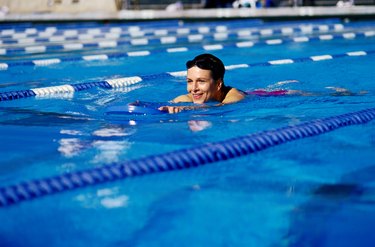
Swimming provides a combination of an aerobic workout with strength building in your arms, core and legs. Since you're in water, you are buoyant, which is easy on your joints, according to Harvard Health Publishing.
When you start a swimming program, you may find that it is difficult to complete a lap and you're quite breathless, even if you are already fit. This is because swimming requires controlled breathing when your face is in the water, which takes time to learn.
Video of the Day
Video of the Day
To progress as a swimmer, it's helpful to take lessons. Swimming statistics show 43 percent of women and 34 percent of men have taken swimming lessons from a certified instructor, according to the American Red Cross. But you can start learning to swim by trying a number of things on your own.
Warning
Find a pool with a lifeguard. You need another person with you to keep an eye on you when you're in the water. If your pool doesn't have lifeguards, bring a friend. Never swim alone.
1. Get Comfortable in the Water
Get in the water and walk around the shallow end. Use this time to get used to the feel of the water and how buoyant you are. Progress to deeper water, getting wet up to your armpits or shoulders. Many beginners have a natural fear of water. Don't worry if this takes a few visits until you're comfortable going this far into the pool.
Read more: Swimming for Beginners: Read This Before You Dive In
2. Get Your Face Wet
Get in the shallow end. Hold onto the side of the pool. Put your face in the water and blow bubbles, advises Swimming.org. Stand back up and breathe normally. Practice until you feel comfortable with your face in the water. Move to deeper water and, without holding onto the side, put your face in the water and blow bubbles. Stand back up and breathe normally. Practice until you feel comfortable.
3. Learn to Float
Learn to float. Hold the side of the pool. Take a deep breath and lift your feet up while leaning backward. Try to float. This can take a few tries. Practice until you can float for 15 to 30 seconds. Practice without holding onto the side.
Hold onto the side. Take a deep breath and put your face in the water while kicking your feet out behind you. Try to float. Practice until you can float for 10 to 15 seconds. Practice without holding onto the side.
4. Practice With a Flotation Device
Grab a flotation device and try one lap of swimming. A kickboard or styrofoam noodle is ideal. Don't use arm supports or anything around your waist as these types of flotation devices interfere rather than help.
Hold the kickboard in front you with straight arms. Push off from the wall and scissor kick with your legs straight behind you, rotating your head to the side to breathe. Complete one lap, resting along the way as necessary.
5. Do It Again
Try another lap, including your arms. Hold the flotation device in front of you with straight arms. Push off from the wall and scissor kick with straight legs. Lift one arm off the kickboard, pulling down through the water and lifting, returning your arm to its starting position. Switch arms and repeat. Rotate your head to breathe from the side as necessary. Rest and repeat as you feel comfortable.
6. Swim Without the Device
Try a lap without the flotation device. Push the kickboard out in front of you and begin your freestyle stroke or front crawl as it is otherwise known, scissor kicking, straight arms in front and side breathing. When you reach the kickboard, either use it as support to rest or push it out again and continue for another few strokes. Rest and repeat as you feel comfortable.
Read more: 7 Tips to Become a Better Swimmer
Purchase the Right Equipment
Make your debut in the pool more productive and enjoyable by buying a few pieces of basic swimming equipment:
- Swim goggles keep the pool chemicals, any debris and your hair out of your eyes so you can see where you're going. They should fit comfortably over your eye sockets without being too tight. Try them on before buying.
- A swim cap keeps your hair somewhat dry and protected, and keeps your hair out of your face and mouth when swimming.
- Recreational swimsuits are poorly suited to swimming laps. They can come off when you push off from the wall and may not provide the range of motion you need to properly move your arms and legs.
Tip
To learn proper technique and additional strokes, enroll in an adult swim clinic.