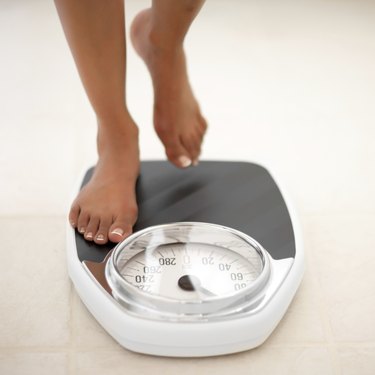
You may want to lose 20 pounds for an upcoming special event, such as a wedding, and fad diets promise fast results. But after you meet your target on a fad diet, it's likely you'll gain all the weight back, and then some. The safest and surest way to lose weight and keep it off is to use a gradual and consistent approach – to drop 1 or 2 pounds a week by making a change in your eating habits. At the rate of 2 pounds a week, you lose 20 pounds in a little over two months, or about 10 weeks. Consult your doctor or a dietitian before beginning any weight-loss diet.
Create a Calorie Deficit to Lose Pounds
Video of the Day
According to general principles of weight loss, 3,500 calories equal a pound of body weight. To lose 2 pounds of body weight a week, you need to create a daily calorie deficit of 1,000 calories, which means if you're currently eating 2,500 calories a day, you'll need to go down to 1,500. A thousand calories may sound like a lot, but depending on your diet, it may not take much for you to trim your intake.
Video of the Day
For example, cut out low-nutrient, high-calorie foods such as a cheeseburger, soda and ice cream, and you're off to a good start. A large single cheeseburger with condiments from a fast-food restaurant comes in at 535 calories; if you're hungry and go for the double cheeseburger, that's 704 calories. Maybe you routinely have a cola with your burger; just one 16-ounce can or bottle is 207 calories. If you round off this high-calorie "meal" with 1/2 cup chocolate ice cream, you've added another 143 calories to your total. These foods, which have very little nutritional value and may leave you feeling hungry again soon after, total about 1,000 calories.
Don't go below 1,000 to 1,200 daily calories if you're a woman or 1,200 to 1,600 if you're a man, according to the National Institutes of Health. Diets that drop below those ranges must be short-term and also administered by a physician for safety.
Change Your Food Choices
The key to reliable weight loss and long-term weight management, however, is not just abstaining from some highly processed foods while continuing to use up your daily calorie allotment on others. Instead, your best bet is to make a change in your eating habits, and to switch your dietary focus to whole foods like fruits and vegetables; lean proteins like fish and chicken breast; and healthy fats like avocado, nuts and seeds. Many of these foods have fewer calories overall and also contain nutrients that assist with weight loss. Vegetables, fruits and whole grains, for example, provide significant fiber, a type of carbohydrate that helps manage your blood sugar levels and keep your hunger under control.The macronutrient protein – found in animal products, soy, legumes, nuts and seeds – is associated with greater satiety.
Switching what you eat doesn't mean you're going to starve. If your aim is to consume 1,500 calories daily, you can have three meals of about 400 calories each, and two snacks that total 300 calories. Play around with the numbers, but this will give you a rough framework for eating well and staying full at the same time.
Fifteen hundred calories actually buys you a lot when you're sticking with whole foods. As a sample menu, for breakfast you can have two scrambled eggs, a slice of whole-wheat toast with a half-ounce of goat cheese and a cup of sliced strawberries for 348 calories. For lunch, have a plate of mixed greens topped with 3 ounces of grilled chicken, a half-cup of black beans, a cup of sliced red bell pepper and a fourth of an avocado for 342 calories; add a half-cup of grapes for a sweet finish to the meal, for an additional 62 calories. At dinner, have 4 ounces of grilled salmon with a cup of wild rice and a cup of steamed Brussels sprouts for 380 calories; enjoy a half-ounce of dark chocolate as your dessert for an extra 85 calories, bringing your total for the three meals to 1,217.
You still have room for two snacks, such as an ounce of almonds for 170 calories and a large apple for 116 calories. Or have one snack and then portion out a tablespoon of healthy olive oil to your various meals. To boost flavor, sprinkle a variety of herbs and spices on your dishes – they are both nutritious and almost calorie free in the amounts normally used.
Add in Exercise
Diet is at the heart of any weight-loss plan, but don't forget to incorporate exercise into your daily regimen. If you only cut calories without also exercising, you'll most likely gain back the weight you lose, says Harvard Medical School. A "diet only" approach slows down your resting metabolic rate, meaning that you will need to eat less as you lose weight. Instead, stimulate your metabolism to burn calories with a 2-mile brisk walk or an uphill bike ride most days of the week. Current guidelines recommend 150 minutes of this kind of exercise each week, coupled with two days of strength-training exercises, such as lifting weights to build and maintain lean muscle.
- Psychology Today: The Truth Behind Fad Diets
- Women to Women: Natural Weight Loss
- Calorie Control Council: Healthy Weight Calculator
- Harvard T.H. Chan School of Public Health: Fiber
- American Journal of Clinical Nutrition: Protein, Weight Management and Satiety
- Harvard Medical School: Exercise and Weight Loss
- CDC: How Much Physical Activity Do Adults Need?
- NIH: Very Low Calorie Diets