














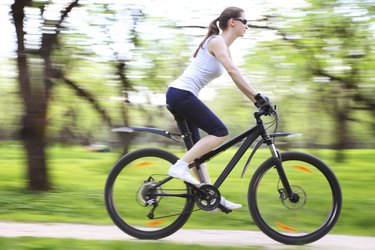

























































Recess and physical education time has steadily decreased or been eliminated in school districts around the nation, displaced by more time focused on academics. Even though research validates physical activity guidelines for children, which encourage exercise at least 60 minutes a day for physical benefits, exercise and its effects on a child's ability to learn had not been researched widely until the latter part of the 21st century. With the advent of sophisticated technologies, science is now able to prove that exercise benefits the brain in numerous ways thus benefiting and improving learning in children.
Brain Development and Learning
A baby is born with a fully-developed brain with 100 billion neurons or brain cells, each one having the potential to connect with 15,000 other cells. These neurons are awaiting instruction on how to connect and communicate and facilitate learning. Proper nutrition combined with a nurturing and stimulating environment all contribute to the ability of the brain to learn.
Brain on Exercise
In his research that was published in his book, "Spark: The Revolutionary New Science of Exercise and the Brain", Harvard psychiatrist Dr. John Ratey explains the major benefits of exercise on the brain, how it can enhance a child's attention, memory, focus and ability to retain what is taught and describes in layman's terms how exercise accomplishes this, as well as providing case studies.
Three major factors explain why and how exercise benefits the brain. First exercise increases cellular components which support the brain's systems responsible for learning, decision-making and memory among others. Secondly, exercise improves the environment of the brain cells by releasing hormones, neurotransmitters and activates BDNF, which he calls the "Miracle Gro for the brain" that enhance neural pathways for learning, and other growth factors, making it easy for brain cells to adapt or learn new information. Thirdly, exercise, more than any other factor, grows brain cells, called neurogenesis. More brain cells means more room for learning.
Types of Exercise to Improve Learning
Currently, research has focused on aerobic activity, ranging from moderate to vigorous, when testing the efficacy of exercise on the brain. "The Effect of Acute Treadmill Walking on Cognitive Control and Academic Achievement in Preadolescent Children", concluded that, "these findings indicate that single, acute bouts of moderately-intense aerobic exercise (i.e. walking) may improve the cognitive control of attention in preadolescent children, and further support the use of moderate acute exercise as a contributing factor for increasing attention and academic performance."
Moving to Learn
Neurokinesiologist Jean Blaydes Madigan developed Action Based Learning which provides teachers with ways to implement moving into the classroom setting. Madigan contends that children learn better if they can move because movement provides the brain with fuel in the form of oxygen and glucose, increases spatial awareness, engages the body in static and dynamic balance which aids focus and attention, integrates coordination of the body with organization of thoughts in the brain's hemispheres and uses repetitive body movements to train the brain in sequencing patterns. "Students engaged in Action Based Learning improve memory retention, reinforce academic concepts, balance brain chemicals while experiencing whole-brain, whole-body learning. Educational research suggests that about 85 percent of school age students are predominantly kinesthetic learners."
Implications
Because of recent interest in the scientific findings linking improved learning with exercise, legislation is being proposed in some states to mandate physical education for its students. Teachers are getting creative in ways to get students moving in the classroom including the use of video games. Parents and school administrators are collaborating to get children more active before and after school with such programs as the Walking School Bus in which parents take turns walking children to school. Besides exercise's salutory benefits of reducing stress, improving mood and health, regular exercise, sustained over the lifespan, can maintain and sustain your child's ability to keep learning.
References
- U.S. Department of Health and Human Services: Physical Activity Guidelines for Americans: Children and Adolescents
- North Dakota State University: Understanding Brain Development In Young Children
- MSNBC: Health: Newsweek: Can Exercise Make You Smarter?
- Action Based Learning: About Us
- Minnesota House of Representatives: H.F. No. 439


