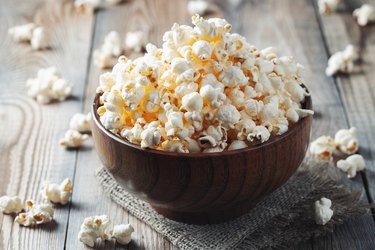
Unsalted, air-popped popcorn is a great low-cost, whole-grain snack — but it loses nutritional value when we add ingredients like butter, says Heli Roy, PhD, RD and associate professor in the Nutrition and Health Department at Louisiana State University.
The fat and calories in popcorn will vary greatly depending on how you're preparing your snack. For example, the popcorn from the movie theater has way more calories, fat and sodium than the air-popped popcorn you make at home.
Video of the Day
Video of the Day
Popcorn, when prepared without butter, has health benefits. It's high in energy-sustaining complex carbs and also has some fiber, which is linked to staving off hunger and keeping you fuller for longer.
Tip
One serving of popped popcorn is equal to 3 cups, according to the Popcorn Board.
Air-Popped Popcorn Nutrition
Air-popped popcorn is made without butter or oil, so it is the lowest in calories of all the varieties. According to the USDA, a 3-cup serving of air-popped plain popcorn contains:
- Calories: 93
- Total fat: 1.1 g
- Saturated fat: 0.2 g
- Trans fat: 0 g
- Cholesterol: 0 mg
- Sodium: 1.9 mg
- Total carbs: 18.7 g
- Dietary fiber: 3.6 g
- Sugar: 0 g
- Protein: 3 g
Popcorn Calories and Macros
- Calories: The calories in popcorn are low relative to other snacks. A 3-cup serving of popcorn only gives you 93 calories. Keep in mind, this is the number of calories in popcorn without butter added.
- Total fat: One serving of air-popped popcorn has 1.1 grams of total fat, which includes 0.2 grams of saturated fat and 0 grams of trans fat.
- Carbohydrates: The carbs in popcorn are high because corn is a grain. One serving of popcorn has 18.7 grams of carbs, which includes 3.6 grams of fiber and 0 grams of sugars.
- Protein: One serving of popcorn has 3 grams of protein.
Vitamins, Minerals and Other Micronutrients
- Manganese: 12% Daily Value (DV)
- Magnesium: 8% DV
- Phosphorus: 7% DV
- Zinc: 7 % DV
- Copper: 7 % DV
- Niacin (vitamin B3): 3%
- Potassium: 2% DV
Stovetop Oil-Popped Popcorn Nutrition
Oil-popped popcorn is typically made on the stove and popped in cooking oil such as olive oil. The number of calories in popcorn with olive oil will vary depending on how much oil and popcorn you're using.
According to the USDA, 3 cups of a standard homemade popcorn with olive oil contains:
- Calories: 165
- Total fat: 9.3 g
- Saturated fat: 1.6 g
- Trans fat: 0 g
- Cholesterol: 0 mg
- Sodium: 291.7 mg
- Total carbs: 18.9 g
- Dietary fiber: 3.3 g
- Sugar: 0 g
- Protein: 3 g
Popcorn With Olive Oil Calories and Macros
When you add oil for popping, even extra-virgin olive oil, you'll increase the calories because the fat from the olive oil sticks to the kernels.
Olive oil, though, is mostly monounsaturated fat, which is linked to beneficial effects on cholesterol levels. Meanwhile, butter is mostly made up of less-nutritious saturated fat.
While it is high in calories, olive oil has health benefits. It has been linked to a lower risk of heart disease, metabolic syndrome, diabetes and some cancers, including breast cancer, according to a December 2019 meta-analysis of studies in Maturitas.
Extra-virgin olive oil has also been associated with reducing inflammation, per July 2019 research in the European Journal of Clinical Nutrition. This is attributed to oleic acid — the primary fatty acid in olive oil — as well as other components.
Tip
Using extra-virgin olive oil to cook popcorn on the stove is a nutritious option, per the Cleveland Clinic. While air-popping popcorn without oil will give you the least amount of calories, adding olive oil will amp up your healthy fats, which are linked to controlling hunger, among other benefits.
Yellow vs. White Popcorn Nutrition
White popcorn, aka rice popcorn, is made from small kernels that look a bit like rice grains, according to Bob's Red Mill. Popped white popcorn is soft and crunchy. On the other hand, yellow popcorn is made from medium or large kernels and takes on a durable, fluffy texture.
Check out the differences in yellow and white popcorn nutrition below for 1 ounce of unpopped popcorn.
Yellow and White Popcorn Nutrition
Calories | 124 | 130 |
Fat | 7.1 | 7 |
Carbs | 14.2 | 16 |
Fiber | 3.5 | 3 |
Protein | 3.5 | 3 |
Kettle Corn Popcorn Nutrition
Kettle corn popcorn is traditionally made in an iron kettle and is seasoned with salt and sugar to give it that signature sweet-and-salty flavor. Kettle corn has more sugar than regular popcorn.
A 1-cup serving of popped kettle corn popcorn contains:
- Calories: 72
- Total fat: 3.8 g
- Saturated fat: 0.5 g
- Trans fat: 0 g
- Cholesterol: 0 mg
- Sodium: 59.4 mg
- Total carbs: 8.2 g
- Dietary fiber: 1.6 g
- Sugar: 0.3 g
- Protein: 1.4 g
Caramel Popcorn Calories and Nutrition
With a little bit of salty and a lot of sweet, caramel popcorn may very well be the snack you were craving. Just make sure to enjoy it in moderation, as caramel popcorn calories can add up.
A 1-cup serving of popped caramel popcorn contains:
- Calories: 125
- Total fat: 0.6 g
- Saturated fat: 0 g
- Trans fat: 0 g
- Cholesterol: 0 mg
- Sodium: 200 mg
- Total carbs: 30 g
- Dietary fiber: 1.2 g
- Sugar: 13.8 g
- Protein: 1.2 g
Adding caramel to your popcorn increases the calorie amount significantly. Just 1 ounce of caramel adds around 90 calories and 15 grams of sugar to popcorn, per the USDA. Plain air-popped popcorn makes for a nutritious snack, though popcorn with added ingredients, such as butter or caramel, isn't as healthy.
The caramel topping contains a lot of added sugar, which is linked to an increased risk of high blood pressure, inflammation, diabetes and weight gain, which are all linked to a higher chance of heart attack or stroke, per Harvard Health Publishing. The recommended amount of sugar per day is no more than 36 grams or 9 teaspoons.
Nutrition in Microwavable Popcorn Bags
The fact that you can read how many calories your microwaved popcorn has can be very convenient — just make sure to look at the amount per serving and do the proper math.
A microwavable bag of Orville Redenbacher's Movie Theater Butter popcorn has 2.5 servings in it. According to the website, one serving of popped popcorn contains:
- Calories: 170
- Total fat: 11 g
- Saturated fat: 6 g
- Trans fat: 0 g
- Cholesterol: 0 mg
- Sodium: 380 mg
- Total carbs: 17 g
- Dietary fiber: 2 g
- Sugar: 0 g
- Protein: 2 g
Smart Pop Popcorn Calories and Nutrition
Smart Pop popcorn is a low-calorie alternative to other brands of microwave popcorn.
Smart Pop Minis
Orville Redenbacher's Smart Pop Minis come in two flavors, Butter and Kettle Corn, and are 94 percent fat-free and contain 100 calories per bag. There are 12 small bags to a standard-sized box of Smart Pop Minis popcorn.
Full-Sized Smart Pop
A full-sized bag of Orville Redenbacher's Butter Smart Pop popcorn contains 120 calories, 0.5 grams of saturated fat and 340 milligrams of sodium while the Kettle Corn flavor has 130 calories, 0.5 grams of saturated fat and 190 milligrams of sodium.
Concerns About Microwave Popcorn
Based on these numbers, a bag of microwaved popcorn has 425 calories and 27.5 grams of fat if you eat the whole bag,
If you're trying to limit your portion sizes of microwave popcorn, another option to consider is buying mini popcorn bags, which generally offer just one serving per bag.
While choosing mini bags might keep your calories down, experts say microwave popcorn has some other pitfalls. Microwavable popcorn bags often have a lot of salt and artificial flavorings, per the Cleveland Clinic.
A high-salt diet is associated with a higher risk for high blood pressure, according to the Harvard T.H. Chan School of Public Health. This puts you at a higher risk for heart disease and kidney disease.
Another concern: The specially designed microwave bags have chemicals called perfluorooctanoic acid (PFOA), the same chemical used in Teflon nonstick coating, and perfluorooctane sulfonate (PFOS), per a December 2013 report in Environmental Health Perspectives. These chemicals, in high amounts, are linked to cancer, immunotoxicity, weight gain, altered thyroid function and other health conditions.
Eating microwave popcorn increased the concentration of PFOA and PFOS in the blood in an October 2019 study in Environmental Health Perspectives.
As the public becomes more aware of these types of chemicals in food, manufacturers have made tweaks to ingredients and packaging. It's important to read labels so you can be aware of what your food has in it.
Tip
A simple way to make DIY microwave popcorn with plain unpopped popcorn kernels is to place about 1/4 cup of your kernels in a small paper bag, fold over the top and place it in the microwave.
Use the "popcorn" setting if your microwave has one, or cook on high for 2 to 3 minutes, or until the popping slows to a few seconds between pops. (Check often to make sure it doesn't burn.)
Popcorn Benefits
Popcorn can be a nutritious snack if it's prepared the right way. Unlike chips or crackers, plain popcorn (without butter) is low in fat and calories.
Popcorn Is a Whole-Grain Carb
Your body needs carbs to provide energy for your cells, to support the beneficial bacteria in your digestive tract and to aid in the synthesis of proteins and fats. The USDA advises avoiding foods high in refined, simple carbs like white sugar, bread and pasta, and to eat more whole-grain complex carbs like popcorn.
Adults should eat between 5 and 8 ounces of whole grains per day, depending on age, according to the USDA. At least half of all grains eaten per day should come from whole-grain foods.
Popcorn Is High in Many Other Nutrients
Besides having more of those beneficial carbs, popcorn is also high in other important nutrients. For one, popcorn is high in fiber, with a 3-cup serving giving you 3.5 grams, or 12 percent of your daily value.
Popcorn also boasts a decent amount of nutrients like manganese, magnesium, phosphorous, zinc, copper, niacin and a small amount of potassium.
Buying popcorn with no salt can be a better option because you can control how much salt you add yourself, or choose salt-free flavorings.
Tip
The nutritional value of different types of popcorn products can vary greatly depending on the type of ingredients that are added.
If you buy microwavable, stove-top or packaged popcorn, check the nutrition facts label to see how many calories, grams of fat and milligrams of sodium the product has.
For the most nutritious popcorn, compare brands and varieties and choose those with the lowest calories and the least saturated fat and salt.
- Clemson Cooperative Extension: "Fat In Your Diet"
- European Journal of Clinical Nutrition: "Extra Virgin Olive Oil: More Than a Healthy Fat"
- Maturitas: "Olive oil consumption and human health: A narrative review"
- Cleveland Clinic: "9 Best Tips For Healthier Popcorn"
- Popcorn.org: "All about popcorn"
- CSPI: "Big Movie Theaters Fill Big Buckets... and Bellies"
- USDA: "Movie theater popcorn with added butter"
- Orville: "Movie Theater Butter Popcorn"
- Environmental Health Perspectives: "PFOA and Cancer in a Highly Exposed Community: New Findings from the C8 Science Panel"
- Journal of Endocrinological Investigation: "Thyroid disruption by perfluorooctane sulfonate (PFOS) and perfluorooctanoate (PFOA)"
- USDA: "Popcorn Kernels"
- University of Chicago: "Popcorn - Cooking with Phase Changes"
- USDA MyFoodData: Goya Foods Inc. - Yellow Popcorn
- Harvard T.H. Chan School of Public Health: Salt and Sodium