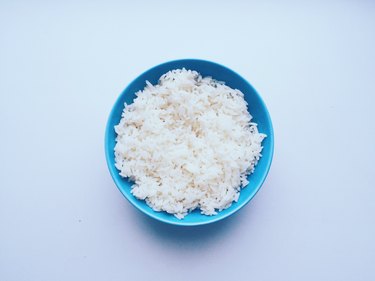
The Rice Diet — which, in its original format, included only rice and fruit — has been around since 1939. But what is it, and is it as effective as some people say when it comes to weight loss and other health conditions?
Here, learn all about the eating program and whether or not it can benefit your wellbeing.
Video of the Day
Video of the Day
Tip
Talk to your doctor before starting any weight-loss program to make sure it's safe for you, per the Mayo Clinic.
What Is the Rice Diet?
The Rice Diet was created by Walter Kempner, MD, in 1939 while he was a professor at Duke University, according to a May 2014 article in the Journal of the American Heart Association. His theory was that decreasing protein intake by sticking to a rice and fruit diet could reduce stress on the kidneys and thus effectively treat renal failure.
Kempner also believed that cutting out sodium and cholesterol could lower blood pressure and improve heart failure in his patients. As a result, Kempner's Rice Diet menu consisted almost entirely of carbohydrates with very low amounts of protein and virtually no sodium or cholesterol, per the Journal of the American Heart Association.
Some fruit juices containing citrate were allowed because Kempner thought could counter metabolic acidosis, a condition associated with kidney disease and kidney failure in which body fluids become too acidic, per the National Kidney Foundation. Diet followers also received a vitamin supplement to make up for the lack of the B vitamins in white rice.
The diet had clinically significant results, according to the Journal of the American Heart Association. Although 25 of the 192 people enrolled in his trial died and 60 people did not markedly improve blood pressure, 107 patients saw significant improvements in blood pressure.
In 66 of 72 patients, there was a decrease in heart size, and 73 of 82 patients had decreased blood cholesterol levels. Diabetic retinopathy improved or disappeared entirely for 21 of 33 patients who experienced the condition.
However, per the Journal of the American Heart Association, these results should be viewed within the context of the time, during which malignant hypertension had a life expectancy of six months.
More recently, a modified, less-restrictive version the Rice Diet was re-popularized by Kitty Gurkin Rosati's book The Rice Diet Solution, which claims that the eating program is effective for lasting weight loss (more on that in a moment).
Rice Diet for Weight Loss
In December 1975, Kempner published research in the Archives of Internal Medicine about the rice and fruit diet menu's effect on weight.
In the study, 106 people with severe obesity followed the diet, along with an exercise prescription and daily motivational support. Each person lost at least 99 pounds, and average weight loss was 141 pounds. Many also experienced significant reductions in blood pressure, blood sugar and triglycerides.
(It's worth noting that the lack of protein and essential nutrients from this diet does not make it sustainable. Sustainable weight loss means maintaining muscle mass, which this fad diet may not support, per May 2017 research in Advances in Nutrition.)
While eating rice is healthy in moderation, this low-calorie diet (which usually involves an upper limit of 1,500 calories per day) is a fad diet with rigid rules, which may lead to unhealthily rapid weight loss and likely weight regain, according to the Mayo Clinic Health System.In other words, while this restrictive eating plan may contribute to some initial weight loss, it's probably not your best bet for sustainably shedding pounds.
Tip
Calorie intake should not fall below 1,200 per day for people assigned female at birth or 1,500 per day for people assigned male at birth, except under the supervision of a doctor, per Harvard Health Publishing. That's because eating too few calories can deprive you of essential nutrients.
The Rice Diet has changed over the years and is not nearly as strict as Kempner's original program. In her book The Rice Diet Solution, Rosati outlines her version of the diet, which has three phases:
- Phase one: This stage lasts one week. The basic Rice Diet menu — rice and fruit — is only eaten on the first day. So, what can you eat rice with after that? For the other six days, dieters can include vegetables, whole-grain bread and cereal and some nonfat dairy or plant milk.
- Phase two: This stage lasts until you reach your weight goal and focuses on creating dietary habits for lasting weight loss. Each week begins with one day of the basic Rice Diet. Then, you add in the grains, vegetables and nonfat milk for the remainder of the week. On one day of your choice, you include one protein source, such as fish, extra nonfat dairy or organic eggs. Phase two includes slightly more sodium and more calories than phase one.
- Phase three: This is the maintenance phase, which gives dieters more choices, additional protein and more flexibility with sodium.
In each phase, you eat specific portions of each food to control your calorie intake, according to the book. The Rice Diet menu is divided into starch, nonfat dairy, vegetables, fruit and protein:
- One starch is equal to 1/3 cup cooked rice or dried beans, 1/2 cup cooked grains, pasta or starchy vegetable, one slice of bread, or 1/4 to 1 cup of cereal.
- One serving of nonfat dairy equals 1 cup of nonfat cow's or plant milk or plain yogurt.
- One vegetable serving is 1/2 cup cooked or 1 cup raw vegetables.
- One fruit serving is one medium sized fruit or 1 cup of grapes or cut fruit.
- One serving of protein is 1 ounce of fish, skinless poultry, lean meat or 1/4 cup cooked dried beans or peas.
Dieters can eat any fruit, grain or vegetable they like as long as there is no added salt or fat. One teaspoon of maple syrup or honey is allowed each day.
Is Rice a Vegetable or Fruit?
No, rice is not a fruit or vegetable — it's a grain, according to the Harvard T.H. Chan School of Public Health.
Sample Rice Diet Meals
The program provides a clear plan for each of your daily meals using the serving sizes for each food group. According to the book, for the basic Rice Diet day, you can have two servings of starches and two servings of fruits at each meal.
On the other six days of phase one:
- Breakfast: one starch + one nonfat dairy + one fruit
- Lunch: three starches + three vegetables + one fruit
- Dinner: three starches + three vegetables + one fruit
Here are some sample meal ideas:
- Breakfast: 1/3 cup cooked rice with 1 cup of milk and 1 cup of grapes
- Lunch: 1/3 cup dried beans and 1/3 cup cooked rice with 1 cup cooked broccoli, 1/2 cup cooked spinach and one apple
- Dinner: 1 1/2 cups pasta with 1 1/2 cups cooked mixed vegetables and 1 cup of tomatoes
During phase two, the basic Rice Diet remains the same. The other days of the week also stay the same except for the single day that protein is included. On that day, you can have:
- Breakfast: two starches + one fruit
- Lunch: four starches + three vegetables + one fruit
- Dinner: three proteins + two starches + two vegetables + one fruit
Here are some recipes to try:
- Breakfast: One slice of bread with 1 cup of plain yogurt and 1 cup of berries
- Lunch: 2/3 cup cooked rice with 3 cups of raw mixed vegetables and one pear
- Dinner: 3 oz. salmon over 1 1/2 cups pasta with 1 1/2 cups cooked asparagus and 1 cup of tomatoes
The final phase of the diet is the same as phase two, except that you eat the protein menu on one extra day each week (not the first day).
Should You Eat Brown Rice or White Rice?
While Kempner's original diet involved eating white rice, you can eat either brown or white rice on Rosati's program (provided there's no added fat or salt), according to her book.
Not sure which to pick? Brown rice packs more of a nutritional punch, with higher doses of vitamins, minerals and fiber than white rice, per the Cleveland Clinic.
Is the Rice Diet Healthy?
Kempner's Rice Diet was too restrictive for the average person to follow. It also had nutritional gaps that could have led to deficiencies if the right supplements were not provided, according to the Journal of the American Heart Association.
What's more, the original Rice Diet was meant to be conducted under medical supervision. As a result, you should not attempt to follow it on your own.
The new version of the diet is more accessible to a wider audience and does not require medical supervision.
But while you can eat rice on this diet along with other nutritious foods, it's still considered a fad diet because it requires following rigid menus and cutting out one or more food groups at least some of the time, per the Academy of Nutrition and Dietetics. Consequently, it's best to stay away from this and other types of trendy eating plans.
- Journal of the American Heart Association: "Who and What Drove Walter Kempner?"
- Archives of Internal Medicine: "Treatment of Massive Obesity With Rice/Reduction Diet Program. An Analysis of 106 Patients With at Least a 45-Kg Weight Loss"
- National Kidney Foundation: "Metabolic Acidosis"
- Harvard Health Publishing: "Calorie counting made easy"
- Harvard T.H. Chan School of Public Health: "Rice"
- Academy of Nutrition and Dietetics: "Staying Away from Fad Diets"
- Cleveland Clinic: "Brown Rice or White Rice: Which Is Your Healthier Option?"
- Mayo Clinic: “Weight loss: Choosing a diet that's right for you"
- Mayo Clinic Health System: "Don't fall for fad diets"
- Advances in Nutrition: "Preserving Healthy Muscle during Weight Loss"