








































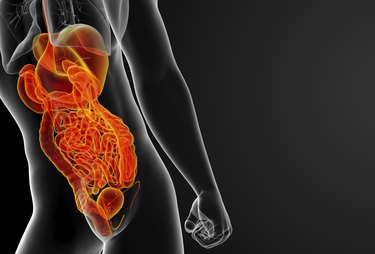























The liver is located in the upper right area of the abdomen. The organ is responsible for many functions, all of which are vital in order to maintain a healthy body. An unhealthy liver cannot perform its functions properly. Depending on its status, it may not be able to make enough plasma proteins or clotting factors. It may not be able to secrete bile, metabolize drugs or filter the blood.
Functions of a Healthy Liver
A healthy liver performs several functions, as described by Elizabeth Corwin, Ph.D. in "Handbook of Pathophysiology." Whenever there is glucose not immediately needed for energy, the liver stores the extra glucose as glycogen. In between meals, the liver can then break down the glycogen to glucose. A healthy liver makes plasma proteins, which circulate in the bloodstream, and substances called clotting factors which are necessary to form clots. It makes bile, which helps to break down fats, detoxifies waste products and drugs, and filters the blood.
Plasma Proteins and Clotting Factors
In "Handbook of Pathophysiology," Elizabeth Corwin, Ph.D. writes that blood is approximately 45 percent blood cells and 55 percent plasma. Plasma is estimated to be 90 percent water, and 10 percent dissolved gases, electrolytes, nutrients, cholesterol, waste products and plasma proteins. An unhealthy liver does not make enough plasma proteins and clotting factors. The main plasma protein is albumin, which has the major responsibility of keeping the correct pressure in the blood vessels. The clotting factors are proteins which are essential to form clots. A person with an unhealthy liver may be swollen and bleed easily.
Unhealthy Liver and Cholestasis
Cholestasis describes an abnormal bile flow which can be due to an unhealthy liver. Bile breaks down fats and without it, neither dietary fats nor the fat-soluble vitamins are broken down. Bile salts are components of bile and they can be toxic if they build up. Their accumulation can lead to inflammation and cirrhosis, or the final stage of an unhealthy liver. Bilirubin is another component of bile and when it accumulates, people develop jaundice. They have a yellowish color to their skin and white part of the eye, explains Mandana Khalili, M.D., Director of Clinical Hepatology at San Francisco General Hospital in "Pathophysiology of Disease."
Drug Metabolism in Unhealthy Livers
When the liver is unhealthy, the blood does not flow through it like it should. Indeed, much of the blood bypasses the liver, along with any medication in the blood that a healthy liver would break down. This can cause a normal dose of a medication to become toxic. The brain is especially sensitive to pain medications and sedatives, and very small doses can result in problems within the brain. The amount of medication and the effect it can have is unpredictable, writes Steven Herrine, M.D., Professor of Medicine of the Division of Gastroenterology and Hepatology at Thomas Jefferson University in "The Merck Manual for Healthcare Professionals."
Loss of Filtering in Unhealthy Liver
A healthy liver protects the body by filtering blood from the stomach and intestines, to remove any harmful substances from circulation. An unhealthy liver cannot perform this function. Its specialized cells, called the Kupffer cells, cannot remove bacteria from the bloodstream, which is why infections in people with an unhealthy liver quickly develop, as explained in "Pathophysiology of Disease" by Dr. Khalili. It cannot remove the steroid hormones that are circulating without attached proteins. This leads to high levels of estrogen in the bloodstream and results in large breasts in men.
References
- "Handbook of Pathophysiology"; Elizabeth Corwin, MSN, Ph.D., FNP; 2000
- "Pathophysiology of Disease: An Introduction to Clinical Medicine"; Stephen McPhee, M.D., Gary Hammer, M.D., Ph.D.; 2010
- The Merck Manual for Healthcare Professionals: Effects of Liver Disease on Drug Metabolism


