








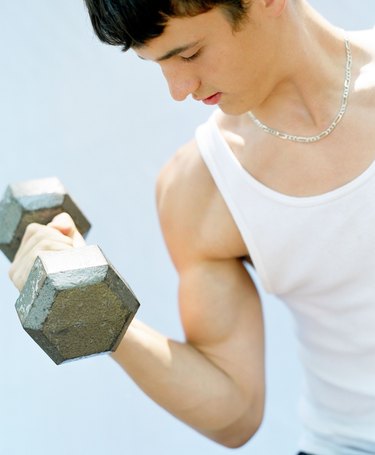

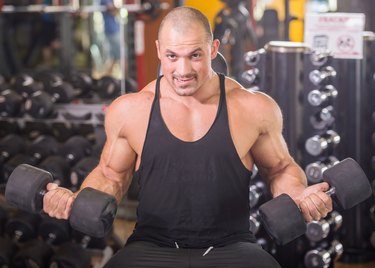






















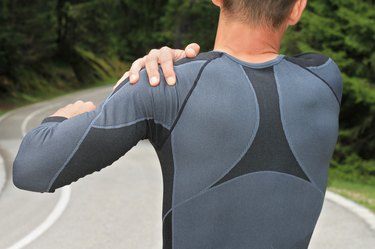

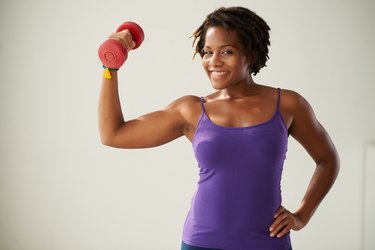






Superficial skeletal muscles are the layer of muscles just under the skin. These are the muscles that become most defined with exercise, and they are easy to locate and palpate. Deeper muscles are smaller and harder to find by palpation. They don't contribute as much to the shape of the body as superficial muscles do.
Muscles of the Head
Superficial muscles that shape facial expressions are the frontalis and occipitalis, orbicularis oculi, orbicularis oris, buccinator, zygomaticus and platsyma. The major chewing muscles are the temporalis and masseter. Superficial muscles that move the head are the semispinalis capitis, splenius capitus and sternocleidomastoid.
Superficial Muscles of theTrunk
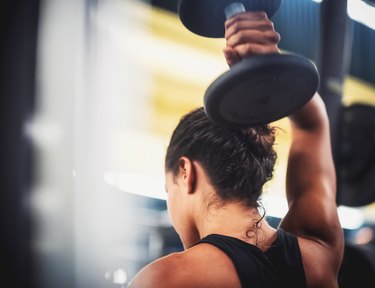
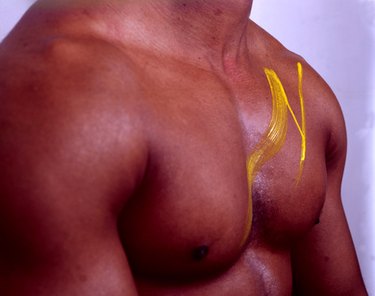
Superficial muscles of the anterior or ventral trunk include the pectoralis major, rectus abdominis, external oblique and serratus anterior. Superficial muscles of the posterior or dorsal trunk include the trapezius, rhomboideus and latissimus dorsi.
Shoulder and Arm
Superficial muscles of the shoulder include the deltoid and the teres major, teres minor, infraspinatus and supraspinatus. Superficial muscles of the arm include the biceps brachii and triceps brachii as well as the brachialis.
Lower arm muscles include the brachioradialis, extensor carpi radialis, extensor carpi ulnaris, extensor digitorum, flexor carpi radialis, flexor carpi ulnaris, flexor digitorum and palmaris longus.
Hip and Leg
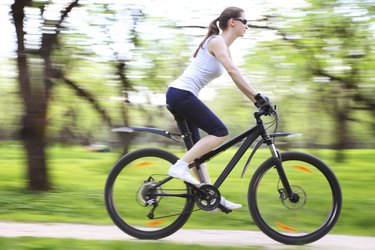
Superficial muscles of the hip include the gluteus maximus and medius as well as the tensor fasciae lata. Anterior upper leg or thigh muscles include the adductor longus, rectus femoris, vastus lateralis, vastus medialis, sartorius and gracilis. Superficial posterior thigh muscles are called hamstrings, which are the biceps femoris, semitendinosus and semimembranosus.
Superficial lower leg muscles include the tibialis anterior, peroneus longus and brevis, extensor digitorum longus, gluteus maximus, gluteus medius, gastrocnemius and soleus.


