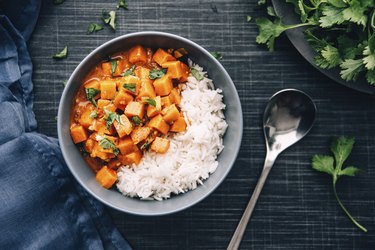
Okinawan nutrition in the mid-20th century relied on the sweet potato. Although the Okinawan people consumed meat, seafood and other animal products, these were sparse in their diet. The traditional Okinawa diet was almost entirely plant-based and very low in calories.
Read more: 10 Easy Clean-Eating Recipes
Video of the Day
Video of the Day
Okinawa Diet Calorie Consumption
The Okinawa diet is well known for being a low-calorie, carbohydrate-rich diet. However, the number of calories you should consume while following the Okinawa diet is often misreported. Calorie intake should be based on multiple factors, including your gender, body size and activity level.
According to an October 2007 study in the Annals of the New York Academy of Sciences__, the Okinawan people in the mid-20th century ate very few calories compared to people today. In fact, the average Okinawan had a negative energy balance of about 218 calories per day.
If you were to take factors like body size into account, the equivalent would be the consumption of around 1,785 calories per day instead of the standard 2,000-calorie diet. However, on any given day, a person's total food consumption could range between 1,605 total calories and 2,012 total calories.
If you're planning to follow an Okinawa diet plan, you should be conscious of your calorie consumption. According to Harvard Health Publishing, women should not consume less than 1,200 calories per day, while men should not consume less than 1,500 calories on a daily basis.
Okinawa Diet Food Groups
According to an April 2014 study in the Mechanisms of Ageing and Development journal and a July 2016 study in the journal Age and Ageing, Okinawa nutrition was primarily plant-based, with root vegetables as the primary components.
If you want to try a traditional Okinawa diet, the study in Mechanisms of Ageing and Development says that you'll end up consuming around 58 percent of your calories from vegetables. The staple of the Okinawa diet is the sweet potato, but other root vegetables and leafy greens were also commonly consumed.
The second biggest category included in the Okinawa diet comes from grains. Around 33 percent of calories come from whole grains. Rice did not grow well on Okinawa, but the traditional diet did feature other grains, like millet.
Legumes are the third largest component of the Okinawa diet. However, they only make up 5 percent of the total calories consumed if you follow the diet. The remaining dietary calories are from fatty foods, sugary foods and animal products. Two percent of calories come from oils, while 1 percent of calories come from fish and other seafood products. Less than 1 percent of calories come from nuts and seeds, sugars, meat products, eggs, dairy and fruit.
You should be aware that there is some disagreement regarding the dietary proportions of the Okinawa diet. Older studies, like the Annals of the New York Academy of Sciences study, state that around 74 percent of calories came from vegetables, while 19 percent of calories came from grains. But ultimately, this difference is minor.
Both studies agree that 91 to 93 percent of daily calories came from vegetables and whole grains, with animal and seafood products making up just 2 to 3 percent of daily calories.
Traditional Okinawan Breakfasts
Okinawan breakfast, lunch and dinner were all served with jasmine tea. All meals were also likely to feature the sweet potato in some shape or form.
The study in the Mechanisms of Ageing and Development journal states that about 965 grams of vegetables were consumed each day. Because the average medium-sized sweet potato is 251 calories, this means that around three sweet potatoes were consumed per day. The remaining 200-odd calories likely came from fiber-rich vegetables like bitter melon, daikon radish, okra, carrots, pumpkin, cabbage, bamboo shoots and sea vegetables.
Read more: 19 High-Fiber Foods — Some May Surprise You!
Japanese breakfasts often feature soybeans, miso soup, and eggs. A typical Okinawa breakfast recipe was likely grain-based, featuring foods like brown rice and fermented soybeans (known as natto). Congee_,_ a type of porridge commonly consumed in Asia, may have also been served with vegetables or soy products.
Miso soup is also a popular breakfast dish. While the Okinawa diet is heavily plant-based, it still involves meat and seafood. All parts of an animal were consumed — even things like pig ears and feet. This means that Okinawa vegan recipes weren't actually that common.
Even when actual meat or offal weren't available, fish and meat broths were produced from bones. These broths were mixed with miso paste to produce the miso soup. This version of miso soup also included tofu, fish, pork or vegetables, resulting in a product that's very different from the traditional mainland Japanese version of this soup.
Traditional Okinawan Lunch and Dinner
Creating a fish, pork or chicken stock, skimming off the fat and using the broth to make stews or stir-fries is also an easy way to produce a flavorful lunch or dinner. This is known as the champuru style of cooking. Stir-fries of bitter melon, cabbage and bamboo would often be served alongside small amounts of fish, pork, tofu or the occasional egg.
There are two other styles of cooking common in Okinawa. The nbushi style of cooking mixes miso (a soybean paste) with vegetables like daikon radish, okra, carrots and pumpkin to produce stews and soups. These vegetables contain a lot of water, so they essentially release liquid as they cook, resulting in a rich, flavorful dish.
Finally, the irichi style of cooking simmers or stir-fries vegetables or fruits like papaya on their own. No actual legumes, meat or fish were integrated, but sometimes fat that had been skimmed off of pork or chicken broths was used instead of a vegetable or seed oil.
Alongside these vegetable dishes, you also would find side dishes of mugwort, marinated seaweed or sauteed greens from the sweet potato plant. Dinner would often end with small amounts of fruit served as a dessert. Brandy made from the millet grain was also consumed on special occasions.
- Age and Ageing: "New Horizons: Dietary Protein, Ageing and the Okinawan Ratio"
- Mechanisms of Ageing and Development Journal: "Healthy Aging Diets Other Than the Mediterranean: A Focus on the Okinawan Diet."
- Annals of the New York Academy of Sciences: "Caloric Restriction, the Traditional Okinawan Diet, and Healthy Aging: The Diet of the World's Longest-Lived People and Its Potential Impact on Morbidity and Life Span"
- Harvard Health Publishing: "Calorie Counting Made Easy"
Was this article helpful?
150 Characters Max
0/150
Thank you for sharing!
Thank you for your feedback!