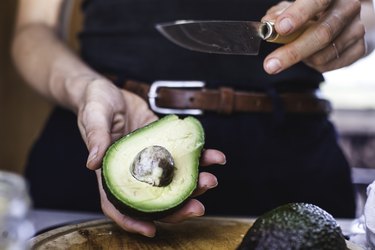
Avocados: Everyone's current favorite source of fat. Their beautiful green color and buttery, nutty flavor have made them increasingly popular. They are so popular, in fact, that after an interview on "60 Minutes," property mogul Tim Gurner was famously quoted saying that millennials can't afford houses because of how much avocado toast they buy.
Maybe an avocado a day isn't good for your wallet, but it's not bad for your health. With so many nutrients and healthy fats, an avocado a day is a healthy choice of food that is unlikely to make you gain weight.
Video of the Day
Video of the Day
Tip
Avocados are known for their fat content. However, these are healthy fats, and a small avocado a day is unlikely to make you gain weight. If anything, it might actually help you lose weight.
Types of Avocado
The avocado is native to Central America, but it's now grown throughout the world. There are hundreds of different of types of avocados, but just a few dozen are popularly cultivated. Avocados types like Bacon, Hass and Pinkerton are some of the most popular. You find avocados in many types of foods — from breakfast to sushi.
Avocado Nutrition Information
Avocado nutrition values differ between types; for example, California and Florida avocado varieties have different fat contents. Nutrient content can also be different. But in general, here's what you can expect from one third of a medium-sized avocado:
- 80 calories
- 8 grams of fat
- 4 grams of carbs
- 1 gram of protein
A whole California avocado has about 12 milligrams of vitamin C (20 percent of the recommended daily value for most people), while a whole Florida avocado has 52.9 milligrams of vitamin C (88 percent of the amount you'd need in a day). If that difference seems significant, you're correct — avocados can also differ in nutrients because of their differences in size.
The average Hass avocado ranges between 6 and 14 ounces, while the Bacon avocado is typically between 10 and 18 ounces. Consequently, eating a small avocado every day is perfectly reasonable, but a larger one every day might be a bit too much.
Despite nutritional differences between avocado types, the serving size is the same. According to the California Avocado Commission that is 50 grams (about a third of a medium-sized California avocado). The 50-gram serving size contains about 84 of the avocado's calories.
Each serving of California avocados contains a gram of protein and 13.5 percent of the recommended daily amount of dietary fiber. Avocados have a reputation for being dense in nutrients.
Each serving also contains:
Vitamin B-3, or niacin (about 5 percent
of the daily recommended amount)
Vitamin B-5, or pantothenic acid (about 7.5 percent
of the daily recommended amount)
Vitamin B-6 (about 7 percent
of the daily recommended amount)
Vitamin B-9, or folate (about 11 percent
of the daily recommended amount)
Vitamin C (about 7.5 percent
of the daily recommended amount)
Vitamin E (about 5 percent
of the daily recommended amount)
Vitamin K (about 13 percent
of the daily recommended amount)
Potassium (about 7 percent
of the daily recommended amount)
Avocados also have a reputation for being high in fat. This is true — but remember that these fats are heart-healthy fats like omega-3 and omega-6 fatty acids. While there are 21 grams of fat in an avocado, this value drops to 7.6 grams per serving.
If you are concerned about the fat content of avocados, Florida avocados have slightly less fat (about 5 grams per serving). These avocados also have nutritional content that is fairly different on the whole, however. One serving will have about double the amount of vitamin C (about 15 percent of your recommended daily value) and about 8 percent of your daily recommended amount of copper, among other nutritional differences.
So, Will I Get Fat If I Eat an Avocado Every Day?
Because a serving size of an avocado is 50 grams and the average California avocado is 136 grams in total, it's not unreasonable to eat an avocado in a day. It certainly would be healthy: Avocados are full of antioxidants and can reduce inflammation. Their healthy fat content has been shown to benefit the heart and support weight management.
So, if you're worried about gaining weight by eating avocados because of their fat content, do not fear! A 2013 study in the Nutrition Journal even showed that eating avocados can increase feelings of fullness, which can help promote weight loss.
Overall, despite their high fat content, avocados are a healthy food. If you're on a low-carbohydrate or ketogenic diet and are after foods with high fat content, avocado is actually one of your healthiest choices.
Eating avocado while on these diets may even be able to promote weight loss and reduce your cholesterol. However, it's always sensible to vary the foods you eat, and an avocado every day could eventually get a bit tiresome. Alternative nutritious foods with healthy fats include extra virgin olive oil, fatty fish and nuts.
Read more: 8 Cool Things You Can Do With Avocados
- SELF Nutrition Data: Avocados, Raw, California
- SELF Nutrition Data: Avocados, Raw, Florida
- California Avocado Commission: AVOCADO SERVING SIZE UPDATE
- University of California: Avocado Varieties
- CNBC: Americans spend $900,000 a month on avocado toast
- Critical Reviews in Food Science and Nutrition: Hass Avocado Composition and Potential Health Effects
- National Heart Foundation of Australia: The avocado
- Exotic Fruits: Avocado fruit—Persea americana
- Nutrition Journal: A randomized 3x3 crossover study to evaluate the effect of Hass avocado intake on post-ingestive satiety, glucose and insulin levels, and subsequent energy intake in overweight adults
- Journal of Complementary and Integrative Medicine: Effect of Persea americana (avocado) fruit extract on the level of expression of adiponectin and PPAR-γ in rats subjected to experimental hyperlipidemia and obesity.