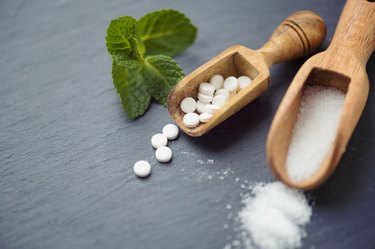
Which low-calorie sweetener is better for you: erythritol or stevia? Both are considered safe for use in foods, so for most purposes, they're interchangeable. However, the way you convert recipes, especially for baking, differs between the two.
Tip
Both erythritol and refined forms of stevia are generally recognized as safe by the FDA; for most people, either alternative sweetener is fine to use. However, there have been adverse effects reported from excessive use of either sweetener. Ultimately, of the two, most people are more likely to end up using stevia — simple because it's more readily available for small-scale consumer use.
Video of the Day
What's the Safest Sugar Substitute?
Multiple refined forms of stevia, usually sold under brand names like Pure Via, Truvia and the like, are generally recognized as safe by the U.S. Food and Drug Administration (FDA) — but whole-leaf stevia and crude stevia extracts are not. The refined forms can be sold as non-nutritive sweeteners, but the nonapproved versions must be sold as dietary supplements.
Video of the Day
Erythritol is also generally recognized as safe (sometimes abbreviated as GRAS) by the FDA. That means foods that include erythritol or refined stevia are exempt from the FDA's usual food additive requirements.
Tip
Erythritol is classified as a sugar alcohol or polyol.
Foods with GRAS products in them don't require warning labels, but you'll still find the sweeteners listed in the ingredients. Keep an eye out for trademarked product names, such as Truvia, that might appear in the ingredient list. Some food manufacturers will also splash the sweetener names, or comments about the food being low-sugar or low-calorie, on the front of the label to attract your attention.
For most people, both of these GRAS products are safe — although you might experience symptoms if you consume them in excess or have a sensitivity or allergy to them.
What if you have diabetes? The Mayo Clinic notes that some sweeteners that are zero- or low-calorie can still affect your blood sugar. For example, sugar alcohols such as erythritol are carbohydrates, so they can affect your blood sugar levels — although not as much as other sugars. Ultimately, the Mayo Clinic recommends talking to your doctor before you start using any sugar substitutes.
What About Weight Loss?
Which sweetener is best for weight loss? Refined stevia is considered a non-nutritive sweetener. To put it another way, it has virtually no calories.
That can be useful for anyone who's limiting their calorie intake as a means of weight loss. But as the Mayo Clinic explains, there's no conclusive scientific evidence that stevia provides any weight loss advantage when compared to other non-nutritive sweeteners. They also warn that for some people, highly refined stevia extracts can cause mild side effects, including nausea and a feeling of fullness.
Erythritol is in much the same boat: The International Food Information Council describes it as a zero-calorie sweetener, which can be helpful to those who are limiting their calorie intake for weight loss. But it's also noted that erythritol is only 60 to 80 percent as sweet as sugar, and excessive intake can cause gastrointestinal distress and affect the absorption of fructose.
Bottom line: While both stevia and erythritol can be useful for weight loss because they sweeten food without boosting your calorie intake, neither is a magic bullet for weight loss. To achieve that, you'll need to establish a calorie deficit, which means burning more calories than you take in.
One healthy way to do this is by combining an increase in physical activity with appropriate calorie restriction. The National Weight Control Registry has tracked more than 10,000 individuals and found that for the vast majority of people who lose weight and keep it off, that combination of choices works.
Tip
What kind of calorie deficit should you aim for? The National Heart, Lung, and Blood Institute recommends aiming for 1 to 2 pounds of weight loss per week, which works out to a deficit of 500 to 1,000 calories per day.
Sweetener Conversion Chart
You won't typically use sugar alcohols such as erythritol in home cooking or baking; most often you'll find them in prepared food and drinks. And, as PennState Extension notes, the sugar-to-sugar-alcohol and sugar-to-stevia conversions can vary, depending on exactly what you're dealing with.
Stevia is much sweeter than sugar, so you'll never use a 1-to-1 conversion — and just to make things a little more confusing, too much stevia can create a bitter aftertaste. So, it's best when used judiciously.
The University of Nebraska-Lincoln Extension provides one of the most comprehensive stevia conversion charts. For every 2 teaspoons of sugar, they recommend using 1/2 teaspoon of spoonable stevia blend, about 1/4 teaspoon of clear liquid stevia or 1/16 teaspoon of pure stevia powder.
As another reference point, 1 cup of sugar works out to about 12 teaspoons of spoonable stevia blend, 2 1/2 teaspoons of clear liquid stevia or 1 1/2 teaspoons of pure stevia powder.
They also note that when baking with stevia, a few tricks may help you get better results. These include:
- Cookies: Crisp, shortbread-style cookies give better results. Consider adding canned pumpkin, peanut butter or raw oatmeal to create chewier cookies.
- Cakes: Separate the eggs and whip the egg whites into super-stiff peaks. This'll help increase the cake volume.
- Breads: Consider adding more time to rise and increasing the amount of baking powder and baking soda.
The Nebraska Extension offers more advice, noting that stevia often works best in fruit and dairy recipes and that you should be prepared for some trial-and-error practice when you substitute stevia into a recipe in place of sugar. That's because stevia doesn't add texture, caramelize, feed yeast or tenderize batter — all things that sugar does.
Tip
If you see a "stevia baking blend," it contains a mix of stevia and sugar to balance reduced calories versus the usual baking performance you get from sugar.
Here's another potential use for stevia: As the Oregon State University (OSU) Extension Service explains, stevia is heat-stable and can be safely used for canning. However, you'll probably end up with a different texture, flavor and color than you'd get from using sugar syrup and other sweeteners.
So if you're planning any large-scale stevia canning operations, do a test batch first. Another potential solution from OSU Extension Service: Try some sugar-free canning recipes — for example, try canning fruit in its natural fruit juices. Then sweeten the end product when you pull it out of the jar to eat.
- International Food Information Council Foundation: "What Is Erythritol?"
- Mayo Clinic: "What Is Stevia? I've Heard It's Good for Weight Control"
- National Heart, Lung, and Blood Institute: "Key Recommendations"
- National Weight Control Registry: "NWCR Facts"
- Food and Drug Administration: "Has Stevia Been Approved by FDA to Be Used as a Sweetener?"
- Calorie Control Council: "Erythritol"
- Food and Drug Administration: "Generally Recognized as Safe (GRAS)"
- Calorie Control Council: "Polyols"
- Mayo Clinic: "Artificial Sweeteners and Other Sugar Substitutes"
- PennState Extension: "Sugar Substitutes"
- Nebraska Extension: "Stevia"
- Oregon State University Extension Service: "Can I Use Stevia for Canning?"
- University of Nebraska-Lincoln Extension: "G06-1634 Stevia"