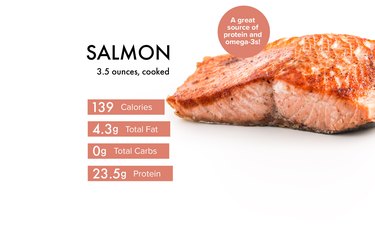
Salmon is go-to protein source for many, and it's clear to see why this fish stands out as a nutritional star: It's uniquely rich in heart-healthy fats called omega-3 fatty acids.
This fish is indeed a fantastic source of protein, and can replace less healthy forms of the nutrient on your plate, like fatty beef or sausage. You'll also find a rich supply of nutrients in salmon that support brain, heart and bone health.
Video of the Day
Video of the Day
Salmon is one of the popular types of seafood in the United States, surpassed only by shrimp and canned tuna. There are several types of salmon available, including Atlantic salmon and Pacific salmon such as chinook, coho, chum, sockeye and pink salmon, per the United States Geological Survey.
True Atlantic salmon is endangered, and commercial and recreational fishing for it is prohibited in the U.S., according to National Oceanic and Atmospheric Administration Fisheries. For that reason, the Atlantic salmon you find in the supermarket is farm-raised.
It's currently recommended that Americans eat two fish-based meals per week, and salmon is a great way to anchor those meals.
Salmon Nutrition Facts
A 3.5-ounce portion of cooked salmon is equal to a single serving. A 3.5-ounce serving of cooked wild coho salmon contains:
- Calories: 137
- Total fat: 4.2 g
- Cholesterol: 54.2 mg
- Sodium: 57.2 mg
- Total carbs: 0 g
- Dietary fiber: 0 g
- Sugar: 0 g
- Protein: 23.1 g
Salmon Macros
- Total fat: A 3.5-ounce serving of cooked salmon has 4.2 grams of total fat, which includes 1 gram of polyunsaturated fat, 1.5 grams of monounsaturated fat, 1 gram of saturated fat and 0 grams of trans fat.
- Carbohydrates: A 3.5-ounce serving of cooked salmon has no carbs, fiber or sugars.
- Protein: A 3.5-ounce serving of cooked salmon has 23.1 grams of protein.
Vitamins, Minerals and Other Micronutrients
- Vitamin B12: 205% of your Daily Value (DV)
- Selenium: 68% DV
- Vitamin D: 56% DV
- Niacin (B3): 49% DV
- Vitamin B6: 33% DV
- Phosphorus: 25% DV
- Vitamin B5: 16% DV
- Riboflavin (B2): 11% DV
- Potassium: 9% DV
- Copper: 8% DV
- Vitamin E: 6% DV
- Vitamin A: 6% DV
- Thiamin (B1): 6% DV
- Zinc: 5% DV
Nutrition and Calories in Salmon Fillet (No Skin)
A 3.5-ounce portion of pink skinless, boneless salmon contains:
- Calories: 99
- Total fat: 2.8 g
- Cholesterol: 35.7 mg
- Sodium: 326 mg
- Total carbs: 0 g
- Dietary fiber: 0 g
- Sugar: 0 g
- Protein: 18.4 g
Smoked Salmon Calories and Nutrition
When it comes to cold-smoked salmon nutrition, a 3.5-ounce portion contains:
- Calories: 226
- Total fat: 14.8 g
- Cholesterol: 52.6 mg
- Sodium: 807.7 mg
- Total carbs: 0 g
- Dietary fiber: 0 g
- Sugar: 0 g
- Protein: 24.4 g
Fried Salmon Nutrition
One small fillet (174 grams) of fried salmon cooked with cooking spray:
- Calories: 355
- Total fat: 11.2 g
- Cholesterol: 148 mg
- Sodium: 789 mg
- Total carbs: 19.8 g
- Dietary fiber: 1.2 g
- Sugar: 1.8 g
- Protein: 40.9 g
Wild Sockeye Salmon Nutrition
A 3.5-ounce portion of roasted wild sockeye salmon contains:
- Calories: 174
- Total fat: 8.7 g
- Cholesterol: 69.5 mg
- Sodium: 1131.2 mg
- Total carbs: 0 g
- Dietary fiber: 0 g
- Sugar: 0 g
- Protein: 22.6 g
Pan-Seared Salmon Calories
A 3.5-ounce serving of pan-seared salmon also contains about 253 calories.
How Does Salmon Compare to Other Fish?
Per 3.5 ounces, cooked | Wild Coho Salmon | Tuna | Trout | Canned Sardines | Atlantic Herring |
Calories | 139 | 130 | 150 | 208 | 203 |
Total Fat | 4.3 g | 0.6 g | 5.8 g | 11.5 g | 11.6 g |
Polyunsaturated Fats | 1.2 g | 0.1 g | 1.8 g | 5.1 g | 2.7 g |
Monounsaturated Fats | 1.5 g | 0.1 g | 1.7 g | 3.8 g | 4.7 g |
Total Carbs | 0 g | 0 g | 0 g | 0 g | 0 g |
Protein | 23.5 g | 29.2 g | 22.9 g | 24.6 g | 23 g |
The Health Benefits of Eating Salmon
1. Salmon Is Rich in Omega-3 Fatty Acids
Omega-3 fatty acids are a type of polyunsaturated fatty acid, and salmon is known for being a good source of them. These fats are essential because the body can't make them on its own.
Omega-3 fats are a catalyst for the production of hormones that regulate blood clotting, inflammation and the contraction and relaxation of artery walls, according to the Harvard T.H. Chan School of Public Health. They also play a role in genetic function.
Likely due to these numerous functions, omega-3s have been linked to helping prevent heart disease and stroke, and helping manage rheumatoid arthritis, lupus and eczema. They're even tied to protecting against cancer and other conditions, per the university. However, more research is needed to confirm these links.
The omega-3 fats you'll find in seafood are EPA (eicosapentaenoic acid) and DHA (docosahexaenoic acid), while the kind typically found in plants is called alpha-linolenic acid (ALA), per the National Institutes of Health (NIH).
"Omega-3 fats, especially those found in animal sources like salmon, are really beneficial for heart health," says Karen Conger, RD, a registered dietitian at UW Medicine. "The ALA omega-3 fats in plants have to be converted into DHA and EPA, which isn't a very efficient process — so you don't get as much bang for your buck as you do with the animal sources."
Notably, large population-based studies have found that eating baked or boiled fish is strongly associated with reduced systemic vascular resistance, and lower incidence of coronary heart disease and heart failure, according to a 2014 review in Tanaffos.
How much salmon can you eat per week? Eating two servings of fish per week — as recommended by the American Heart Association (AHA) — especially fatty kinds like salmon that are higher in EPA and DHA, is linked to a reduced risk of coronary death and total mortality.
It's best to try to fit omega-3s into your diet through whole food sources like salmon.
While fish oil supplements might be helpful, they can also cause side effects like indigestion, loose stools, increased risk of bleeding or a suppressed immune response if you take too much, per the Mayo Clinic. Consult your health care provider if you want to take fish oil supplements and you're also on blood-thinning medications.
Getting your omega-3s from food like fish increases your body's levels of them similarly to fish oil capsules, according to a September 2015 study in the journal Molecular Nutrition & Food Research.
2. It’s a Healthy Source of Protein
Salmon is a fantastic protein source with 23.5 grams per serving and only 1.1 grams of saturated fat. The AHA recommends that only 5 to 6 percent of your daily calories come from saturated fat (that's about 13 grams per day).
Saturated fats are found in higher amounts in foods like fatty beef, lamb, pork, poultry with skin and butter, and replacing them with foods high in monounsaturated fats or polyunsaturated fats, like salmon, may help lower your blood cholesterol levels.
"Even though salmon is reasonably high in fat, I would still consider it a lean protein because it's low in saturated fat," Conger says. "That protein helps to support muscle synthesis and muscle repair throughout the day."
Salmon is a good source of complete protein, meaning it supplies all of the amino acids the body can't make on its own. Our bodies need protein to build and maintain bones, muscles and skin, per the U.S. National Library of Medicine (NLM).
About 10 percent to 35 percent of your daily calories should come from protein. While most Americans do get enough protein, many could benefit from getting it from healthier sources like salmon, per the Ohio State University Extension.
3. It’s Rich in B Vitamins
Salmon provides an impressive array of B vitamins that play a number of important roles in your body. A 3.5-ounce serving of wild coho salmon provides the following:
- Vitamin B12: 208% of the DV
- Vitamin B6: 33% DV
- Pantothenic acid (B5): 16% DV
- Riboflavin (B2): 11% DV
- Thiamin (B1): 6% DV
Your body needs B vitamins to obtain or create energy from the food you eat and to form red blood cells, according to the NLM.
Animal proteins such as fish, poultry meat, eggs, dairy products, fortified cereals and enriched grain products provide B vitamins, as do plant foods such as leafy green vegetables and beans.
A shortage of B12 and B6, in particular, can lead to anemia. In fact, up to 20 percent of adults over age 50 may have borderline vitamin B12 deficiency, according to Harvard Health Publishing.
This could cause cognitive issues such as trouble thinking and reasoning or memory decline. Vitamin B12 only naturally occurs in animal products, and the body cannot make it on its own.
Salmon — High in B12
Salmon's vitamins contribute to its overall health, and it is especially rich in vitamin B12.
B12 is essential for the formation of red blood cells, and it plays a role in proper nerve function and the production of DNA.
Salmon contains more vitamin B-12 per serving than beef, which is often cited as a good source of vitamin B12. A 3.5 ounce serving of wild coho salmon contains 208% of the DV.
4. Salmon Can Support Bone Health
Salmon contains a number of key nutrients that play a role in keeping your bones strong and fracture-free.
Adequate protein intake is important for bone health, and many older adults do not get enough in their diets, per the National Osteoporosis Foundation. Some research has also found that foods rich in omega-3s may have bone-boosting benefits, but more studies are needed to confirm this link.
Salmon also provides calcium and vitamin D, which work together to support your bones. "By eating canned salmon with bones, you'll get more calcium," Conger says. "The vitamin D in salmon is needed for calcium absorption. Since Vitamin D is a fat-soluble vitamin, salmon is a good source of it."
Until about age 30, your body creates new bone faster than old bone is depleted. Your bone mass hits its peak around age 30, after which you lose slightly more bone mass than you develop.
Not getting enough calcium in your diet contributes to decreased bone density, early bone loss and a greater risk of fractures, according to the Mayo Clinic.
Salmon also provides 26 percent of your daily value of phosphorus, which is present in every cell in the body but found mostly in the bones and teeth, per the NLM. Its main function is the formation of bones and teeth. It also works with B vitamins to help with kidney function, muscle contractions, normal heartbeat and nerve signaling.
5. Salmon Is Linked to Good Brain Health
Because omega-3 fats play a number of roles, including building cell membranes throughout the body and brain, it's possible they may promote healthier brain cells and prevent deterioration of the brain, according to Harvard Health Publishing.
This may be particularly true when it comes to getting omega-3s from foods like salmon.
Older adults who ate at least one seafood meal each week performed better on cognitive tests than those who ate less, found a May 2016, five-year observational study in the journal Neurology. In particular, those with the APOE-ε4 gene variant, which raises the risk of Alzheimer's disease, seemed to benefit from eating omega-3 fats.
On the other hand, fish oil pills didn't appear to slow decline in thinking skills in an August 2015 study of over 3,000 older adults in the American Medical Association.
A 3.5-ounce serving of salmon also provides 69 percent of your daily value of selenium, an essential trace mineral that acts as an antioxidant.
While it's uncommon, a deficiency in selenium may be associated with age-related declines in brain function because of a decrease in selenium's protective effect on cells, per the NIH.
Selenium's brain benefits may be optimal at certain levels of the mineral. Selenium levels that are too low or (to a lesser degree) too high are associated with a higher risk of depressive symptoms and negative mood in young adults in a November 2014 study in the Journal of Nutrition.
In addition, the high levels of B vitamins in salmon are associated with helping prevent dementia and increasing the production of neurotransmitters, chemicals that send messages from neurons in the brain to the rest of the body, per the Cleveland Clinic.
The body doesn't store B vitamins, and not eating enough can raise your risk of cognitive decline such as memory loss or neurodegenerative diseases like Alzheimer's.
Can You Eat Too Much Salmon?
The AHA recommends eating two 3.5-ounce servings of cooked fatty fish like salmon per week. However, while eating salmon every day over a short period of time could be healthy, eating too much fish — even those low in mercury — could result in mercury buildup in your body.
Farm-Raised vs. Wild Salmon: What’s Better?
Both farmed and wild salmon can be a delicious and healthy addition to your diet. Wild salmon tends to be lower in calories and fat (both saturated fat and healthy omega-3s) than farmed salmon.
Farmed salmon also tends to be five to 10 times higher in persistent organic pollutants (POPs), which are linked to several diseases such as type 2 diabetes and obesity, per the Cleveland Clinic. Wild salmon can contain contaminants too, but they're generally found at lower levels.
Although both types of salmon provide important nutrients, it may be best to opt for wild-caught salmon when possible.
Salmon Health Risks
Allergies
Although it's not as common as other types of food allergies, an allergy to finned fish such as salmon can cause anaphylaxis, which is severe and potentially life-threatening.
Food allergies typically appear in childhood, but a fish allergy may not be observed until adulthood. Research has shown that up to 40 percent of people with a fish allergy may not have symptoms until adulthood, per the American College of Allergy, Asthma & Immunology. If you have a salmon allergy, some experts may suggest avoiding all fish — but it might be possible to eat other kinds.
If you suspect you have an allergy, consult your allergist to determine if other types of fish might be safe to eat. Fish allergy symptoms may include hives or skin rash, nausea, runny nose or sneezing, headaches or asthma, and you may need to carry an EpiPen with you at all times in case of anaphylaxis.
Drug Interactions
Smoked salmon contains tyramine, an amino acid that can trigger blood pressure spikes if taken with linezolid (Zyvox), used to treat bacterial infections, per Consumer Reports.
People taking monoamine oxidase inhibitors (MAOIs) may also need to follow a low-tyramine diet, per the Mayo Clinic. MAOIs treat depression by blocking the enzyme monoamine oxidase, which breaks down extra tyramine in the body. If you eat high-tyramine foods and take an MAOI, tyramine can reach dangerous levels quickly.
Examples of MAOIs used for depression include Isocarboxazid (Marplan), Phenelzine (Nardil), Selegiline (Emsam) and Tranylcypromine (Parnate).
Be sure to discuss any medication and food interactions with your health care professional.
Salmon Preparation and Helpful Tips
There are many benefits of eating salmon, and it's a tasty addition to a healthy diet. That said, it's important to buy high-quality salmon and to prepare and store it properly to avoid food-borne illness.
1. Inspect Salmon Before You Buy It
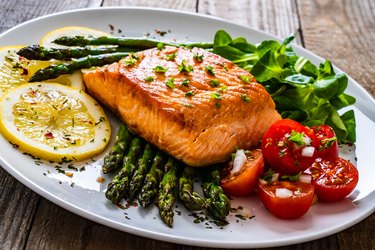
When you're shopping for fresh seafood, you should only buy fish that's refrigerated or on a thick bed of fresh ice, per the FDA. Fish should smell fresh and mild (not fishy or sour), eyes should be clear and shiny (if you're buying a whole fish) and the flesh should spring back when pressed.
Keep in mind that color alone is not an indicator of freshness, as it can be affected by many factors such as diet, environment or treatment.
While fresh fish marked as "Previously Frozen" may not have characteristics like bright eyes or firm fresh, it should still smell fresh and mild.
When purchasing frozen seafood, the FDA recommends avoiding packages with signs of frost or ice crystals (this may mean the fish has been stored for a long period of time, or thawed and refrozen). Frozen fish should always be hard, not bendable, and the package should not be open, torn or crushed on the edges.
Is Frozen Salmon Healthy?
Just like fresh salmon, frozen salmon is good for you and offers an array of health benefits.
Although many people believe that fresh salmon is better for you, there is no scientific evidence that freezing fish changes its nutritional status. Some argue that frozen tastes even fresher, especially when frozen at the peak of freshness
When it comes to frozen vs. fresh salmon, frozen salmon fillets have the same nutrient profiles as their fresh counterparts.
One added benefit of buying salmon from the freezer aisle? Frozen salmon can be much more affordable. The frozen salmon patties at Costco, for example, are often sold for less than $10 per pound.
Similarly, buying a frozen bag of salmon fillets at the retailer can also be cost-effective.
2. Check if It’s Sustainable
When you're purchasing salmon, check the Monterey Bay Aquarium Seafood Watch to see if it's been fished or farmed in ways that have less of an impact on the environment.
Select the type of salmon, whether it was farmed or wild-caught and where it's from to easily determine if it's considered the best choice, a good choice or a choice to avoid.
Tip
You can buy wild salmon year through if you buy it canned — most canned salmon will mention "wild-caught" right on the label.
3. Store It Properly
Store seafood in the refrigerator or freezer shortly after purchasing it. If you plan to cook your salmon within two days of purchasing it, store it at a temperature of 40 degrees Fahrenheit or lower, per the FDA. Otherwise, wrap it tightly in foil, plastic or moisture-proof paper and store in the freezer.
Wash your hands with warm, soapy water for at least 20 seconds before and after handling seafood. Be sure to keep raw food separate from cooked foods, and wash all surfaces like cutting boards or counters with soap and hot water between the preparation of raw seafood and that of cooked foods.
4. Cook It Thoroughly
Salmon must be cooked to an internal temperature of 145 degrees Fahrenheit, and it should separate easily with a fork.
Uncooked spoiled seafood may have a sour, rancid, fishy or ammonia-like odor, which becomes more potent after cooking. Do not eat seafood if you detect an odor before or after cooking it.
Cooked fish like salmon will last up to three to four days in the refrigerator, and up to four to six months in the freezer, per the Clemson Cooperative Extension.
Fresh salmon will last two to three months in the freezer and three days in the fridge while smoked fish will last up to 14 days in the refrigerator and up to two months in the freezer.
Salmon Recipes
Alternatives to Salmon
Salmon provides a rich array of healthy nutrients, including omega-3 fatty acids, protein, B vitamins, calcium, vitamin D, phosphorus and selenium.
That's why it's tied to benefitting your health in a number of ways, from preventing heart disease and cognitive decline to strengthening your bones and regulating mood.
You can find many similar health benefits in other seafood such as:
- Albacore tuna
- Atlantic herring
- Mussels
- Anchovies
- Black cod
- Atlantic mackerel
- Trout
- Shrimp
- Sardines
- My Food Data: "Cooked Coho Salmon (Wild)"
- Harvard T.H. Chan School of Public Health: "Omega-3 Fatty Acids: An Essential Contribution"
- National Institutes of Health: "Omega-3 Fatty Acids"
- Tanaffos: "Omega-3 Supplements and Cardiovascular Diseases"
- American Heart Association: "Fish and Omega-3 Fatty Acids"
- Mayo Clinic: "Fish Oil"
- Molecular Nutrition & Food Research: "Incorporation of eicosapentaenioic and docosahexaenoic acids into breast adipose tissue of women at high risk of breast cancer: a randomized clinical trial of dietary fish and n-3 fatty acid capsules."
- American Heart Association: "Saturated Fat"
- U.S. National Library of Medicine: "Dietary Proteins"
- Ohio State University Extension: "Putting MyPlate on Your Table: Protein"
- Cleveland Clinic: "Fish Faceoff: Wild Salmon vs. Farmed Salmon"
- USDA: "Fish, salmon, coho, farmed, cooked, dry heat"
- USDA: "Fish, salmon, coho, wild, cooked, dry heat"
- U.S. National Library of Medicine: "B Vitamins"
- Harvard Health Publishing: "Vitamin B12 deficiency can be sneaky, harmful"
- National Osteoporosis Foundation: "Food and Your Bones — Osteoporosis Nutrition Guidelines"
- Mayo Clinic: "Bone health: Tips to keep your bones healthy"
- U.S. National Library of Medicine: "Phosphorus in diet"
- Harvard Medical School: "Do omega-3s protect your thinking skills?"
- Neurology: "APOE ε4 and the associations of seafood and long-chain omega-3 fatty acids with cognitive decline"
- The Journal of the American Medical Association: "Effect of Omega-3 Fatty Acids, Lutein/Zeaxanthin, or Other Nutrient Supplementation on Cognitive Function: The AREDS2 Randomized Clinical Trial."
- National Institutes of Health: "Selenium"
- Journal of Nutrition: "Optimal Serum Selenium Concentrations Are Associated with Lower Depressive Symptoms and Negative Mood among Young Adults"
- Cleveland Clinic: "B is for Brain Health"
- American College of Allergy, Asthma & Immunology: "Fish Allergy"
- Consumer Reports: " Food and Drug Interactions You Need to Know About"
- Mayo Clinic: "MAOIs and diet: Is it necessary to restrict tyramine?"
- U.S. Food & Drug Administration (FDA): "Selecting and Serving Fresh and Frozen Seafood Safely"
- Monterey Bay Aquarium Seafood Watch: "Salmon Recommendations"
- Clemson Cooperative Extension: "Safe Handling of Seafood"
- United States Geological Survey: "How many species of salmon are there and how large can they get?"
- National Oceanic and Atmospheric Administration Fisheries: "Atlantic Salmon (Protected)"
- My Food Data: "Cooked Yellowfin Tuna"
- My Food Data: "Cooked Trout"
- My Food Data: "Canned Sardines"
- My Food Data: "Atlantic Herring"
- USDA: "Pink Salmon Skinless & Boneless"
- USDA: "pink skinless, boneless salmon"
- USDA: "Cold Smoked Salmon"
- My Food Data: "Roasted Wild Sockeye Salmon"