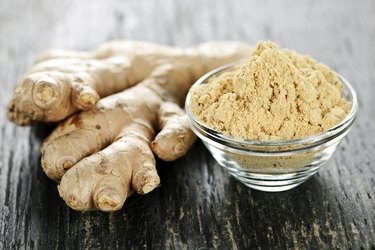
When your recipe calls for fresh ginger and you only have ground ginger on hand, you need to know how much to use to make a substitution. When you are converting grated ginger to ground ginger or vice versa, it is important to use the proper amount.
Tip
If you are out of ground ginger or prefer to cook with fresh herbs, you will need to know how much to use. In general, 1 tablespoon of chopped fresh herbs is equivalent to 1/4 teaspoon of the dried, powdered version.
Video of the Day
Read more: How Much Raw Ginger Can You Eat?
Video of the Day
Ground Ginger Vs. Fresh Ginger
There are some significant differences when comparing ground ginger to fresh ginger. The pungency and flavor of dried ground ginger differ from those of fresh ginger root. Even though you can substitute one for the other in a pinch, they each tend to work better in different types of dishes.
Ground ginger is the preferred form for baked goods and spiced drinks, whereas fresh ginger is more often used in savory dishes, especially in Asian cuisine.
According to Colorado State University Extension, 1 tablespoon of fresh chopped herbs, such as ginger, is equivalent to 1/4 teaspoon of ground ginger.
Compare the Nutrients
The amount of fresh or ground ginger consumed in a serving of food is usually too small to deliver many nutrients. However, nutrients do vary if you substitute ground ginger for fresh or fresh ginger for ground.
For example, ground ginger contains significantly more manganese that its fresh counterpart. According to the USDA, 1/4 teaspoon of ground ginger contains 0.15 milligrams of this nutrient, while the equivalent 1 tablespoon of fresh ginger contains only 0.02 milligrams.
Note the Different Active Ingredients
Fresh ginger root primarily contains gingerol, but it changes when exposed to heat. When the root is dried to produce ground ginger, the gingerol converts into another active ingredient, shogaol.
Gingerol in fresh ginger helps reduce pain. It is also the ingredient you need to relieve nausea and settle an upset stomach. Both active ingredients have anti-inflammatory and antioxidant abilities, but the shogaol in ground ginger may be more potent in these roles than gingerol, reports a review published in the journal Preventive Nutrition and Food Science in June 2012.
Read more: Benefits of Garlic & Ginger
Follow These Safety Guidelines
Ginger is safe when consumed in normal amounts through foods, but if you take supplements or consume large quantities, it may interact with some medications and medical conditions. To stay safe, consult your physician before consuming either form of ginger if you're pregnant or you take prescription medications.
Research has suggested that ginger might slow down blood clotting, which could increase the risk of bleeding in people who have a bleeding disorder or take anticoagulant medications, according to the National Center for Complementary and Integrative Health.
If you have diabetes or take medications to control diabetes, be sure to carefully monitor your blood glucose because ginger may lower your levels of blood sugar.
People taking calcium channel blockers to lower blood pressure should also be cautious with ginger because it might cause an irregular heartbeat or a drop in blood pressure.
- Preventive Nutrition and Food Science: "Optimization of Extraction Conditions for the 6-Shogaol-Rich Extract From Ginger (Zingiber officinale Roscoe)"
- Colorado State University Extension: "Herbs: Preserving and Using"
- National Center for Complementary and Integrative Health: "Ginger"
- USDA FoodData Central: "Spices, Ginger, Ground"
- USDA FoodData Central: "Ginger Root, Raw"