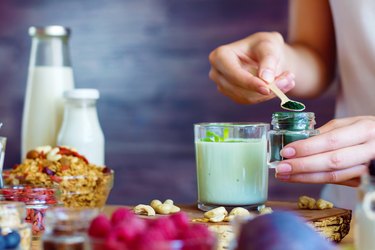
Maybe you've spotted spirulina tabets at your local health food store, or perhaps you've heard spirulina powder is an especially healthy ingredient to add to your veggie smoothies.
Wondering what the green stuff is, exactly? Spirulina is a type of sea vegetable, a microscopic saltwater plant harvested for its health benefits and sold dried as a health supplement, per Harvard Health Publishing.
Video of the Day
Video of the Day
The blue-green algae thrive in warm climates and in warm alkaline water. Many cultures around the world include spirulina as part of their daily diets because of its powerful nutrient benefits. It's available dried and freeze-dried, in powder or pills and as flakes.
Because spirulina can absorb heavy metals and is susceptible to contamination from toxins, it's important that you purchase it from a reputable source.
The Health Benefits of Spirulina
There are several health benefits of spirulina, whether in powder or pill form.
1. Spirulina Is Packed With Antioxidant Power
Antioxidants are powerful substances that help protect your body from free radicals, which are unstable molecules that damage healthy cells.
Spirulina contains antioxidants such as vitamins A, C and E. An August 2010 review in Cardiovascular Therapeutics notes that spirulina's beneficial antioxidant activities were demonstrated in a large number of preclinical animal studies, as well as in a limited number of human studies. The evidence suggests that the antioxidants in spirulina can benefit your heart health.
2. Spirulina Is High in Protein
Protein is found in every cell in your body. It's essential for the proper development, maintenance and repair of muscle, bone, skin, hair and body tissue. Proteins also help carry out many of your body's chemical reactions.
Spirulina is a good source of lean protein: It boasts a 60 percent protein content, making it a much richer source of protein than most vegetables, per Harvard Health Publishing. A single tablespoon, which has just 20 calories, contains 4 grams of protein, per the USDA.
3. Spirulina May Have a Positive Effect on Cholesterol
Spirulina might help you achieve healthy cholesterol levels, by lowering "bad" LDL cholesterol and triglycerides while raising "good" HDL cholesterol.
In people with high cholesterol, consuming 1 gram of spirulina per day lowered triglycerides by 16 percent and LDL by 10 percent, according to a July 2013 study in the Journal of the Science of Food and Agriculture.
In another study, people with type 2 diabetes who consumed 2 grams of spirulina daily also saw improvements in their cholesterol levels, per early winter 2001 research in the Journal of Medicinal Foods.
Related Reading
Spirulina Tablets vs. Powder
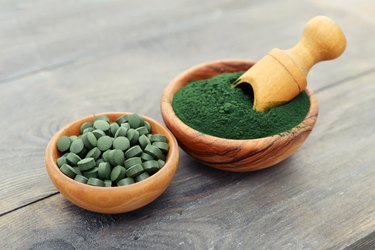
If you're interested in taking spirulina, you'll find that it's available in many forms; tablets and powder are two of the most common. While the main ingredient is the same — spirulina — there are some differences when it comes to powder vs. pills.
Absorption Differences
Some tablets are now designed to break down quickly for easy digestion. In general, though, powders are more reliable for absorption than tablets, as in some cases the tablets may not fully disintegrate, leading to fewer absorbed nutrients, per Australian Spirulina. To ensure the tablets disintegrate easily, manufacturers often add extra chemicals. Many tablets are also coated so they are easier to swallow.
Watch Out for Fillers
While some producers make spirulina tablets without fillers, many tablets contain binders that hold the spirulina powder together, per Australian Spirulina. Silicon dioxide, a type of clay, is commonly used to bind tablet ingredients, and because of the need for binders, spirulina tablets may contain upward of 20 to 30 percent binder in a single tablet. This means that you will need to consume more tablets to achieve the same dosage as pure spirulina powder.
Spirulina powder generally contains less filler than tablets do and can be added to smoothies, juices and other foods. In turn, though, tablets can be more convenient to store and transport compared to powder.
Storing and Cost
Spirulina tablets and powder are both cost-effective, but tablets typically have a longer shelf life.
You can easily mix spirulina powder into smoothies, juices or even soups and baked goods, but it can be very inconvenient if you need to consume spirulina outside of your home. If you do decide to use spirulina powder rather than tablets, you can always make your own spirulina capsules — capsules are available for purchase at many health food stores — which makes it easier for you to keep a supply in your purse, glove box or at work in your desk to take as needed.
How to Use Spirulina
Spirulina powder can be mixed into foods, and you can also crush tablets into a fine powder and add it directly to drinks and dishes.
In addition to mixing spirulina powder in with juices or smoothies — use a blender to ensure fewer clumps — you can also add it to dips, salads and pasta sauces. Mix 2 teaspoons of spirulina powder into your pesto sauce to give a nutritional boost to your meal, sprinkle the powder over a salad or mix it in with a sour cream dip, salsa or guacamole.
Related Reading
Spirulina Side Effects and Safety Concerns
Spirulina appears to be safe at doses as high as 10 g in most people with normal kidney and liver function, according to a December 2020 review in Marine Drugs. Some people, however, may experience side effects such as headache, sweating, nausea, difficulty concentrating and flushing of the face.
Avoid spirulina if you have an autoimmune disease, such as multiple sclerosis, rheumatoid arthritis or lupus, because it could stimulate your immune system, making your condition worse. Talk with your doctor before taking spirulina if you're pregnant or breastfeeding.
- Australian Spirulina: "Spirulina FAQs"
- Australian Spirulina: "Spirulina Tips"
- Drug Topics: "Overview of Pharmaceutical Excipients Used in Tablets and Capsules"
- Cardiovascular Therapeutics: "Hypolipidemic, antioxidant, and antiinflammatory activities of microalgae Spirulina"
- Harvard Health Publishing: "By the way, doctor: Is spirulina good for you?"
- USDA: "Spirulina powder"
- Journal of the Science of Food and Agriculture: "The hypolipidaemic effects of Spirulina (Arthrospira platensis) supplementation in a Cretan population: a prospective study"
- Journal of Medicinal Foods: "Role of Spirulina in the Control of Glycemia and Lipidemia in Type 2 Diabetes Mellitus"
- Marine Drugs: "Are There Any Beneficial Effects of Spirulina Supplementation for Metabolic Syndrome Components in Postmenopausal Women?"