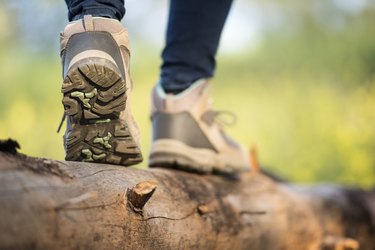
Headed for a walk in the woods but still debating with yourself about hiking boots vs. tennis shoes? The choice in footwear, whether it's as stark as boots vs. sneakers, or the more subtle difference between hiking shoes and running shoes, can make or break your hike.
Tip
Unless the trail you walk is unusually smooth and dry, tennis shoes are not made to handle hiking terrain. On the other hand, heavy hiking boots may be overkill for some trail conditions.
Video of the Day
Know Your Trail
The difference between hiking shoes and running shoes, or hiking boots vs tennis shoes, becomes more important as the trail becomes more varied. A day hike through a well-maintained state park will be less challenging on your feet than a long trail with ever-changing conditions. Before you set out, research some important questions to decide on your trail footwear:
Video of the Day
- Will I be gone long enough to require a heavy pack?
- Will there be steep climbs and other kinds of hills?
- Is there uneven terrain?
- Is part of the trail likely to be slippery from ice, mud or wet leaves?
- Might the walking surface be strewn with branches, jagged stones and other sharp objects?
- Will I be crossing streams and walking through other wet places?
- Will I experience low temperatures, ice or snow?
- Are encounters with snakes or other biting creatures a real possibility?
Hiking Boots vs. Tennis Shoes
Tennis shoes are made to handle well on a court surface, points out the American Academy of Orthopaedic Surgeons. Because of this, they aren't made with the kind of deeply-grooved, sturdy rubber tread that is so important on the trail. In addition, hiking boots and some trail shoes provide extra cushioning at the soles to help absorb the shock caused by carrying a heavy pack. Tennis shoes aren't made to absorb that added weight.
Compared to trail shoes or hiking boots, tennis shoes pose several other limitations on serious hikes. They traditionally sport a lower cut, which limits ankle support on the trail. Also missing is a sturdy and/or ventilated "upper," meaning the part covering the top of your feet. Hiking boots may come with all-leather uppers. Or you may prefer a boot or trail shoe with a combination of mesh, leather and synthetic material used on the uppers.
Footwear for Lighter Hikes
Even after determining that tennis shoes and other workout sneaker types aren't going to cut it on the trail, you'll still need to choose from various types of trail footwear.
If you're going to be sticking to paved or well-tended paths, and won't be carrying a heavy pack, walking shoes may be enough for you. Mayo Clinic recommends well-made walking shoes that have heel collars, mesh uppers, cushioned insoles, a roomy toe box and an Achilles tendon protector.
"Trail runners" are somewhere between walking shoes and hiking shoes. This footwear is meant for jogging in off-road conditions. They're stiffer than regular running shoes, but are still extremely lightweight, notes the orthopedic-focused Hospital for Special Surgery.
Taking on Tougher Trails
Hiking shoes are sturdy, and offer more protection from the elements and from rugged trails. They often have rubber toe caps and internal shanks for greater foot support. If your pack won't exceed 30 pounds and you're not going on any "ankle-breaker" hikes, hiking shoes may be ideal for the journey.
For the most rugged trail conditions, however, hiking boots are still the gold standard. These have the sturdiest ankle support, offer better protection from snow and boggy conditions, and deeper insole cushioning for when you'll be carrying a heavy pack. They achieve this through a combination of the height and rigidity of the ankle collar, heavy sole cushioning, and sturdy material.
Should You Toss the Tennies?
Some "tennis shoes" are more versatile than others. In fact, not all so-called "tennis shoes" are created equal. Many people use the term interchangeably with everyday sneakers — some of which can be quite flimsy. In contrast, true "court shoes" meant for tennis at least offer some stability and a decent tread in mildly challenging conditions.
Are tennis shoes ever useful on a heavy-duty hike? Sure — for wearing around camp, or as a short-term alternative if your primary trail footwear gets caked in mud. But for the most part on the hiking boots vs tennis shoes question, the tennis shoes won't cut it except on the most gentle paths.
- Appalachian Mountain Club: "Hiking Boots vs Trail Runners: Best Footwear for the Backcountry"
- American Academy of Orthopaedic Surgeons: "Atheletic Shoes"
- Mayo Clinic: "Walking Shoes: Features and Fit That Keep You Moving"
- Hospital for Special Surgery: "Choosing the 'Best Fit': Which Shoes Should I Wear?"
- Cambridge Dictionary: "Tennis Shoe"
- National Outdoor Leadership School: Alumni Wind River Hiking and Wilderness Medicine First Aid: "Equipment Guidelines"