Walking is one of the best forms of exercise that I, as a personal trainer, recommend for people with overweight and obesity. It's simple, easier on your joints than other forms of exercise and has countless benefits for your physical and mental health.
Because walking is something many people do normally throughout their day, some mistakenly assume they won't get many noticeable benefits from walking. But this couldn't be further from the truth! Regular walking can have a tremendous effect on both your body and your brain.
Video of the Day
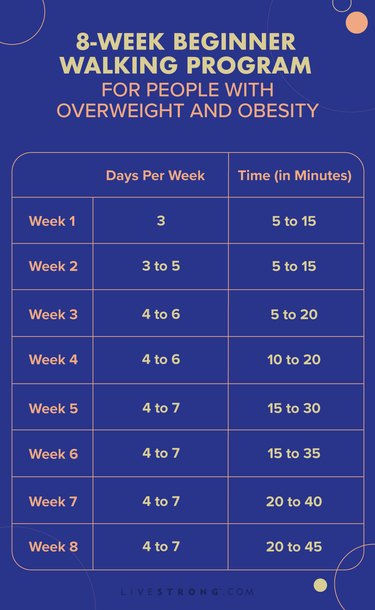
To help you get started on your journey of walking for exercise, I created this eight-week beginner's walking program for people with overweight and obesity.
The 8-Week Beginner Walking Program
Get a printer-friendly PDF version of this beginner's walking program here.
Walking for People With Overweight and Obesity
This eight-week walking program is designed to help you first increase the number of days you walk per week, then increase the length of each walk. It's better to do shorter walks more frequently as opposed to doing a long walk once or twice per week when you're starting out.
Longer walks can be intimidating when you're getting started, making them more tempting to skip. You may find it's easier to motivate yourself to take a five-minute walk than a 30- or 45-minute walk. And when you do something most days, it becomes a part of your regular routine more quickly.
Once you're doing a short walk at least five days a week, gradually increase the duration of your walks. Pick a timeframe that makes the most sense with your schedule as well as your current fitness level. It's better to start with less and build on your success.
Focus on keeping your intensity low throughout the entire program. Depending on your fitness level, this may mean a few things:
- Walking slowly enough that you could comfortably carry on a conversation
- Breathing exclusively through your nose most of the time (this may not be possible for folks with sinus trouble)
- Keeping your target heart rate at around 60 to 70 percent of your maximum heart rate (if you have access to a heart rate monitor), according to the Centers for Disease Control and Prevention. For most people, that will be somewhere around 120 to 150 beats per minute.
If you have trouble achieving these measures, slow down your pace or shorten your walk. Some beginners may need extra time acclimating to walking and should make it a goal to gradually reduce their level of exertion while working through the program. Expending less effort while walking farther and more frequently is a key sign your fitness level is improving.
Once you've successfully completed this program, you can up the ante and start doing some or all of your walks at higher intensities. Consider doing this if you have ambitions to start running or doing other more intense forms of exercise.
However, you don't need to speed up to enjoy the benefits of walking. A March 2020 JAMA study observed "there was no significant association between step intensity and all-cause mortality after adjusting for the total number of steps per day." That means the total amount of walking was more important than the speed or intensity.
More Benefits of Regular Walking
- Improved cognitive function. Walking helps keep your brain and memory sharp, especially as you get older. A May 2017 review in Clinical Interventions in Aging found older adults who regularly engaged in physical activity such as walking had a lower risk of cognitive decline and better memories than adults who moved less often.
- Improved sleep quality. People who walked more reported a better quality of sleep than folks who walked less in a July 2019 study in Sleep Health.
- Lower risk of stroke. More time spent walking is associated with a lower risk of stroke, according to a March 2018 report in Circulation.
- Potential for longer life. The 2020 JAMA study mentioned above found higher daily step counts were associated with lower rates of dying from any cause. Researchers noted significant changes with modest increases in daily step count (from averaging between 2,000 and 4,000 to averaging between 4,000 and 6,000 daily steps), meaning you don't need to walk that much more to potentially benefit.
Tip
Always talk to your doctor or another trusted health care provider before beginning any new exercise routine.
Try These Body-Weight Warm-Ups Before Your Walks
A full warm-up isn't absolutely necessary before you start walking. However, if you're an older adult, live in a cold climate or have joint pain or a previous injury, spending a few minutes warming up your muscles and joints can make a big difference in how you feel.
Floor-Based Warm-Up
The following exercises are performed on the floor and will help get your walk off to a great start. Skip them if you have trouble getting up and down off the ground and begin with the moves farther down.
- Lie on your back with your knees bent and feet flat on the floor.
- Drive through your heels, squeeze your butt and lift your hips off the floor until your spine is in a neutral position. Don't press so far that you arch your lower back.
- Hold for 1 second, then relax your hips to the ground.
- Begin on all fours with your hands beneath your shoulders and your knees beneath your hips.
- Keeping your knee bent, pick one leg off the ground and trace a slow circle with your hip. Try to isolate the movement from the hip and don't excessively bend your elbows or lean side to side.
- Do 5 circles in one direction, then switch directions and do another five on that leg before switching legs.
- Begin on all fours with your knees a little wider than your hips and your hands in front of your shoulders.
- Gently rock your hips back toward your heels to stretch your hips and lower back. Keep your head up and look in front of you.
- Complete the rep by rocking forward again. Keep your spine neutral and core engaged.
- Begin half kneeling with one foot out in front of you so your knee forms a 90-degree angle and the other on the ground beneath your hip.
- Initiate the stretch by rocking your hips back.
- Gently push your hips forward. Think about squeezing your butt as you press into the stretch. You should feel a stretch in the hip and on the front of the kneeling leg.
- Hold the stretch for 3 to 5 deep breaths per side.
- Begin half kneeling with one foot out in front of you so your knee forms a 90-degree angle and the other on the ground beneath your hip.
- Keeping your front heel on the floor, gently press your knee forward out over your toes. The angle between your foot and your shin should decrease. If your knee hurts or your heel comes off the floor, you've gone too far.
- Complete the rep by bringing your knee back behind your toes and returning to the starting position.
Standing Warm-Up
The following drills and stretches can be done standing and are a good option for folks who can't easily get up and down from the floor. Depending on your fitness level, you can combine both sets of drills into a longer warm-up or just focus on these standing drills.
- Stand tall and place one hand on a wall or another stable surface to help you balance.
- Use the opposite hand to grab your ankle behind your body. If you can’t reach your ankle with your hand, loop a yoga strap or resistance band around your foot.
- Gently pull your foot up and back toward your butt until you feel a stretch in the front of your leg.
- Stand as tall as possible. Don't lean forward or arch your back as you stretch.
- Hold the stretch for 3 to 5 deep breaths per side.
- Place one leg on a bench, box, chair or other stable surface. Your leg should be as straight as possible without locking out your knee, and your heel should be on the box.
- Gently lean forward and reach for your toes. You should feel a stretch in the back of your leg. If you can't reach your toes, go as far as you can.
- Hold the stretch for 3 to 5 deep breaths per side.
- Stand in front of a wall. Flex your ankle so you can get the toes of one foot up onto the wall. Keep your back leg relatively relaxed.
- Keeping your legs as straight as possible, gently bring your hips forward. Don't just fall into the wall — focus on leading with your hips. You should feel a stretch in the back of your lower leg.
- Hold the stretch for 3 to 5 deep breaths per side.
- Stand with one foot about a palm's distance away from a wall. The other leg should be relatively relaxed. Place your hands on the wall for balance.
- Keeping your front heel on the floor, gently press your knee forward out over your toes and toward the wall. The angle between your foot and your shin should decrease. If your knee hurts or your heel comes off the floor, you've gone too far.
- Complete the rep by relaxing back away from the wall to the starting position.
Walking Warm-Up
The next two drills are walking drills, which might be challenging for balance, depending on your current fitness level. Both can also be done in place without moving forward.
- Start standing.
- Using both hands, pull one knee up toward your chest.
- Relax your leg back to the ground.
- Take a step forward and repeat on the opposite side.
- Continue alternating until you've completed your reps.
- Start standing.
- Pick one knee up toward your chest and reach your opposite hand across to touch it.
- Walk forward and repeat with the opposite arm and leg.
- Continue alternating sides until you've completed your reps.
3 Things to Know Before You Start Walking
You don't need a gym membership or lots of gear to start walking. All you need is a supportive pair of shoes and space to move. If it's not safe to walk outside where you live, you can get started walking laps around the inside of your house.
However, there are a few things you should keep in mind before beginning your walking program.
1. Build Up Gradually
Scale-up training volume before you crank up the intensity. This means you want to be able to walk more frequently and for longer distances before you try to increase your speed or walk up and down steep hills, for example.
This gives your body time to develop the necessary muscle strength and aerobic endurance to support more intense activity. When in doubt, slow down and use a more leisurely pace so you can walk longer and add more days to your routine. You can always kick up the intensity later.
2. Walk Naturally
Don't worry about using proper form or maintaining a certain posture while walking. Your body position will improve naturally as you get stronger and increase your fitness level. At the beginning of your walking journey, it's much more important to get moving.
That being said, the one thing you do want to make sure you're doing is gently swinging your arms as you walk. Your right arm should swing forward as you step with your left foot and vice versa. This is called cross-patterning and helps your body move with greater ease.
3. Consider New Sneakers
If your budget allows, invest in a good pair of walking shoes. They can make a huge difference in how your joints feel during and after walking. This is especially important for people with overweight and obesity, who are at a higher risk of developing lower-body joint pain.
You might be able to visit an in-person running store, where a trained salesperson can observe the way you walk and suggest the style or brand of shoe that will help you feel your best.
- JAMA: "Association of Daily Step Count and Step Intensity With Mortality Among US Adults"
- Clinical Interventions in Aging: "Cognitive decline in normal aging and its prevention: a review on non-pharmacological lifestyle strategies"
- Arquivos de Neuro-Psiquiatria: "Pilates and aerobic training improve levels of depression, anxiety and quality of life in overweight and obese individuals"
- Sleep Health: "Walk to a Better Night of Sleep: Testing the Relationship Between Physical Activity and Sleep"
- Circulation: "Heart Disease and Stroke Statistics—2018 Update: A Report From the American Heart Association"
- Preventing Chronic Disease:"Walking as an Opportunity for Cardiovascular Disease Prevention"
- CDC: "Target Heart Rate and Estimated Maximum Heart Rate"