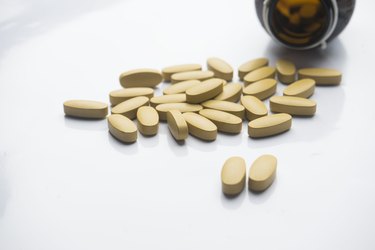
Iron deficiencies are marked by low ferritin levels. Here's what you need to know about your iron requirements and which ferritin supplements you should be taking.
Understanding Iron and Ferritin
Video of the Day
Iron is an essential mineral that your body needs to produce blood. According to the University of California San Francisco (UCSF), around 70 percent of the iron in your body is found in red blood cells called hemoglobin and in muscle cells called myoglobin. Hemoglobin transports oxygen from your lungs to all the various tissues around your body. Myoglobin receives, transports, stores and releases oxygen.
Video of the Day
UCSF notes that around 6 percent of the iron in your body is found in proteins and enzymes, which are required for functions like respiration, energy metabolism, collagen synthesis and immune function. According to the American Society of Hematology (ASH), iron is also required for healthy skin, hair, nails and cells.
Read more: Can Iron Deficiency Cause Psychological Problems?
The ASH explains that only part of the iron you eat is absorbed by your digestive system; the rest of it is released into your bloodstream. A protein called transferrin binds to this iron and takes it to your liver, where it is stored as ferritin. Per UCSF, the remaining 25 percent of the iron in your body is stored as ferritin.
Your liver releases ferritin as required for your body to make new red blood cells in your bone marrow. Your red blood cells have a lifespan of around 120 days, after which they are no longer able to function properly. These dysfunctional cells are absorbed by your spleen. The iron from these cells is reused to make new blood cells.
Ferritin Levels and Iron Deficiency
According to the Office of Dietary Supplements (ODS), these are the recommended daily intakes of iron:
- Adult men: 8 milligrams
- Adult women between the ages of 19 and 50: 18 milligrams
- Adult women above the age of 50: 8 milligrams
- Pregnant people: 27 milligrams
- Lactating people: 10 milligrams
Adult men have around 1,000 milligrams of iron stored in their bodies, which is enough for about three years, whereas adult women have only around 300 milligrams of iron stored in their bodies, which is only enough for about six months, according to UCSF.
Read more: What Is a Normal Iron Level for a Woman?
If your iron intake is chronically low, your iron stores can get depleted and cause your hemoglobin levels to fall. The ODS lists three stages of iron deficiency. Iron depletion is the mildest form of the condition, where your iron stores are exhausted.
If your iron levels are depleted further, it is referred to as iron-deficient erythropoiesis. This is a condition where your iron levels are low but your hemoglobin levels are normal for the moment. If your iron levels are depleted even further, it is known as iron deficiency anemia and it is characterized by red blood cells that are smaller in size and low in hemoglobin.
According to the Mayo Clinic, the ferritin level in your blood is an indicator of how much iron your body has stored. If your ferritin level is low, it is an indication that your iron stores are low and that you are deficient in iron. Normal ranges of blood ferritin are between 20 and 500 nanograms per milliliter for men and between 20 and 200 nanograms per milliliter for women.
Read more: What Causes Low Ferritin?
The ODS states that iron deficiencies are not uncommon in the U.S., especially among teenage girls, pregnant people, infants and young children. Other people at risk of iron deficiencies are women with heavy menstrual bleeding, people who donate blood frequently and people with conditions like gastrointestinal problems, colon cancer and heart failure.
The U.S. National Library of Medicine lists fatigue, pallor, dizziness, weakness, rapid heartbeat and shortness of breath as some of the symptoms of iron deficiencies.
Ferritin Supplements and Sources
According to the ASH, one way to increase your iron intake is through your diet. Foods that are good sources of iron include beef, lamb, pork, turkey, chicken, duck, sardines, shellfish, anchovies, broccoli, kale, collard greens, turnip greens, peas, black-eyed peas, lima beans, pinto beans and iron-enriched foods like grains, rice, pastas and cereals. When it comes to meat, organ meats and dark meats are better sources of iron.
You can also get iron from multivitamin supplements; the ODS notes that most multivitamin supplements, especially the ones designed for women, contain 18 milligrams of iron, which is 100 percent of the daily requirement for most women.
The ASH notes that people with iron deficiencies may require ferritin supplements with more iron than multivitamins can provide until the deficiency is corrected. If the cause of the deficiency is not identified and cannot be corrected, you may need to continue taking ferritin tablets.
Most people who have iron deficiencies need between 150 and 200 milligrams of elemental iron per day, according to the ASH, however it's recommended that you visit your doctor for a prescription since you could require anywhere between 2 and 5 milligrams of iron per kilogram of body weight per day. Inform your doctor about any other vitamin and mineral supplements you take.
Read more: Types of Iron Supplements
Choosing the Right Ferritin Supplements
The ASH notes that there is no evidence that any one type of ferritin tablet, salt or liquid is better than the other. Since many ferritin tablets have different forms of iron like ferrous and ferric iron salts, it is recommended that you read the label on the supplement to see how much elemental iron it contains.
The ODS lists ferrous and ferric iron salts like ferrous gluconate, ferrous sulfate, ferric sulfate and ferric citrate as some of the most popular forms of iron supplements. Ferrous iron supplements are more soluble, so the iron in these tablets is more bioavailable than ferric iron.
According to the ODS, most iron-only supplements provide around 65 milligrams of iron, which is significantly higher than the daily requirement. However, these high doses of iron that are above 45 milligrams of iron per day are associated with side effects like constipation and nausea.
Other forms of ferritin supplements, like carbonyl iron, heme iron polypeptides, iron amino-acid chelates and polysaccharide-iron complexes may be less likely to cause gastrointestinal problems than ferrous and ferric iron salts, states the ODS.
Various factors can also affect whether your body is able to absorb the iron from the supplement. Per the ASH, vitamin C helps your body absorb iron better, so some doctors may prescribe 250 milligrams of vitamin C to be taken along with your ferritin tablet. Antacids may interfere with iron absorption, so you should take your ferritin tablet either two hours before or four hours after you take the antacid.
Read more: The Best Way to Take Iron Pills
The ODS notes that calcium may also hinder the absorption of iron, so taking calcium and iron supplements together is not advised, although the relationship between the two minerals has yet to be conclusively proven.