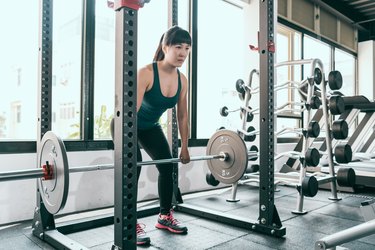
The Smith machine gets a lot of flack for making lifts easier, but there's a time and place for it, especially for strength-training newbies and those looking to really hone in on certain muscles.
"One of the biggest differences between free weights and the Smith machine is that on top of working your prime movers — larger muscles like quads, hamstrings, glutes, pecs, lats, delts, etc. — free weights also require you to use your small stabilizers in order to maintain balance throughout the lift," says Lauren Pak, CPT, co-owner of Jason and Lauren Pak and co-host of the podcast Reasonably Fit.
Video of the Day
Video of the Day
When it comes down to it, there are a few reasons lifting with free weights, such as dumbbells, kettlebells and barbells, is better than lifting with the Smith machine — and vice versa. Here are the key differences between free weights and the Smith machine, plus the pros and cons of using each tool for certain exercises.
4 Differences Between Free Weights and the Smith Machine
1. Free Weights Are More Functional
Free weights make lifts more functional because they mimic movements you make in everyday life.
"You need to be able to balance, so working your small stabilizer muscles during your workouts will have great carryover into activities of daily living," Pak explains.
Because the Smith machine stabilizes the weight for you, your main movers are still working hard, but the small stabilizers that often assist in a lift no longer need to contribute, she says.
"This can allow you to lift a little more weight and/or perform more reps because you don't have the added element of balance to make the movement more challenging."
The Smith machine also makes the weight lighter. For example, the standard barbell weighs 45 pounds, but the Smith machine reduces the weight by 10, 15 or 20 pounds; it's impossible to know the exact amount.
2. The Smith Machine Targets Prime Muscles
When you take the balance work out of the equation, you can really hammer on the brute strength work.
"Because you're isolating certain muscle groups and there are safety features built into the Smith machine, quite often you can lift a little bit more," says Tony Horton, CPT, creator of Power Life.
This means you'll need to be intentional about working your stabilizers into your routine, Pak says. Training them to work with your bigger muscles will help your body move more efficiently and avoid injury.
You'll engage your smaller stabilizers when you're lifting without a machine, and when you're lifting things in real life or playing sports.
3. Free Weights Allow You to Move More Naturally
"When you're lifting with free weights, you're able to maneuver the weights in the most natural pattern for your body," Pak says. "There are so many anatomical variations that cause individuals to squat, hinge, lunge, push and pull slightly differently. Free weights allow you to find the angles that feel best to you based on your individual anatomy."
The Smith machine, on the other hand, forces you to lift along a fixed vertical path.
"You have to make your body conform to the pre-set pattern of the machine versus being able to find your most natural movement pattern," Pak says.
This is part of what makes the machine great at targeting the main muscles that power each lift. But the downside is that it can force you to move in ways that don't work with your unique anatomy or flexibility restrictions — leading to potential discomfort or even injury.
4. The Smith Machine Is Helpful for Beginners
Generally, the Smith machine can be helpful for beginner lifters who have never handled a barbell before, Horton says. In this case, its limitations are its strengths: Lifting along a set track removes balance and stability work and makes it a bit easier to execute the exercise.
The machine is also self-spotting for doing overhead lifts, which can be useful for beginners and advanced lifters, Horton adds.
Horton recommends making sure you're very familiar with the latching mechanism first so you don't have any issues when you need to re-latch the weight on quickly.
"Your hands have to do quite a bit of work to pull it off and click it back on," he says. Ask a gym employee to teach you how to do it right, and then practice before you do any lifting.
Smith Machine vs. Free Weights Benefits
Free Weights | Smith Machine |
|---|---|
Translate to everyday activities | Targets prime muscles |
Work prime muscles and stabilizers | Built-in self-spotter |
Allow for natural movement | Lightens the load on lifts |
More accessible | Great for beginner lifters |
Warning
You should only lift what you're capable of, Horton says. "Don't be fooled into thinking that because you're using a Smith machine you can suddenly lift a bunch of weight and keep pushing the envelope. You can still get hurt."
As with any other type of lifting, start light and slowly progress to heavier weights only when your current weight feels too easy, aka when you can bang out all your reps and still have a bunch more left in you.
Free Weight Bench Press vs. Smith Machine Bench Press
Free Weight Pros
"The bar path can curve slightly, which is typically recommended from a powerlifting and shoulder health perspective in order to get the most out of the movement," Pak says.
The freedom of movement in the regular bench press also means your muscles need to stabilize the weight so you can't press the weight up with abandon like you can with the Smith machine.
Free Weight Cons
While a regular barbell bench press allows you to move however you want, it's also slightly more dangerous than a Smith machine.
On the sides of a Smith machine are hooks you can slide the barbell into. If you're struggling during a rep and you think you're going to fail, you can simply lock the bar in place and be unharmed (assuming you know how to do this). In a regular bench press, you need to have a spotter if you are attempting a weight you're unsure about.
Smith Machine Pros
"If you don't have a spotter, the Smith machine is a good option for heavy bench pressing without the risk of getting stuck under the bar," Pak says.
Smith Machine Cons
"The bar path has to move directly straight up and down (not forward or backward), which can cause some discomfort in the shoulder joint and is a weaker path in general," Pak says.
So you need to position your body so the bar will be able to touch the lower half of your chest at the bottom of the lift.
You also lose some of the power of the move when the bar travels on a fixed plane in the Smith press. The bench press motion of pushing the weight back up actually gives you momentum and allows you to use your shoulder and chest muscles a little more.
While some people can often lift more on the Smith bench press versus free weights, the benefits and movement patterns don't translate well when using free weights.
When benching with free weights, some of the small muscles around your shoulder joint, such as the rotator cuff, are required to stabilize the bar. Because the Smith machine does this for you, your internal rotators don't develop properly and you'll have trouble stabilizing the bar when moving to free weights, setting yourself up for injury.
Instead of figuring out how to convert the Smith machine to free weights, lift free weights and you never have to wonder. The weights on Smith machines vary, but gravity is constant.
Bench Press
Free Weights | Smith Machine | |
|---|---|---|
Pros | Freedom of movement, protect shoulder health, work stability | Allows you to lift heavy without a spotter |
Cons | High risk of injury without a spotter | Lack of freedom of movement, high risk of injury, loss of power |
Free Weight Squat vs. Smith Machine Squat
Free Weight Squat Pros
Squatting with free weights is super functional. "You have to use your stabilizers to balance, which carries over into everyday activities and aids in injury prevention," Pak says.
A barbell or another free weight squat also recruits more muscles in your legs than any stance in the Smith machine. This is particularly important when squatting because activating your hamstrings helps protect the patella tendon (which attaches the bottom of your kneecap to the top of your shinbone) when you flex your quads.
Free Weight Squat Cons
There really aren't many. One minor one to consider: "You may not be able to lift quite as heavy as you could with the Smith machine," Pak says.
Smith Machine Squat Pros
You can play with foot placement to target muscles a little differently, Horton says.
"You want to make sure your feet are between shoulder- and hip-distance apart, but you can adjust your feet forward an inch or two to hit the quads and glutes a little bit differently."
This tweak will build your muscles in a different way, and you want to create as much variety in squatting as possible, he adds.
Smith Machine Squat Cons
You lose out on the stability benefits of free-weight squats, Pak says. This can lead to joint instability, which puts you at high risk for injury.
The fixed position of the barbell on the machine requires you to either push your knees forward while your hamstrings are deactivated, risking your knees, or lean forward, increasing the shearing force on your lower back.
Squat
Free Weights | Smith Machine | |
|---|---|---|
Pros | Functional for everyday activities, recruit leg muscles, protect your knees | Works your glutes and quads, flexibility with foot placement |
Cons | Might not be able to lift heavy | Loss of stability benefits, risk of knee and lower back injury |
Free Weight Shoulder Press vs. Smith Machine Shoulder Press
Free Weight Shoulder Press Pros
An overhead press targets your shoulders, particularly the deltoids, and triceps. The exercise also involves several secondary back muscles that work as stabilizers, including your trapezius, latissimus dorsi and rhomboids.
Using free weights will stimulate these back muscles even more than the Smith machine because you must hold the weights in a fixed plane without the machine's assistance. This will also provide stability benefits for your shoulders, Pak says.
Moreover, doing a standing shoulder press allows you to create more total-body tension and will help you to lift more weight overhead, Pak says.
Free Weight Shoulder Press Cons
"Because of the higher stability demand, there is more room for error, and the risk of dropping the weights or your form deteriorating is higher," Pak says.
In particular, Horton notes anytime you're standing up and pressing weight overhead, you run the risk of putting a lot of pressure on your spine if your core and glutes aren't properly engaged. This makes it even more important to make sure you're not lifting too heavy and following proper form.
Smith Machine Shoulder Press Pros
The fixed nature of the barbell makes lifting heavier weights easier to control than dumbbells or a barbell. You could do a Smith press, especially if you are trying to lift very heavy weight, without a spotter.
Smith Machine Shoulder Press Cons
There aren't many overhead press alternatives you can do on the Smith machine.
"You can only perform the overhead press from a seated or kneeling position, which makes it much more challenging to generate total-body tension and therefore won't allow you to lift as heavy as you could while standing with free weights," Pak says.
Shoulder Press
Free Weights | Smith Machine | |
|---|---|---|
Pros | Activate back muscles, build shoulder stability, create total-body tension in standing variation | Better control of the weight in the overhead position, allows you to lift heavy without a spotter |
Cons | A higher risk of form mistakes and injury, more difficult to use properly | Limited options for variations of the exercise |
Free Weight Deadlift vs. Smith Machine Deadlift
Free Weight Deadlift Pros
Similarly to a squat, a deadlift is a compound movement that recruits several stabilizer muscles that support the spine, in addition to the big movers (glutes and hamstrings).
Many lifters use heavy weight for deadlifts, so it's important to be able to continue progressing. You can deadlift with dumbbells or a barbell, which will allow you to add almost endless amounts of weight. Using free weights also makes it easy to bail — aka drop the weight — if you need to mid-lift. Just make sure your toes aren't directly underneath.
Free Weight Deadlift Cons
You'd be hard-pressed to find any cons. The deadlift is a classic strength move that benefits casual lifters and powerlifters alike.
Smith Machine Deadlift Pros
Because the deadlift involves moving weight almost directly up and down, form with a barbell versus a Smith machine isn't very different, Horton says. You're moving in a fixed path either way. Unlike other Smith machine exercises, the forced vertical path is more natural with this move.
With the Smith machine, you can re-rack the bar without having to fully lower it down for the last rep. But because the deadlift doesn't really require a spotter — if it's too heavy, you can drop it on the floor without worrying about crushing your body — there aren't really any pros to using it.
Smith Machine Deadlift Cons
Usually, a deadlift starts by picking up a heavy barbell or dumbbells from the floor. With the Smith machine, you have to start with the weight in the air when you unrack it.
"Unlike picking it up off the ground, here you're picking it up at the finish point," Horton says. "You have to be prepared when it comes off the hooks to get ready to drop the weight down to the ground and back up again." This can feel awkward and potentially throw off your form.
Deadlift
Free Weights | Smith Machine | |
|---|---|---|
Pros | Recruit all major muscle groups, including hips, legs, core, and back; easy to progress | Supports a fixed movement pattern |
Cons | None | Different starting position may throw off your form |
- Journal of Strength and Conditioning Research: Comparison of Muscle Force Production Using the Smith Machine and Free Weights for Bench Press and Squat Exercises
- Journal of Strength and Conditioning Research: A Comparison of Free Weight Squat to Smith Machine Squat Using Electromyography
- American Journal of Sports Medicine: Flexion-Distraction Injury of the Thoracolumbar Spine During Squat Exercise with the Smith Machine
Was this article helpful?
150 Characters Max
0/150
Thank you for sharing!
Thank you for your feedback!