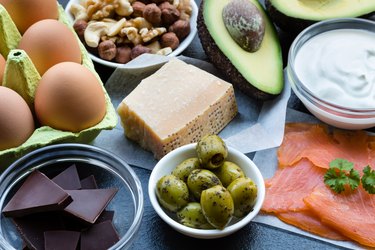
When it comes to dietary fat, there are two things most of us can agree on: From a flavor perspective, it's pretty delicious; but on the nutritional side, it can be kind of confusing.
While some people still swear by low-fat diets, others insist that you should be eating almost nothing but fat including plenty of butter, bacon and cream (hello, keto diet). So who's right?
Video of the Day
Video of the Day
Turns out, the answer falls somewhere in the middle. Here's what you should know about dietary fat, how it can affect your body and your weight and how to strike a healthy balance in your diet.
What Is Fat and Why Is it Important?
Along with carbohydrates and protein, dietary fat is a type of macronutrient. It's an important source of energy, and our cells use it to function properly. It's also key for helping the body absorb fat-soluble vitamins A, D, E, and K as well as keeping our skin and hair healthy.
Basically, you need some fat in your diet. But certain kinds are better for you than others. And even when it comes to healthy fats, it's possible to get too much.
Our bodies need fat to function. When you eat fat, your digestive tract breaks it down into fatty acids that get taken up by cells throughout your body. At that point, the fatty acids can be burned for energy right away or they can be stored as an energy source for later, explains Georgie Fear, RD, author of Lean Habits for Lifelong Weight Loss.
The fats you eat equip your body with essential fatty acids including linoleic and linolenic acid, which aid in brain development, controlling inflammation and blood clotting, according to the U.S. National Library of Medicine. These fats are classified as essential because our bodies can't produce them on their own.
So, if fat is necessary for our bodies to function, why is it often vilified?
The problem occurs when the body stores too much fat as a future energy source, which can happen when we eat more than we need. And that can be pretty easy to do. "Fat has the highest calorie load per gram of food at 9 calories per gram, compared with carbs and protein, which contain 4 calories per gram each," says Sarah Pflugradt, RD.
But, just because fat is calorie-dense, that doesn't mean we should steer clear. Choosing the right types of fat is essential in maintaining a healthy diet and weight.
Related Reading
What Are the Different Types of Fat?
We all need some fat in our diets — but certain types of fats are worth eating more often than others.
"The basic message on fats should be to learn the difference between which fats are good for your body, which should be limited and which to avoid completely," Pflugradt says.
Healthy Fats
Unsaturated fats are considered healthy fats (aka, the best type of fat) and should be a part of your daily diet. These consist of:
Monounsaturated fats (MUFAs): A type of unsaturated fat that can help protect your heart and blood vessel health, lower bad (LDL) cholesterol and promote healthy levels of good (HDL) cholesterol, as well as help control blood sugar.
Higher MUFA intake paired with lower saturated fat intake is tied to a lower risk for heart disease and other major causes of death, a July 2017 study in Circulation shows.
Olive oil and olives, canola oil, nuts and nut butters and avocado are all great sources of MUFAs. Diets like the "ketotarian diet" focus on eating mostly plant-based fats.
Monounsaturated fats are made up of a chain of carbon with one pair of carbon molecules joined by a double bond. The more double bonds there are, the more solid the fat will be. Monounsaturated fats are generally liquid at room temperature, but turn slightly solid when chilled, per the AHA.
Polyunsaturated fats (PUFAs): Another type of unsaturated fat linked to heart health. The July 2017 study also found that replacing saturated fat with polyunsaturated fat reduced heart disease risk by around 30 percent, which is about the same as statins.
Walnuts, sunflower seeds, flaxseeds, safflower oil and fatty fish are all great sources of PUFAs. Omega-3 and omega-6 fatty acids are special types of PUFAs that your body can't produce. They're beneficial for heart and brain health, and have also been linked to lower rates of inflammation and depression.
You can find them in fatty fish like salmon, tuna, sardines, herring and anchovies, along with flaxseeds, walnuts and chia seeds.
Polyunsaturated fats have two or more double bonds between carbon atoms in the carbon chain backbone of the fat, per Harvard Health Publishing. They are more solid than monounsaturated fats but less so than saturated fats. This makes polyunsaturated fats also liquid at room temperature.
Polyunsaturated Fats vs. Monounsaturated Fats
Both types of fat have distinct health benefits. There is evidence that both types reduce LDL cholesterol levels in the blood when included in a diet low in saturated and trans fats, according to the AHA. This helps lower the risk of heart disease and stroke.
Monounsaturated fats have the added benefit of being high in vitamin E, an antioxidant nutrient, per the AHA.
Fats to Limit
Saturated fats: Saturated fats are solid at room temperature. Although experts long thought that saturated fat increased the risk for heart disease, a June 2018 study in the BMJ highlights the lack of evidence that concludes saturated fat increases the risk of heart disease — on the flip side, there's more solid evidence that replacing saturated fat with polyunsaturated fat can reduce the risk of heart disease.
"We know that saturated fat doesn't do wonders for our cholesterol and has the potential to raise bad cholesterol. That's why we should limit it," Pflugradt says. Red meat, full-fat dairy, palm and coconut oils are all high in saturated fats.
Fats to Avoid
Trans fats: Trans fats are the worst type of fat and should be avoided at all costs. Man-made trans fats are produced by heating liquid vegetable oils with hydrogen gas, a process called hydrogenation, in order to make them more spreadable.
You'll find them in fried foods, baked goods, packaged snacks, vegetable shortening and margarine.
These man-made fats can be spotted in ingredient lists as partially hydrogenated oil, they're actually banned in the U.S. Naturally occurring trans fats can be found in small quantities in ruminant animals and their products (such as milk and cheese).
Trans fats are known to increase the risk of heart attack, stroke and type 2 diabetes as well as raise bad LDL cholesterol and lower good HDL cholesterol, according to the Harvard School of Public Health.
So, Does Eating Fat Make You Gain Fat?

You are just as likely to lose weight and keep it off by including moderate amounts of healthy fats in your diet.
Getting the right amount of fat doesn't just make it easier to maintain a healthy weight — if you're looking to drop pounds, it might actually help.
Remember, fat keeps you full longer, so cutting it out will likely backfire. It also makes food taste more delicious, making your meals more enjoyable overall. (Just think of the difference between a dry salad and a salad drizzled with an olive oil vinaigrette!)
"Cutting fat out of the diet often leads to an increased intake of processed carbs, sugars and salt."
Eating dietary fat may also nix the urge to snack shortly after your meal. Because fat slows the entry of glucose into the bloodstream and moderates blood sugar levels, it helps stave off the blood sugar spikes and crashes that can trigger the urge to scarf down a sleeve of cookies or a bag of chips. And that could lead to fewer calories eaten overall.
What's more, eating fat might help you burn fat. A November 2018 study in The BMJ journal found that adults with overweight on a higher-fat, lower-carb diet burned 209 to 278 more calories per day compared to those on a high-carb, low-fat diet.
Still think that going low-fat or fat-free is the best move for your weight or health? Consider this: Adult obesity rates have doubled since the low-fat craze of the 1980s and 1990s, while childhood obesity rates have increased more than three-fold, according to the Centers For Disease Control and Prevention (CDC).
Low-fat diets may not be the cause of the obesity epidemic, but the research surely points to an association. What's more, a December 2015 meta-analysis of more than 50 studies in The Lancet Diabetes & Endocrinology found that low-fat diets are rarely successful for weight loss.
"Cutting fat out of the diet often leads to an increased intake of processed carbs, sugars and salt," Pflugradt points out. That's problematic because fat is more satisfying than refined carbs — it keeps you fuller for longer and helps promote stable blood sugar levels. Cutting back, as a result, could drive you to eat more throughout the day.
"A high-carb, low-fat diet is a recipe for spiking blood sugar, which may increase your risk for weight gain and diabetes down the road," Fear says. High-fiber, unprocessed carb foods tend to work better for balancing blood sugar levels.
But you can gain weight from eating more calories than you burn, as any calories (from fat, carbs or protein) that your body doesn't need for energy ultimately get stored as fat. And because high-fat foods are more calorie-dense, they can be easier to overeat, Fear says.
That's why it's important to enjoy them in moderation: Think a handful of nuts for a snack, a tablespoon of olive oil on a salad or a quarter of an avocado on a sandwich.
Tip
Check food labels to ensure you're avoiding foods packed with saturated or trans fats. Get less than 10 percent of your daily calories from saturated fats and replace them with unsaturated fats whenever possible. Eliminate trans fats from your diet.
How Many Grams of Fat Per Day
Fat is good as long as you don't overdo it. Current dietary guidelines recommend getting 20 to 35 percent of your total calories from fat.
"For most women, that looks like approximately 15 grams of fat per meal, and 20 grams for men," Fear says. As for saturated fat? It should only account for around 10 percent or less of your total calories.
The key is swapping saturated fat-rich foods for ones that contain mostly unsaturated fats — like using avocado in your sandwich instead of cheese. Replacing saturated fats with foods high in refined carbs — like having fat-free chocolate milk instead of whole milk — won't improve your health.
In fact, replacing saturated fat with refined carbs may increase the risk for heart disease and even diabetes, according to the Harvard School of Public Health.
Tip
In short, it’s a good idea to have some fat at every meal, every day. Most of it should come from unsaturated sources, but small amounts of saturated-fat-rich foods are perfectly fine. “I always like to say that you should choose your vices carefully,” Pflugradt says.
“If you have foods high in saturated fat that you like to use every day like butter, heavy cream or coconut oil, just be aware of how many other saturated fat-rich foods you might be eating and adjust accordingly.”