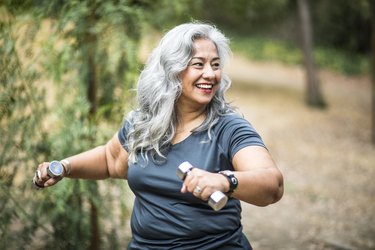
As you get older, your muscle mass naturally decreases, but this doesn't mean you can't rebuild your aging muscles. While the process of bulking up looks different for a 70-year-old versus, say, a 30-year-old (hint: for seniors, regular, progressive weight training is key), it's entirely possible for older adults to get bigger and stronger. Win the battle against age-related muscle loss by doing progressive resistance training, eating a healthy diet and being consistent about both.
Read more: Exercises for Senior Citizens
Video of the Day
Video of the Day
Why Your Muscles Decrease With Age
Everyone's aging process looks a little different; there's even variation when people reach advanced ages. Regardless of how you age, however, diminishing strength and muscle loss are common bodily changes, even if you exercise regularly. There's good news, though: Muscle loss and loss of strength can be slowed considerably simply by changing your fitness plan and level of activity.
According to a 2016 article published in the New York Times, skeletal muscles are composed of different fibers, and these fibers can die off with aging, becoming more sedentary and doing fewer high-intensity forms of exercise. In fact, according to Dr. Marcas Bamman, director of the UAB Center for Exercise Medicine at the University of Alabama in Birmingham, sedentary adults can lose 30 to 40 percent of their muscle fibers by the time they reach 80. While you can't add to the number of fibers you have, you can increase lean muscle tissue and strength capacity, at virtually any age, through weight training.
Building Muscle After 70
If you want to successfully build aging muscles, it's crucial to focus on age-specific exercise for seniors over 70. Strength training is one of the most important interventions against muscle loss, according to Harvard Health Publishing. To effectively build muscle, you'll need to do regular, challenging (but not stressful) strength-building exercises.
Introduce weights and machines into your fitness regimen if you haven't already, and, as recommended in a 2011 news release from the University of Michigan Health System, published by ScienceDaily, try to incorporate full-body exercises and exercises that use more than one muscle group and joint at a time (for example, the chest press and leg press).
According to Dr. Mark Peterson (a research fellow at the University of Michigan Physical Activity and Exercise Intervention Research Lab), "You should also keep in mind the need for increased resistance and intensity of your training to continue building muscle mass and strength."
One excellent way to ensure you're continuing to build your strength is by hiring a personal trainer to help you come up with a customized fitness plan and provide adjustments based on your progress. This way, you can be sure that you're doing the right type of resistance training that's necessary to build strength and minimize muscle loss as you age.
Read more: Exercises for People Over 70
Lifestyle and Diet Plan for Seniors
Weight training over 70 years old is important, but diet and lifestyle both play a big role as well. As you're upping your weight training and building muscle after 70, high-grade dietary protein, colorful fruits and veggies, and a moderate amount of healthy fats (nuts, seeds, olive oil, avocado) should all be part of your diet. Reducing your sedentary behavior and engaging in regular cardio (brisk walking, jogging, swimming or biking) can also help you stay strong and healthy in the long run.