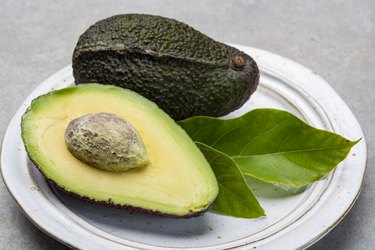
There's no denying that Hass avocados, also often referred to as California avocados, are rich, creamy, nutritious and delicious. However, it's also true that avocados are higher in calories than some other fruit, meaning they need to be enjoyed in moderation.
Hass Avocado Calories
Video of the Day
One Hass avocado that weighs around 136 grams without any skin or seeds contains about 227 calories, according to the USDA. The Hass avocado calories might seem high, but a suggested serving is about a quarter of an avocado, says the Dietitians Association of Australia, and that equals a very reasonable 56 calories per serving — just the right amount to spread across the top of a slice of toast.
Video of the Day
The number of calories in avocado seems high because of its fat content. Each gram of fat contains 9 calories, compared to the 4 calories in each gram of protein and carbohydrates, according to the Cleveland Clinic.
However, the Hass avocado calories come from healthy monounsaturated fat, which helps to lower bad cholesterol and promote healthy levels of good cholesterol in your body, according to the Academy of Nutrition and Dietetics. It also protects your heart and blood vessel health, and helps control blood sugar.
Read more: 18 Fat-Rich Foods That Are Good For You
Discovering Hass Avocado Nutrition
Not only are Hass avocados a rich source of monounsaturated fats, they're also packed with fiber. Most people fall short in reaching the recommended daily amount of 25 grams of fiber, according to Cedars-Sinai Hospital, but avocados contain about 1 gram per tablespoon of creamy fruit.
In March 2018, the American Journal of Clinical Nutrition published an umbrella review of meta-analyses that looked at how dietary fiber consumption affects a person's health. Six out of 21 analyses determined that fiber has a significant positive effect on cardiovascular disease, coronary artery disease, pancreatic cancer and gastric cancer.
Hass avocado nutrition data also includes a significant amount of vitamins and minerals, including vitamins B2, B3, B5, B6, C, E and K, and folate, magnesium and potassium. The fat in avocados helps your body better absorb some of these vitamins, including E and K, which are known as 'fat-soluble' vitamins.
Of course, you can't overlook an avocado's antioxidant content either — something that is indicated by the bright green hue of the fruit's flesh, which comes from chlorophyll, notes the Dietitians Association of Australia.
A study published in 2016 in Advanced Neurobiology reviewed how avocado's phytochemicals could play a role in preventing neurodegenerative disease. The study's authors concluded that the fruit's significant array of bioactive nutrients could, in fact, play a pivotal role in preventing diseases such as Parkinson's and Alzheimer's.
Read more: 8 Cool Things You Can Do With Avocados
How to Enjoy Avocado
When you pick out a Hass avocado in the grocery store, it probably won't be ripe yet. Harvard Health Publishing recommends putting the avocado in a paper bag with an apple or banana for two to three days to ripen.
Once it's ripe, cut the avocado in half and remove the stone in the middle. Scoop the green flesh out and mash it up, adding a teaspoon or two of lime juice, plus salt and pepper. Spread the avocado on a piece of wholegrain toast for a trendy, nutritious treat.
- USDA: "Avocados, Raw, California"
- Cleveland Clinic: "Fat and Calories"
- Academy of Nutrition and Dietetics: "Choose Healthy Fats"
- American Institute for Cancer Research: "AICR HealthTalk"
- Cedars Sinai: "In Case You Need a Reason to Eat More Avocado"
- American Journal of Clinical Nutrition: "Dietary Fiber and Health Outcomes: An Umbrella Review of Systematic Reviews and Meta-Analyses"
- Dietitians Association of Australia: "Fast Facts: All About Avocados"
- Advanced Neurobiology: "Avocado as a Major Dietary Source of Antioxidants and Its Preventive Role in Neurodegenerative Diseases"
- Harvard Health Publishing: "Vegetable of the Month: Avocado"