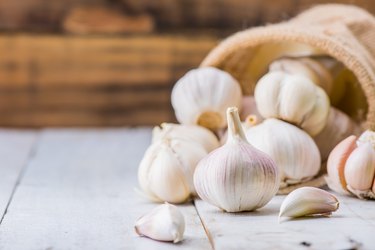
A little bit of garlic goes a long way when it comes to adding flavor to food. But garlic's benefits go well beyond seasoning: It contains powerful antioxidants and compounds that deliver major health perks.
Overall, garlic may have positive effects on your heart health, immunity and much more. Read on for a breakdown of the legitimate reasons you should add garlic to your diet, as well as the unproven claims you're better off ignoring.
Video of the Day
Video of the Day
Warning
If you suffer from reflux or indigestion, or if you're taking blood-thinning medications, talk to your doctor about how garlic might affect you.
3 Health Benefits of Garlic With Strong Evidence
1. Has Anti-Inflammatory Properties
Thanks to its powerful antioxidants and sulfur compounds, garlic may help reduce inflammation and protect your cells against aging, oxidative stress and damage.
Allicin is an organosulfur compound found in garlic. Many preclinical studies have found that organosulfur compounds from garlic could have anti-inflammatory properties, per the Oregon State University Linus Pauling Institute Micronutrient Information Center. That's especially important because chronic inflammation seems to be the underlying cause of many major degenerative diseases, including heart disease, rheumatoid arthritis, Parkinson's and Alzheimer's, according to Harvard Health Publishing.
If you suffer from an inflammatory condition, you may want to make the most of raw garlic's benefits. Garlic had an anti-inflammatory effect, with raw garlic exhibiting a stronger effect than garlic that had been heated, in an August 2013 study in Food and Chemical Toxicology. The levels of allicin were also higher in the raw garlic, which is most likely the reason for its greater benefits.
2. Linked to Heart Health
If you want to keep your ticker in tip-top shape, start seasoning your meals with garlic. It's associated with reduced blood pressure, which is in turn linked to a lower risk of heart disease and stroke.
What's more, garlic has been reported to decrease unstable angina (lack of blood flow and oxygen to the heart), increase the elasticity of blood vessels, reduce peripheral arterial occlusive disease (lack of blood flow to the limbs) and slow the progression of calcium buildup in the arteries of people taking cholesterol-lowering medications, per a landmark March 2006 review in The Journal of Nutrition, which is still among the most comprehensive on the topic. That said, the number of trials in these areas is limited.
"Evidence from clinical trials points toward garlic having a role to play in either preventing or delaying cardiovascular disease," write the authors of the review. "However, more research is still required to convince health workers, consumers, and regulatory bodies." (It's worth noting that the guest editors of this review were associated with a supplement company that sells garlic extract. Experts and medical organizations don't widely recommend garlic supplements.)
While research has shown that garlic has anti-inflammatory properties that can also help lower cholesterol, blood pressure and blood sugar, the effects are typically observed with very high doses of garlic powder — not necessarily the amount of garlic you might put in your stir-fry, per the American Heart Association.
Still, it's a common ingredient in heart-healthy diets like the Mediterranean diet, and it can give your dishes a flavorful kick in lieu of salt.
Some limited research has also found that garlic powder may have antithrombotic effects, meaning it could play a role in preventing blood clots, per an older but frequently referenced January 2007 study in Bioscience, Biotechnology, and Biochemistry.
This leads to a common question: Does eating garlic actually make your blood thinner? Maybe, but only temporarily and slightly, per an older but frequently cited March 2001 review in JAMA Internal Medicine.
That said, because garlic supplements are typically more concentrated than the amount of garlic you eat, supplements may increase the risk of bleeding and thin the blood like aspirin. Because of this, it's especially important to tell your doctor if you're taking or plan to take garlic supplements if you are on a blood thinner like warfarin or need surgery, per the National Institutes of Health. Garlic supplements and warfarin could be a risky combination.
3. Can Support Your Liver
Your liver is found below your rib cage on the right side of your body, and it's key for digesting food and eliminating toxic substances, per the Mayo Clinic. But why is garlic good for liver health? Garlic can activate liver enzymes that help your body flush out toxins naturally, per Fisher-Titus Medical Center, a hospital in Ohio.
In general, eating a balanced diet that limits high-calorie meals, saturated fat, sugars and refined carbohydrates can keep your liver healthy, per the American Liver Foundation. (That may involve eating garlic daily if you're getting a wide range of vegetables and fruits.)
As for a specific link between garlic and fatty liver disease: Garlic powder supplements appeared to help decrease body weight and fat in people with fatty liver disease, per a January 2016 study in Advanced Biomedical Research. But most experts don't recommend garlic supplements for the majority of people.
(As a side note, garlic body odor may be a sign of liver disease, and a reason to check in with your doctor.)
4 Health Benefits of Garlic With Some Evidence
1. Associated With Better Immunity
There's some limited evidence that garlic acts as a natural germ-fighter and can help keep you from catching a cold or reduce the severity of one.
For example, research in the June 2012 issue of Clinical Nutrition found that aged garlic extract is associated with bolstered immune cell function and, subsequently, slashing the length of a cold. However, keep in mind that garlic extract is much more concentrated than raw garlic, so the effects can't necessarily be applied to eating garlic.
There aren't many other current studies in this area. One older paper, a randomized, double-blind, placebo-controlled study of 146 people from the July-August 2001 issue of Advances in Therapy, found that a daily garlic supplement over 12 weeks reduced the number of colds by more than 60 percent compared to a placebo.
However, a November 2014 review in the Cochrane Database of Systematic Reviews concluded that the evidence for garlic's effect on colds is insufficient and more research needs to be done.
2. Could Potentially Help With Acne
Because garlic has anti-inflammatory and antibacterial properties, it makes sense that it would help clear up skin, and indeed, the Cleveland Clinic notes that it has the power to kill acne-causing bacteria. But there hasn't been any research done on garlic for pimples, specifically, so it's not possible to say whether this home remedy is actually effective.
Plus, applying garlic directly to your skin may cause irritation like contact dermatitis, per a January 2011 report in Dermatology Reports.
3. Tied to Cancer Prevention
Garlic's anti-cancer activity appears to come from its organosulfur compounds, per Oregon State University. In fact, garlic has been linked to lower rates of gastrointestinal tract cancers thanks to its sulfur-containing compounds, according to a March 2015 review in Cancer Prevention Research. Sulfur comprises about 1 percent of the dry weight of garlic.
Eating raw garlic seems to be particularly helpful: People who ate raw garlic at least twice a week had lower rates of lung cancer than those who ate it less often, per another July 2013 study in Cancer Prevention Research.
Tip
To get the biggest benefit, chop, slice or crush fresh garlic before eating it. This helps activate compounds like allicin and make them more potent.
4. Shows Potential to Help Gastritis
Garlic extract significantly helped with symptoms of gastritis like hemorrhagic spots in gerbils, per an August 2014 study in the World Journal of Gastroenterology. Of course, those results do not necessarily apply to humans, and more research is needed to determine clinical uses of garlic in gastritis treatment.
Though some people recommend garlic and honey for stomach ulcers or to treat inflammation of the stomach lining (some research shows garlic may help with ulcers in rats, per a July 2016 study in Nutrition), these home remedies are not widely accepted by the medical community. The most commonly prescribed treatments for these ailments include antibiotics, antacids, histamine blockers and proton pump inhibitors, per the Cleveland Clinic.
Still, garlic may play a role in prevention: Foods that contain flavonoids like garlic may stop the growth of H. pylori, bacteria that can cause gastritis, per Mount Sinai.
Is Garlic Powder OK for GERD?
Many foods can trigger acid reflux or gastroesophageal reflux disease (GERD), per One Medical. Garlic is one of them, but its dehydrated version may be less irritating for your stomach and less likely to cause reflux. If garlic powder causes issues for you, though, try parsley, basil or dill for flavor instead.
5 Unproven Claims About Garlic
Despite what you may have heard, garlic isn't proven to be effective against the following:
1. HPV
HPV, or human papillomavirus, is the most common sexually transmitted infection nationwide, per the Centers for Disease Control and Prevention (CDC). Keep in mind that it is different from HIV or HSV (herpes). Many HPV infections occur in people in their late teens or early 20s. HPV often goes away on its own, but when it doesn't, it can potentially cause genital warts and cancer. The virus can also cause plantar warts on your feet that last a year or two, per the Mayo Clinic.
Garlic extract helped remove warts (similar to cryotherapy) after two months in a small February 2018 study of men with genital warts in Dermatologica Sinica. Still, it's best not to rely on garlic for warts or to help sexually transmitted infections go away — although garlic has antiviral properties, it does not cure STIs like HPV or serve as a guaranteed natural wart removal.
Instead, protect yourself against HPV and its health issues by doing the following, per the CDC:
- Getting vaccinated: The HPV vaccine is typically given at age 11 or 12 and is encouraged for anyone through age 26, per the CDC. Some adults ages 27 to 45 may also get the vaccine if their doctor recommends it.
- Getting screened for cervical cancer routinely
- Using latex condoms correctly every time you have sex
Being in a mutually monogamous relationship is also associated with a lower risk.
2. Cold Sores
Although garlic is considered generally antiviral, there's not enough evidence to say with certainty that garlic will kill herpes virus loads that cause cold sores.
Instead of relying on garlic for cold sores — or more specifically, garlic for herpes simplex virus, which causes cold sores — try other widely accepted home remedies to soothe your pain.
Strategies like using a cold and damp washcloth, ice or cold compress and petroleum jelly on the cold sore can reduce pain and swelling when used early, per Houston Methodist. They may even shorten the amount of time your cold sore hangs around.
3. Hemorrhoids
Hemorrhoids, also known as piles, are swollen veins in the lower rectum and anus, similar to varicose veins, per the Mayo Clinic. You should see a doctor if you're bleeding during bowel movements or your hemorrhoids don't improve after a week of care at home. Over-the-counter hemorrhoid cream, soaking regularly in a warm bath, eating high-fiber foods and taking pain relievers may help during this time.
So, what about home remedies like boiling water and garlic for piles? Some people recommend using garlic powder, minced garlic or even a whole garlic clove for hemorrhoids. These are not widely accepted remedies, though, and we don't know if they're effective or even safe.
Instead of using a garlic suppository or another garlic remedy for your hemorrhoids, try approved natural remedies such as a sitz bath, witch hazel, pure aloe vera and epsom salt with glycerin, per the Cleveland Clinic.
Similarly, avoid using garlic in the anus to treat pinworms or other parasites, and don't use it to relieve anal itching. Instead, see your doctor for the best solution to these issues.
4. Gout
Gout is a type of arthritis marked by sudden, severe attacks of pain, redness and swelling that often occur in the big toe, per the Mayo Clinic.
Some proponents claim that garlic helps treat gout, but there is no solid scientific evidence to support these claims.
That being said, garlic is known to be anti-inflammatory, and inflammation is a key feature of gout — so eating garlic may be good for gout and arthritis more generally. Garlic has diallyl disulfide, which is an anti-inflammatory compound that reduces the effects of pro-inflammatory cytokines, per the Arthritis Foundation.
It may help prevent cartilage damage from arthritis, but it's best to choose fresh garlic from the supermarket produce section, because bottled garlic may have preservatives that hamper its strength. Garlic oil for joint pain is not widely recommended by medical organizations.
5. Staph
Staphylococcus, or staph, is a group of bacteria that can cause skin and bone infections, endocarditis (inflammation of the heart), food poisoning, pneumonia and toxic shock syndrome, per the National Library of Medicine.
One older but often-cited December 2003 study in the Journal of Antimicrobial Chemotherapy found that garlic extract may have protective functions against MRSA, a type of staph infection that's resistant to many antibiotics, but the study was done in rodents, so we can't say for sure whether the results apply to humans.
Because garlic is antibacterial, it can be tempting to use garlic for skin infections or as one of the many natural antibiotics for staph that are rumored to be helpful. Applying garlic to skin infections is not recommended, though, because direct contact can cause irritation.
More widely accepted treatments for staph that are backed by the medical community include antibiotics (including the use of IV antibiotics like vancomycin or daptomycin for antibiotic-resistant MRSA strains) or wound drainage by your doctor, per the Mayo Clinic. In the meantime, you should keep the infected area clean and covered to avoid spreading the bacteria.
Risks and Warnings
As with anything else, taking garlic as a remedy for health woes comes with risks. Here's what to be aware of when you turn to garlic.
Garlic Detoxes Aren’t the Answer
Some may claim that you need a garlic cleanse or garlic detox to cleanse the body — or to cleanse your blood, more specifically. Or you may hear that a garlic alcohol detox is exactly what you need after one too many drinks.
But remember this: Your body does not need help to detox, because it detoxifies itself, per The University of Texas MD Anderson Cancer Center. Strict detox diets are dangerous because they can cause electrolyte imbalances, fatigue, diarrhea and vitamin and mineral deficiencies. If you think you need more or less of a specific nutrient or food, talk to your doctor or a registered dietitian.
That said, a balanced diet that includes (but is not solely limited to) foods like garlic, onions and eggs — aka foods that contain sulfur — can help your body's normal filtering process work efficiently, per Massachusetts General Hospital. Be sure to stay hydrated too, especially after exercise, to keep detoxifying organs like your kidneys working efficiently.
Supplements May Have Side Effects
It's best to get nutrients from food, not supplements. Garlic supplements can cause headaches, appetite loss, fatigue, muscle aches, dizziness and even allergic reactions like asthma attacks or skin rashes, per the Cleveland Clinic. Plus, taking a garlic supplement can increase the effect of blood thinners. Talk to your doctor before starting any new supplement.
Dosage
Eating one to two cloves of raw garlic daily is considered safe in adults, though you may experience side effects like bad breath and body odor, per a classic July 2005 report in American Family Physician, which is still among the most comprehensive of its kind. If you eat too much raw garlic on an empty stomach, it can cause stomach upset, gas and changes in your gut microbiota.
Like just about everything else, it's best to eat garlic in moderation. Try it in these delicious garlic recipes:
- The Journal of Nutrition: "Garlic and Cardiovascular Disease: A Critical Review"
- American Heart Association: "Sorting folklore from fact on the health benefits of garlic"
- Bioscience, Biotechnology, and Biochemistry: "Antithrombotic effects of odorless garlic powder both in vitro and in vivo"
- JAMA Internal Medicine: "Garlic Shows Promise for Improving Some Cardiovascular Risk Factors"
- National Institutes of Health: "Garlic"
- Clinical Nutrition: "Supplementation with aged garlic extract improves both NK and γδ-T cell function and reduces the severity of cold and flu symptoms: A randomized, double-blind, placebo-controlled nutrition intervention"
- Centers for Disease Control and Prevention: "Genital HPV Infection - Fact Sheet"
- Dermatologica Sinica: "A clinical study of efficacy of garlic extract versus cryotherapy in the treatment of male genital wart"
- Mayo Clinic: "Plantar warts"
- Oregon State University Linus Pauling Institute Micronutrient Information Center: "Garlic"
- Harvard Health Publishing: "Understanding acute and chronic inflammation"
- Food and Chemical Toxicology: "Short-term heating reduces the anti-inflammatory effects of fresh raw garlic extracts on the LPS-induced production of NO and pro-inflammatory cytokines by downregulating allicin activity in RAW 264.7 macrophages"
- Houston Methodist: "How Can I Get Rid of Cold Sores Quickly?"
- Cancer Prevention Research: "Garlic and onions: Their cancer prevention properties"
- Cancer Prevention Research: "Raw garlic consumption as a protective factor for lung cancer, a population-based case-control study in a Chinese population"
- Dermatology Reports: "Garlic in dermatology"
- Mayo Clinic: "Hemorrhoids"
- Cleveland Clinic: "7 Best and Worst Home Remedies for Your Hemorrhoids"
- Mayo Clinic: "Pinworm infection"
- Mayo Clinic: "Liver disease"
- Fisher-Titus Medical Center: "What Foods Cleanse Your Liver?"
- American Liver Foundation: "13 Ways to a Healthy Liver"
- Advanced Biomedical Research: "Effect of garlic powder consumption on body composition in patients with nonalcoholic fatty liver disease: A randomized, double-blind, placebo-controlled trial"
- Mayo Clinic: "Gout"
- Arthritis Foundation: "Best Spices for Arthritis"
- World Journal of Gastroenterology: "Medicinal plant activity on Helicobacter pylori related diseases"
- Nutrition: "Gastroprotective effect of garlic in indomethacin induced gastric ulcer in rats"
- Cleveland Clinic: "Gastritis"
- Mount Sinai: "Gastritis"
- One Medical: "Simple Food Swaps for 8 Heartburn Triggers"
- National Library of Medicine: "Staphylococcal Infections"
- Journal of Antimicrobial Chemotherapy: "Garlic extract and two diallyl sulphides inhibit methicillin-resistant Staphylococcus aureus infection in BALB/cA mice"
- Mayo Clinic: "Staph infections"
- The University of Texas MD Anderson Cancer Center: "4 detox myths: Get the facts"
- Massachusetts General Hospital: "How to Detox Your Body Naturally"
- Cleveland Clinic: "6 Surprising Ways Garlic Boosts Your Health"
- American Family Physician: "Health Effects of Garlic"
- Advances in Therapy: "Preventing the common cold with a garlic supplement: a double-blind, placebo-controlled survey"
- Cochrane Database of Systematic Reviews: "Garlic for the common cold"
- Centers for Disease Control and Prevention: "HPV Vaccine"
Is this an emergency? If you are experiencing serious medical symptoms, please see the National Library of Medicine’s list of signs you need emergency medical attention or call 911.