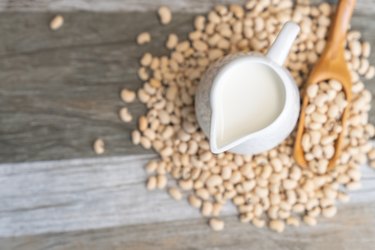
Soy and soy products are rich in isoflavones, or phytoestrogens. These so-called plant estrogens can affect your body similarly to regular estrogen, but at a much weaker level — or in some cases, they can counter estrogenic activity. Does that mean soy milk is bad for you?
The Confusion About Soy
Video of the Day
Soy's seemingly contradictory effects in your body may seem confusing, but brace yourself: They're backed by a broad body of research on soy and estrogen that is in and of itself contradictory at times, which in turn has led to some contradictory and confusing public statements.
Video of the Day
As explained in a Nutrition Source article from the Harvard T.H. Chan School of Public Health, part of the uncertainty around soy does come from its intricate effects on your body. It can both mimic the action of estrogen in your body, albeit at a weaker level, or in some cases it can block estrogen activity.
But the authors also observe that studies on soy are not standardized for key factors, including ethnicity of the subjects (which may affect their ability to metabolize soy), hormone levels (particularly in women) and animal versus human studies.
Ultimately, a good deal of the confusion comes from this variation in how studies are conducted. That lack of standardization muddies the waters and makes it even more difficult to make blanket statements about soy's effects on your body.
Some researchers also warn that although phytoestrogens tend to have much weaker effects on the body than your own estrogen hormones, supplements that are particularly rich in concentrated levels of soy isoflavones or soy protein can generate stronger effects. So the type of soy being studied can make a big difference — as can the natural variation in isoflavone content between various samples of the same soy product.
Tip
Did you know that you can get phytoestrogens from many other plants — not just soy? Although soy is particularly high in isoflavones (one type of phytoestrogen), Tulane University explains that you'll also find phytoestrogens in a number of other plant-based foods, including garlic, parsley, wheat, rice, beans, carrots, potatoes, apples, cherries, dates and the like. Even your coffee has phytoestrogens in it.
Here's another issue to consider: While the phytoestrogens in soy and other plant products can bind with both alpha and beta receptors of estrogen, they can also produce a number of biological effects without going through the estrogen receptors. Although soy and estrogen studies may be a primary point of interest, they're not the only pathway to understanding how this plant product acts on the human body.
With multiple mechanisms at work in a product that is often studied with contradictory methods, using nonstandardized soy derivatives, it's little wonder that the results can be contradictory and confusing.
However, more recent research and analyses of prior research suggest that soy milk and other soy-based foods may provide a number of health benefits.
Soy Milk and Estrogen
The effects of soy milk on estrogen and other hormones is a subject of ongoing scientific inquiry — but the greatest flurry of peer-reviewed research on this topic took place in the early 2000s.
One of the most useful analyses of research to date was published in a February 2019 issue of Open Access Macedonian Journal of Medical Sciences (OAMJMS). There, the authors recap some of the many positive effects that are now attributed to phytoestrogens, with soy being one of the best sources.
For those concerned about soy milk and estrogen or female hormones — one key effect of phytoestrogens is their ability to suppress menopausal symptoms while avoiding the health risks typically associated with hormone replacement therapy.
Soy was also found to be helpful in reducing total cholesterol; lowering blood pressure and improving heart function; inhibiting inflammation and encouraging weight loss; improving skin health; and reducing blood sugar levels.
As the authors of the OAMJMS article note, phytoestrogens are also understood to help reduce the risk of Alzheimer's disease. Data is still unclear on whether intake of phytoestrogens from soy is beneficial for bone health in women, with the subjects' age (and thus, presumably, their initial bone health status at the time of the study) playing an apparent role in the potential benefits.
It has even been theorized that perhaps the relatively low incidence of chronic disease in East Asian populations, when compared to Western populations, is due to the East Asians' higher consumption of soy products.
That's not to say that soy products are a magic bullet for anything that may ail you. One potential negative effect of phytoestrogens noted in the OAMJMS analysis: At least one soy isoflavone, genistein, may suppress immune system responses and inhibit the proliferation of a particular type of white blood cell. However, more study is needed to fully understand this mechanism.
Some experts continue to argue for more safety analysis before they provide an unreserved recommendation for consuming soy. For example, the authors of another analysis, published in the December 2014 issue of German Medical Science, take a more conservative stance about using soy in lieu of hormone replacement, warning that there have been reports of phytoestrogens creating adverse interactions with prescription drugs.
Your Metabolism Matters
There's more at work here than just the soy itself — your body also plays a role in what effects soy will have on it, and scientists are still unraveling exactly how that works.
One landmark piece of the puzzle in understanding soy's effects was an analysis published in the December 2002 issue of the Journal of Nutrition. There, researchers described a growing body of evidence that indicated that the body's ability to metabolize soybean isoflavones may determine the effectiveness of soy protein diets in treating or preventing hormone-dependent conditions.
The aforementioned February 2019 analysis in the OAMJMS elaborates on that point by noting that Japanese, Chinese and Korean people are significantly better than Western populations at metabolizing at least one major isoflavone of soy.
The authors observe that this is related to genetics, the composition of intestinal flora, and diet. Of particular note, the typical Asian diet tends to be many times richer in soy products than the typical European or American diet.
Another landmark study published in the Journal of Nutrition, this one in January 2006, found that gender also plays a role in how soy is metabolized, with women achieving higher peak serum levels of at least one soy isoflavone, daidzein. The subject pool for this study included a total of 59 healthy adults, fairly evenly divided between premenopausal women, postmenopausal women and men.
The same study also evaluated how three different soy foods were metabolized: soy milk, textured vegetable protein (also known as TVP or TSP) and tempeh. The researchers found that the soy milk was absorbed faster and produced peak isoflavone levels more quickly than the other foods.
Read more: Is Soy Milk Bad for Men?
What About Soy Milk?
What does all this research mean when it comes to pouring out a glass of soy milk — or not — in the morning? Although research is ongoing, here's a recap of the key points that come to the forefront when you deal with a nondairy milk substitute instead of concentrated isoflavone or phytoestrogen supplements:
- Soy foods are nutrient-dense, protein-rich, and safe to consume several times a week, as noted by the Harvard T.H. Chan School of Public Health. This is reaffirmed by dietitian Kathy McManos, director of the Department of Nutrition at Brigham and Women's Hospital, in an article in the March 2018 Harvard Health Letter.
- The phytoestrogens in soy products have a milder effect on your body than your own estrogen.
- A growing body of evidence indicates that the phytoestrogens in soy may provide numerous beneficial side effects.
- Soy-based isoflavone/phytoestrogen supplements may have different effects in your body than soy foods, thanks to the supplements' much higher concentrations of isoflavones.
- There have been some reports of soy supplements generating adverse interactions with prescription medications, or adverse reactions on their own.
Because of the adverse reactions just mentioned, you should always talk to your doctor before taking any new supplements, including soy. As noted at the Linus Pauling Institute, "Although diets rich in soy or soy-containing products appear safe and potentially beneficial, the long-term safety of very high supplemental doses of soy isoflavones is not yet known."
But you probably don't need to talk to your doctor before having a glass of soy milk or pouring it over your cereal — unless you suspect you might be allergic, that you may have a hormone-dependent condition (such as estrogen receptor-positive breast cancer) or that you might be pregnant and want to confirm the latest research about soy.
Tip
About 0.4 percent of children are allergic to soy. This is according to Food Allergy Research and Education, which also notes that soy allergies typically occur early in childhood. They advise that the majority of children with a soy allergy will outgrow it by age 10. That said, it is possible for adults to be allergic or intolerant to soy as well.
Speaking of children: In a review of current research on soy isoflavones, the Linus Pauling Institute affirms that at present, there is no convincing evidence that infants fed soy-based formula are at a greater risk for adverse effects than those being fed a formula made from cow's milk.
However, they also note that studies have not yet examined the effect of an isoflavone-rich diet on fetal development or pregnancy outcomes in humans, and there is no guideline for the safety of isoflavone supplements during pregnancy.
Studies on Soy Milk
While the aforementioned studies and analyses cast a wide net in an attempt to quantify the effects of soy isoflavones, a relatively smaller number of studies have been conducted on soy milk itself.
Most of these studies use small pools of subjects and often prompt a need for more research to clarify the implications of their results. But if nothing else, they illustrate the measurable impact that dietary choices can have on your health.
For example, a study published in the July 2002 issue of the Journal of Nutrition followed 40 women and men with mild to moderate hypertension for three months. During that time, they found that the subjects who drank soy milk experienced much greater improvements in their blood pressure than those who drank cow's milk instead.
Another study, published in an October 2011 issue of Nutrition Research, followed several hundred postmenopausal white women for two years and found that both cow's milk and soy milk showed beneficial effects on bone density. Because both types of milk showed benefit, researchers weren't sure whether soy milk's benefit came from its isoflavone content or its calcium content. However, this is still a promising result for postmenopausal women who pursue a vegetarian diet.
Read more: Long-Term Side Effects of Soy Milk
- Journal of Nutrition: "The Clinical Importance of the Metabolite Equol - A Clue to the Effectiveness of Soy and Its Isoflavones"
- Open Access Macedonian Journal of Medical Sciences: "Phytoestrogens and Their Health Effect"
- Harvard T.H. Chan School of Public Health: "Straight Talk About Soy"
- Journal of Nutrition: "Factors Affecting the Bioavailability of Soy Isoflavones in Humans After Ingestion of Physiologically Relevant Levels From Different Soy Foods"
- Tulane University: "Phytoestrogens"
- German Medical Science: "Soy and Phytoestrogens: Possible Side Effects"
- Food Allergy Research and Education: "Soy Allergy"
- Journal of Nutrition: "Soy Milk Lowers Blood Pressure in Men and Women With Mild to Moderate Essential Hypertension"
- Nutrition Research: "Soy Milk and Dairy Consumption Is Independently Associated With Ultrasound Attenuation of the Heel Bone Among Postmenopausal Women"
- Linus Pauling Institute: "Soy Isoflavones"
- Harvard Health Letter: "Confused About Eating Soy?"
- Cancer Epidemiology, Biomarkers and Prevention: "Effect of Soymilk Consumption on Serum Estrogen and Androgen Concentrations in Japanese Men"