













Boils are painful nodules filled with pus. They occur when Staphylococcus aureus bacteria invade your hair follicles or sebaceous glands, triggering an infection under your skin that eventually erupts on the skin's surface in a boil. Boils usually last about two weeks, but there is a danger that bacteria will enter your bloodstream and cause blood poisoning, or sepsis. Doctors may prescribe antibiotics or lance the boil to speed healing. Herbs cure boils naturally. Herbal boil treatments rely on alterative herbs to restore the body's proper functioning and antibacterial herbs to fight infection.
Japanese Honeysuckle
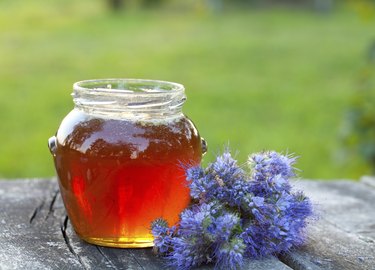
Japanese honeysuckle (Lonicera japonica), also known as jinyin hua, is a climbing vine native to Japan, Korea, China and Taiwan. Japanese honeysuckle has antibacterial and anti-inflammatory actions, and is used in Asian medicine to treat boils, fevers and ulcers. In their book "Chinese Herbal Medicine Formulas and Strategies," Dan Bensky and Randall Barolet cite Japanese honeysuckle as a main ingredient in a traditional Chinese medicine formula for boils, called Wu Wei Xiao Du Yin. This remedy expels heat, reduces inflammation and detoxifies the body. As a poultice, Japanese honeysuckle relieves inflammation and acts as an astringent to heal the skin.
Burdock
Burdock (Arctium lappa) is a popular herbal alterative, used specifically for skin problems, including boils and carbuncles, which are clusters of boils. Burdock works through the digestive system, the root of many skin disorders, to restore metabolic balance. According to herbalist and teacher Jim McDonald, burdock also normalizes the sebaceous glands, where the staph infection generally begins. A poultice of burdock will draw out the toxins from the boil, bringing it to a head so it can heal faster.
Echinacea
Echinacea (Echinacea angustifolia, E. purpurea) is an antimicrobial and alterative. The 2001 issue of the "Alternative Medicine Review" states that echinacea directly inhibits Staphylococcus aureus, the bacterium that causes boils. In his 2003 book "Medical Herbalism: The Science and Practice of Herbal Medicine," herbalist David Hoffmann states that the plant constituent echinacoside was active against Streptococcus and Staphylococcus aureus. He recommends echinacea for infection anywhere in the body.
Blue Flag
Blue flag (Iris versicolor) is a wetland plant with distinct purple flowers. Blue flag works well for many skin diseases and infections, including the infection of the sebaceous glands that results in boils. David Hoffmann calls blue flag a hepatic alterative because it affects skin disorders through its detoxifying actions on the liver. In his 2007 book "Therapeutic Herb Manual: A Guide to the Safe and Effective Use of Liquid Herbal Extracts," Ed Smith states that blue flag corrects glandular toxicity and is a useful remedy for pustular eruptions and disorders of the sebaceous glands.
References
- "Chinese Herbal Medicine Formulas and Strategies"; Dan Bensky and Randall Barolet; 1993
- Jim McDonald, Herbalist: Burdock
- "Alternative Medicine Review"; Echinacea; 2001
- "Medical Herbalism: The Science and Practice of Herbal Medicine"; David Hoffmann; 2003
- "Therapeutic Herb Manual: A Guide to the Safe and Effective Use of Liquid Herbal Extracts"; Ed Smith; 2007


Member Comments