
































Shingles is a skin disease caused by the varicella-zoster virus, the same virus that produces chickenpox. Once infected, the virus lies dormant in nerve tissue that surrounds your spinal cord and brain stem, from which it may re-emerge years later through the skin of your torso. Characterized by a highly contagious and often painful rash, early treatment with oregano oil may speed healing and relieve symptoms. In addition, see your doctor without delay about starting oral antibiotic therapy.
Description
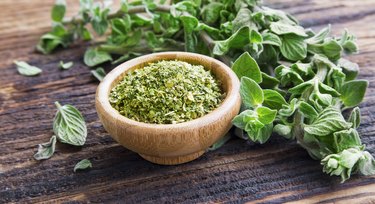
Wild oregano, also known as wild marjoram and mountain mint, is a member of the mint family. While many plants in the botanical kingdom are called oregano, the species familiar to most people as the culinary seasoning is Origanum compactum, whereas the variety most commonly used for medicinal purposes is Origanum vulgare.
Active Ingredients
According to the "Physicians' Desk Reference for Herbal Medicines," oregano oil is extracted from the fresh or dried leaves of the plant via steam distillation. The primary compounds in the oil and their concentrations are given as 40 to 70 percent carvacrol, 8 to 10 percent gamma-terpene and 5 to 10 percent p-cymene. The oil also contains trace amounts of thymol, linalool, alpha-pinene and myrcene.
Pharmacological Actions
The antimicrobial activity of carvacrol has been extensively studied. In the Feb. 2005 issue of Applied and Environmental Microbiology, researchers from South Bank University in London describe carvacrol as a natural broad-spectrum biocide, which means it's capable of killing a wide variety of microorganisms. The team of scientists, led by lead researcher J. R. Knowles, specifically studied the effect of carvacrol on biofilms formed by the accumulation of selected microorganisms adhering to and flourishing on a solid substrate. Using cryosectional analysis, the study team found that carvacrol significantly reduced the growth of Staphylococcus aureus and Salmonella enterica serovar Typhimurium.
Another study published in BMC Microbiology on June 17, 2005, demonstrated that carvacrol and p-cymene neutralize Escherichia coli in unpasteurized apple juice. The authors of this paper also noted that similar results have been observed with Bacillus cereus, another food-borne pathogen that commonly affects grains.
Anti-Herpes Effects
Traditionally, oregano oil has been used to ease the pain and inflammation associated with shingles, symptoms collectively referred to as postherpetic neuralgia. However, there is virtually no evidence-based data to confirm its efficacy for this specific application simply because it hasn't been studied. What can be drawn from the medical literature is evidence that some of the individual constituents found in oregano oil counter pathogens in the herpes family of viruses. This is significant since shingles emerges as herpes zoster after initial infection with varicella-zoster, although both are members of the Herpesviridae family.
For instance, a review presented in the June 21, 2007, edition of "Phytotherapy Research" attributes the antiviral and anaesthetic properties of clove oil that act against herpes viruses to the presence of carvacrol and thymol, compounds also found in oregano oil. Similarly, German scientists report in the May 24, 1010, issue of the same medical journal that eucalyptus, tea tree and thyme essential oils demonstrate anti-herpes activity due to the presence of gamma-terpene, p-cymene, thymol and alpha-pinene, which are also found in oregano oil.
Safety
No known side effects are associated with the topical use of oregano oil. However, if a secondary rash or skin irritation occurs, discontinue use and see your physician. If you are pregnant or nursing, consult your physician before using oregano oil.
References
- PDR for Herbal Medicines; Thomas Fleming, Chief Editor, et al; 2000
- Applied and Environmental Microbiology; Antimicrobial Action of Carvacrol at Different Stages of Dual-Species Biofilm Development by Staphylococcus aureus and Salmonella enterica Serovar Typhimurium; J. R. Knowles et al.; 2005
- BMC Microbiology: Carvacrol and P-cymene Inactivate Escherichia coli O157:H7 in Apple Juice; Gabriella Kiskó, Sibel Roller; 2005
- NCBI: Phytotherapy Research; The chemical composition and biological activity of clove essential oil, Eugenia caryophyllata (Syzigium aromaticum L. Myrtaceae): a Short Review; Chaieb K et al.; 2007
- NCBI: Phytotherapy Research; Comparative Study on the Antiviral Activity of Selected Monoterpenes Derived from Essential Oils; Astani A et al.; 2010


Member Comments