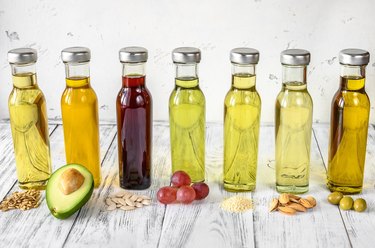
There is a seemingly endless number of cooking oils on the market, but not all of these oils are created equal. Oil is a fat, after all, and some fats are healthier than others, especially when you're trying to lose weight.
In fact, a diet higher in monounsaturated fat may help with weight loss when you're cutting calories, according to a November 2015 randomized, controlled trial in Diabetology & Metabolic Syndrome.
Video of the Day
Video of the Day
Here are the best cooking oils for weight loss, ranked by how much research there is to support their role in helping you shed pounds.
1. Olive Oil
Packed with vitamin E and antioxidants, extra-virgin olive oil is often considered one of the healthiest oils.
Olive oil contains around 73 percent monounsaturated fat, according to the USDA. Monounsaturated fats are associated with lowering low-density lipoproteins — LDLs, the "bad" cholesterol — and raising the levels of high-density lipoproteins — HDLs, the "good" cholesterol — in your bloodstream. Proper balance between LDLs and HDLs can help decrease your risk of heart disease.
So, how is that connected to weight loss? Well, the better your body functions, the better you feel, and the more likely you are to exercise and make healthy choices.
Plus, research suggests that unsaturated fatty acids (like those found in olive oil) can help people maintain a healthy weight more effectively than saturated fats, per an April 2014 review in the European Journal of Nutrition.
Olive oil is a staple in the Mediterranean diet, which prioritizes fresh vegetables and fruit, lean proteins and healthy fats like olive oil, nuts and avocado. It's not a weight-loss diet per se, but research, including a March 2019 review in Nutrients, has linked it to weight loss, lower waist circumference and lower BMI.
Should You Drink Olive Oil to Lose Weight?
Health experts are big proponents of this cooking oil. But does that mean you should be drinking olive oil to lose weight? It does not. Olive oil does not burn fat. It has no chemical properties that will magically dissolve the calories in that tiramisu you had for dessert.
Taking a spoonful of olive oil before a meal, as some fad diets suggest, simply acts as a laxative, which plays to the mistaken belief that the faster food moves through you, the fewer calories your body will absorb. It simply doesn't work that way. Losing weight means taking in fewer calories than you burn, no matter how many of them come from olive oil.
One smart way to use olive oil? Substitute it for commercial salad dressings to benefit your heart, per the Harvard T.H. School of Public Health. Making healthy choices at every meal and for every snack is the most effective, long-term way to lose weight and keep it off.
Tip
The labels "light," and "extra light" you see on bottles of olive oil refer to the color and flavor, not how many calories or how much fat they contain. All olive oils generally contain the same number of calories, so choose olive oil based on your taste preferences.
2. Canola Oil
Like olive oil, canola oil is mostly made of monounsaturated fat: around 63 percent, according to the Harvard T.H. Chan School of Public Health. This is why canola oil is generally considered a healthy cooking oil.
It also earns points because it's low in saturated fat, with just 7 percent. This oil also contains a good amount of phytosterols, which have found to help reduce the absorption of cholesterol into the body, per Harvard.
When it comes to canola oil for weight loss, one randomized, controlled study of 100 people found that a diet including canola oil may help people lose belly fat, especially if they have obesity. The participants drank canola oil in a smoothie each day for a month, and at the end of that time, they had lost about a quarter pound of belly fat. The results were published November 2016 in Obesity.
Canola oil is popular for cooking because it has a medium-high smoke point, like extra-virgin olive oil, but has a milder flavor. Like any oil, it should be used in moderation.
3. Flaxseed Oil
Flaxseed oil shares many of the health benefits of the actual flaxseed, such as plant-based omega-3s and monounsaturated fats. In fact, flaxseed oil has the highest levels of omega-3s compared to all other cooking oils: A tablespoon has more than 7 grams, according to the USDA. For the sake of comparison, a 3-ounce serving of cooked salmon has about 2 grams of omega-3s.
While flaxseed oil is considered a healthy oil, it should not be used when cooking with heat because of its high ALA content. It's best for enjoying as a dressing or for dipping. In fact, it is recommended to keep the oil refrigerated to prevent it from going rancid.
Flaxseed oil is available in pill or supplement form, which some people take for weight loss. Because the omega-3s in flaxseed are anti-inflammatory, some research suggests flaxseed may help with weigh management.
One small April 2012 study in Appetite found that participants who consumed flaxseed in different forms (with 2.5 g of fiber) experienced increased feelings of satiety and ate fewer calories compared to the control group. Additional research, including one February 2018 meta-analysis in Nutrition Review, examines the ability of whole flaxseed to improve glycemic control, which can help balance insulin and blood sugar levels — two things that are associated with healthy weight management.
More research is needed on flaxseed oil's effect on weight loss.
Related Reading
4. Saffron Oil
Should you consider saffron oil for weight loss? You may value saffron for the flavor it adds to foods, but there's some preliminary evidence that the essential oils that give saffron its distinct aroma and color — safranal and crocin — may also be helpful to someone on a weight-loss diet.
A randomized, placebo-controlled, double-blind study from May 2010 in Nutrition Research looked at the effects of a saffron extract supplement made with the essential oils on appetite and snacking in a group of women with overweight. The women were asked to keep a food diary but were not told to restrict food intake. The researchers found that the women taking the supplement snacked less and lost more weight than the control group. (Note: While this study uses gendered language, LIVESTRONG.com tries to avoid using gendered language in favor of more inclusive terms.)
While this study may be promising for those looking to lose weight, more research is necessary.
There are health risks associated with taking saffron oils in supplement form. In amounts of 5 grams or more, saffron can be toxic; at 20 grams, it can be fatal, according to June 2015 findings in Drug Research.
You may also experience side effects when using the spice as a supplement, such as dizziness, nausea, vomiting or diarrhea in mild cases, and numbness, yellowing of the skin or eyes or spontaneous bleeding in extreme cases.
Tip
Whichever oil you choose to cook with, it's important to eat it in moderation when weight loss is a goal. All oils are basically 100 percent fat, with 9 calories per gram. One tablespoon of oil contains about 124 calories.
What About Coconut Oil?
Perhaps you've heard about people using coconut oil for weight loss. Certain diet communities, like paleo and Whole30, often celebrate the stuff. But there are mixed findings about coconut oil's abilities to promote weight loss, per the Mayo Clinic.
Coconut oil is primarily made of saturated fat — 1 tablespoon of coconut oil contains 11 grams of saturated fat — which is associated with weight gain, per the National Institutes of Health (NIH). The NIH recommends focusing your fat intake primarily around monounsaturated and polyunsaturated fats, which are believed to be healthier.
While using coconut oil in moderation isn't likely to cause weight gain, it's unlikely to help you lose weight, according to the Mayo Clinic.
Related Reading
- American Heart Association: Healthy Cooking Oils 101
- Cleveland Clinic: Heart-Healthy Cooking: Oils 101
- Health-Alicious-Ness.com: Nutrition Facts Comparison Tool
- Harvard T.H. Chan School of Public Health: "Fats and Cholesterol"
- Drug Research: "Clinical Applications of Saffron (Crocus sativus) and its Constituents: A Review"
- Mayo Clinic: "Coconut oil for weight loss: Does it work?"
- National Institutes of Health: "Facts about saturated fats"
- USDA: "Olive Oil"
- Harvard School of Public Health: "Ask the Expert: Concerns about canola oil"
- Today's Dietitian: "Healthful Oils: The Canola Controversy"
- USDA: "Flaxseed Oil."
- Appetite: "Flaxseed dietary fiber supplements for suppression of appetite and food intake☆"
- Nutrition Review: "Flaxseed supplementation on glucose control and insulin sensitivity: a systematic review and meta-analysis of 25 randomized, placebo-controlled trials"
- Nutrition Research: "Satiereal, a Crocus sativus L extract, reduces snacking and increases satiety in a randomized placebo-controlled study of mildly overweight, healthy women"
- European Journal of Nutrition: "Effect of dietary fatty acid composition on substrate utilization and body weight maintenance in humans"
- Diabetology & Metabolic Syndrome: "Effects of unsaturated fatty acids on weight loss, body composition and obesity related biomarkers"
- Nutrients: "Mediterranean Diet and Cardiodiabesity: A Systematic Review through Evidence-Based Answers to Key Clinical Questions"
- Obesity: "Effects of canola and high‐oleic‐acid canola oils on abdominal fat mass in individuals with central obesity"