





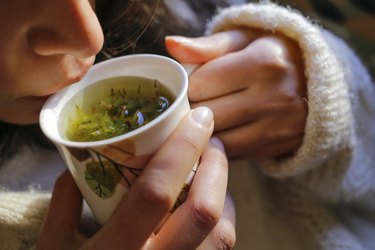




























































Your nervous system controls the physical and mental activities you engage in each day, and excess stress to this system can make you agitated. This type of agitation is routinely known as an attack of the nerves. Your physician may recommend yoga, meditation or medications to soothe your nerves, but you may also drink tea. Some teas have long been known for their ability to ease nervous conditions.
Chamomile Tea
Chamomile has been used as a home remedy for calming nerves for thousands of years, and there is some scientific evidence to suggest the use of this daisy-like flower for this purpose. Research published in the August 2009 issue of the "Journal of Clinical Psychopharmacology" studied patients with generalized anxiety disorder who received chamomile extracts over an eight-week period. The results indicate that patients who consumed chamomile demonstrated a decrease in anxiety.
Lavender Tea
Include lavender tea in your daily diet to ease nerves. This herb has been in use since ancient Egypt as a mood enhancer. Lavender helps with anxiety both when you breathe in the scent and when you consume it, whether directly or in tea. You should avoid consuming lavender oil as it can be poisonous. Research on this herb's effectiveness is mixed. A study featured in the 2010 issue of "Reviews in the Neurosciences" notes that lavender has only been found useful for anxiety in some research.
Valerian Tea
Valerian has been used as a medicinal herb since at least the second century, most often as a treatment for sleep disorders. This herb can be steeped in tea to improve your nerves as well. Evidence available in the June 2010 journal "Primary Care" indicates that valerian has shown some positive impact on anxiety, but the research is preliminary; more research is needed to confirm these findings. Note that you should limit consumption of valerian tea to four to six weeks as this is a safe duration for intake.
Green Tea
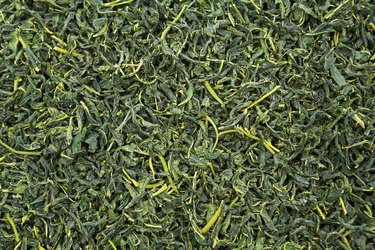
Green tea contains a compound known as L-theanine, an amino acid that may produce a relaxant effect that is good for your nerves. A study that appeared in the May 1998 issue of "Neurochemical Research" notes that L-theanin in green tea may trigger the release of certain neurotransmitters in the brain, including dopamine. Carolyn Perrini, CLS, CNC, notes that due to the neurotransmitter effect and the production of certain types of brain waves, the L-theanine in green tea relaxes you within 30 to 40 minutes of drinking it.
References
- University of Maryland Medical Center; German Chamomile; November 2008
- "Journal of Clinical Psychopharmacology"; A Randomized, Double-Blind, Placebo-Controlled Trial of Oral Matricaria recutita (Chamomile) Extract Therapy for Generalized Anxiety Disorder; J.D. Amsterdam, et al.; August 2009
- National Center for Complementary and Alternative Medicine; Lavender; July 2010
- "Review in the Neurosciences"; A Systematic Review on the Anxiolytic Effects of Aromatherapy on Rodents Under Experimentally Induced Anxiety Models; H.W. Tsang, et al.; 2010
- "Primary Care"; Complementary and Alternative Medicine Usage for Behavior Health Indications; M.M. Larzelere, et al.; June 2010
- National Center for Complementary and Alternative Medicine; Valerian; July 2010


Member Comments