Cabbage is part of the cruciferous family of vegetables, which also includes Brussels sprouts, broccoli, cauliflower, collard greens and kale, among others.
The four major types of cabbage are green, red, savoy and Napa. Green cabbage ranges from pale to dark green, red cabbage looks purple or crimson-red with white veins running throughout and Napa and savoy cabbage are yellowish to pale green in color.
Video of the Day
Video of the Day
Both green and red cabbage have leaves with a smooth texture while savoy and Napa are more ruffled. The characteristic crunchy texture and pronounced taste is most often associated with red and green cabbage while savoy and Napa varieties are more delicate and mild in flavor.
Cabbage is delicious raw or cooked and it is a low-calorie option that is chock-full of vitamins, minerals and phytochemicals — packing a powerful punch of healthy benefits.
Cabbage Nutrition Facts
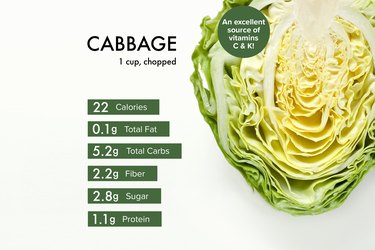
One cup of chopped cabbage is equal to a single serving. One cup of chopped raw cabbage contains:
- Calories: 22
- Total fat: 0.1 g
- Cholesterol: 0 mg
- Sodium: 16 mg
- Total carbs: 5.2 g
- Dietary fiber: 2.2 g
- Sugar: 2.8 g
- Added sugar: 0 g
- Protein: 1.1 g
Cabbage Macros
- Total fat: A one-cup serving of cabbage has 0.1 grams of total fat, which includes 0.02 grams polyunsaturated fat, 0.02 grams monounsaturated fat, 0 grams saturated fat and 0 grams trans fat.
- Carbohydrates: A one-cup serving of cabbage has 5.2 grams of carbohydrates, which includes 2.2 grams of fiber and 2.8 grams of naturally occurring sugar.
- Protein: A one-cup serving of cabbage has 1.1 grams of protein.
Vitamins, Minerals and Other Micronutrients
- Vitamin K: 56% of your Daily Value (DV)
- Vitamin C: 36% DV
- Folate (B9): 10% DV
- Manganese: 6%
- Vitamin B6: 6% DV
- Thiamin (B1): 5% DV
- Pantothenic Acid (B5): 4% DV
- Calcium: 3% DV
- Magnesium: 3% DV
- Potassium: 3% DV
- Riboflavin (B2): 3% DV
- Vitamin A (IU): 3% DV
- One serving of cabbage is not a significant source of iron (2% DV), zinc (1% DV), vitamin E (1% DV), choline (2% DV), phosphorus (2% DV), copper (2% DV) or niacin (1% DV).
Health Benefits of Cabbage
Like other cruciferous vegetables, cabbage has a rich and varied nutrient profile with a wide variety of vitamins, minerals and antioxidants.
1. Cabbage Is Tied to Preserving Bone Health
Our bones bear the brunt of our weight on a daily basis, so they are constantly breaking down and rebuilding.
Eating enough calcium and vitamin D, especially throughout childhood, is essential but vitamin K is a key part of bone metabolism and essential for bone health, too, according to the National Institutes of Health (NIH).
Not getting enough vitamin K is associated with an increased risk of osteoarthritis and fractures in older adults, according to a study published in the June 2014 issue of Molecular Nutrition & Food Research.
Clocking in at 56 percent of your daily needs per one-cup serving, cabbage is packed with this bone-building nutrient. Meeting your vitamin K needs can help reduce bone turnover (aka breakdown) and can improve bone strength, according to an April 2012 article published in the Open Orthopedics Journal.
2. Cabbage Is Linked to a Reduced Risk of Cancer
Including cruciferous vegetables, like cabbage, in the diet on a regular basis is one the American Cancer Society's key dietary recommendations to reduce the risk of cancer.
Cruciferous vegetables contain a group of anti-cancer compounds known as glucosinolates, which are sulfur-containing chemicals. These glucosinolates break down when cooked and eaten to form biologically active compounds that have been associated with preventing the development of cancer, per the National Cancer Institute.
Epidemiological evidence suggests that a higher intake of cruciferous vegetables shows reduced incidence of cancer, according to an article in the December 2014 BBA Reviews on Cancer journal.
What's more, eating cabbage boasts antioxidant benefits. These antioxidants help protect our cells from oxidative damage. Eating a rainbow of colors from plant foods, such as cabbage, every day is linked to a decreased risk of a variety of cancers, according to the Harvard Health Publishing.
3. Cabbage Is a Vitamin C Powerhouse
Vitamin C serves many purposes throughout the human body — including its vital role is as an immune-supporting antioxidant, according to a November 2017 article published in Nutrients.
Clocking in at 36 percent of your daily value, one serving of cabbage is an excellent source of this valuable nutrient.
Vitamin C acts as an antioxidant throughout the body, protecting DNA, proteins and lipids from oxidative damage from free radicals. Eating foods rich in vitamin C is associated with helping prevent and/or treat a range of health conditions, including heart disease, cancer and the common cold, according to the NIH.
Another amazing benefit of vitamin C is its ability to help humans absorb non-heme, or plant-based, iron.
Non-heme iron is found in plant foods, such as beans, lentils, leafy greens and whole grains. Our bodies cannot easily absorb non-heme iron and vitamin C acts synergistically to reduce the non-heme form from ferric to ferrous, which allows humans to more easily absorb the nutrient, according to the October 2019 issue of Antioxidants.
This is particularly important for vegans and vegetarians who are more likely to experience anemia because they consume primarily non-heme iron versus the animal-based heme iron, per a November 2018 study in the American Journal of Lifestyle Medicine.
Cabbage Health Risks
Food Allergies
Cabbage is generally regarded as safe for most people to consume and is not known to be associated with any food allergies to date.
However, cruciferous-family vegetables, including cabbage, contain goitrogens, which may interfere with thyroid hormone action in certain situations, particularly when iodine levels are low, according to the January 2016 issue of the Journal of Clinical and Diagnostic Research.
Cooking may help inactivate the goitrogenic compounds. However, if you're eating large quantities of raw cruciferous vegetables — more than four servings per week — be sure to get adequate amounts of iodine, which is found in iodized salt, seaweed vegetables, seafood and supplements.
If you have a thyroid condition, discuss any concerns with a health care professional.
Drug Interactions
Vitamin K interacts with a few medications and certain medications can also have an adverse effect on vitamin K levels, the NIH states.
Vitamin K is vital for blood clotting, so high amounts of this nutrient dilutes the effects of prescription blood thinners such as warfarin.
People taking blood thinners should not cut vitamin K out completely since it is an integral part of a healthy diet. Instead, they should be consistent with the vitamin K eaten daily to keep a constant level because sudden changes (up or down) can disrupt the medication's coagulating power, the Cleveland Clinic states.
Individuals on antibiotics or bile acid sequestrants to reduce cholesterol may experience decreased vitamin K levels.
Be sure to discuss any medication and food interactions with your health professional.
Cabbage Recipes
Cabbage Preparation and Useful Tips
Cabbage is widely available year-round. Choose cabbage that is firm, dense, has shiny, crisp and colorful leaves and no signs of decay, cracks, bruises or blemishes.
The majority of the outer leaves should be firmly attached to the stem. Precut cabbage, either halved or shredded, is also available and many grocery stores.
Store cabbage in the refrigerator to prolong its shelf life. Place the entire head as is or in a perforated plastic bag in the crisper drawer. Red and green cabbage should stay fresh for at least two weeks while savoy or Napa cabbage will keep for about one week.
If you need to store a partial head of cabbage, place in a perforated plastic bag or wrap with plastic wrap before placing in the refrigerator.
Here are some tips for preparing cabbage:
- Remove any fibrous, thick outer leaves. Then, cut into halves or quarters then run cabbage under cold water.
- To cut cabbage into smaller pieces, remove the core. If you're grilling or wrapping pieces in foil and baking, you may want to leave the core attached.
- Cabbage can be cut into wedges, grated by hand with a knife or shredded in a food processor.
- If you're boiling red cabbage, add an acid, such as vinegar or lemon juice, to the water to prevent the color from running.
Cabbage can be used in a wide variety of ways. Here are some quick serving ideas:
- Cut into wedges, drizzle with olive oil, salt and pepper then grill.
- Cut into wedges, place each wedge in a piece of foil, drizzle with olive oil, salt and pepper, close the foil to form individual packets then bake at 400 degrees Fahrenheit for approximately 40 minutes.
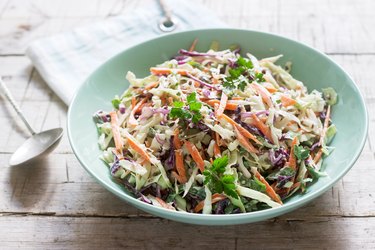
- Shred cabbage and add to salads or make coleslaw.
- Use shredded cabbage in sandwiches or pitas.
- Braise shredded cabbage with apple, vegetable broth, red wine vinegar, salt and pepper.
- Sauté cabbage and onions as a side dish.
- Ferment shredded cabbage to make sauerkraut or kimchi.
- Steam cabbage, add a drizzle of olive oil, salt, pepper and toasted nuts.
- My Food Data: “Cabbage”
- Molecular Nutrition and Food Research: “Vitamin K and musculoskeletal health in postmenopausal women”
- Open Orthopedics Journal: “Essential Nutrients for Bone Health and a Review of their Availability in the Average North American Diet”
- American Cancer Society: “Broccoli & Cruciferous Vegetables”
- BBA – Reviews on Cancer: “Phenethyl isothiocyanate: A comprehensive review of anti-cancer mechanisms”
- Harvard Health Publishing: “Phytonutrients: Paint your plate with the colors of the rainbow”
- Nutrients: “Vitamin C and Immune Function”
- NIH: “Fact Sheet for Health Professionals: Vitamin C”
- Antioxidants: “Vitamin C in Plants: From Functions to Biofortification”
- Journal of Clinical and Diagnostic Research: “Various Possible Toxicants Involved in Thyroid Dysfunction: A Review”
- NIH: “Fact Sheet for Health Professionals: Vitamin K”
- Cleveland Clinic: “Why Vitamin K Can Be Dangerous If You Take Warfarin”
- American Journal of Lifestyle Medicine: "https://www.ncbi.nlm.nih.gov/pmc/articles/PMC6367879/"