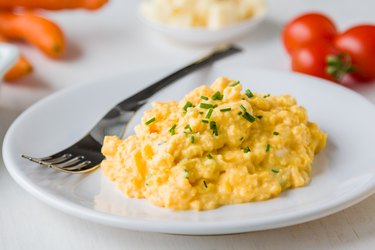
Eggs are a low-calorie, nutrient-dense food and low-cost food. The staple is incredibly versatile — they can be poached, boiled, scrambled or fried, and eaten as a meal or snack.
Scrambled eggs, in particular, are easy to make and can range from soft and creamy to firm and formed. They make for a healthy breakfast so long as you cook them with heart-healthy oil such as olive oil, and can be a great vehicle for getting more veggies in.
Video of the Day
Video of the Day
Scrambled Egg Nutrition Facts
Two large eggs is equal to a single serving of scrambled eggs. Scrambled eggs (likely made with milk) has the following nutritional breakdown, according to the USDA:
- Calories: 159
- Total fat: 10.2 g, 13% Daily Value (DV)
- Cholesterol: 375.8 mg, 125% DV
- Sodium: 447.8 mg, 19% DV
- Total carbs: 2.2 g, 1% DV
- Dietary fiber: 0 g
- Sugar: 1.9 g, 4% DV
- Added sugar: 0 g
- Protein: 13.6 g, 27% DV
Scrambled Egg Macros
- Total fat: Two large eggs scrambled contain 10.2 grams of total fat, which includes 1.95 grams of polyunsaturated fat, 3.8 grams of monounsaturated fat, 3.5 grams of saturated fat and 0 grams trans fat.
- Carbohydrates: Two large eggs scrambled contain 2.2 grams of carbohydrates, which includes 0 grams of fiber and 1.9 grams of naturally occurring sugar.
- Protein: Two large eggs scrambled contain 13.6 grams of protein.
Vitamins, Minerals and Other Micronutrients
- Selenium: 58 % DV
- Choline: 46%DV
- Riboflavin (B2): 38% DV
- Vitamin B12: 37% DV
- Vitamin A: 20% DV
- Zinc: 13% DV
- Vitamin D: 12% DV
- Vitamin B6: 10% DV
- Iron: 10% DV
- Folate (B9): 9% DV
- Copper: 9% DV
- Calcium: 7% DV
- Vitamin E: 7% DV
- Thiamin (B1): 37% DV
- Magnesium: 4%
- Potassium: 4%
Health Benefits of Scrambled Eggs
Whole scrambled eggs have a rich and varied nutrient profile and contain a wide variety of vitamins, minerals and macronutrients.
1. Eggs Are Linked to Good Brain Health
Eggs are one of the only foods that are a rich source of both choline and lutein (a type of carotenoid), which are key components in brain function and health.
During pregnancy and breast-feeding, an adequate supply is particularly important since choline and lutein are essential for normal brain development, according to a 2018 study in the Journal of the American College of Nutrition.
Cognitive health continues as we age, and research has shown that people with Alzheimer's disease have lower levels of the enzyme that converts choline into acetylcholine in the brain, according to the National Institutes of Health (NIH).
Lutein has also been shown to support brain health, especially in older adults, as discussed in the June 2020 issue of Brain Imaging Behavior.
2. Eggs Are a Good Source of High-Quality Protein
Eggs pack a powerful punch of high-quality protein, clocking in at 6.3 grams per one large egg and all nine essential amino acids.
Protein is vital for both weight management and physical activity and performance. Protein may help you feel full, which, in turn, may help prevent overeating, as discussed in the February 2015 issue of the Nutrition Journal.
Protein also helps to build, maintain and repair muscle, according to the NIH. Whole foods that are high-quality protein sources, such as eggs, may provide a range of nutrients that contribute to greater muscle performance and recovery.
3. Eggs Are Tied to Better Heart Health
Eggs are rich in several nutrients that promote heart health — and recent research shows that there are no significant associations between moderate egg intake (that is, around 1 egg each day) and major cardiovascular events, lipid levels or mortality, according to a January 2020 study in the American Journal of Clinical Nutrition.
In fact, eating an egg a day was associated with a lower risk of myocardial infarction, according to a May 2018 study published in Heart.
The American Heart Association Nutrition Committee currently states that healthy people can eat one to two eggs daily in the context of a broader heart-healthy dietary pattern. Note that for people with high cholesterol, especially anyone who has diabetes or a risk of heart disease, these guidelines may differ, and it may be best to avoid high-cholesterol foods.
Research suggests that nutrients such as folate and essential fatty acids found in eggs promote heart health and decreased cardiovascular risk, according to Harvard Health Publishing.
Related Reading
Scrambled Egg Health Risks
Food Allergies
Eggs are one of the most common eight allergens identified nationwide, particularly among children.
As many as two percent of children are allergic to eggs — however, studies show that roughly 70 percent will outgrow the allergy by 16 years of age, according to the American College of Allergy, Asthma and Immunology.
Symptoms range from vomiting and gastrointestinal distress to hives and a rash to anaphylaxis. It is important to work with an allergist if you or a member of your family has an allergic reaction to eggs.
Foodborne Illness
Due to salmonella, eating undercooked eggs can make you sick, according to the Centers for Disease Control and Prevention (CDC).
Avoid foodborne illness by scrambling eggs thoroughly, so there are no runny bits, storing them properly and washing anything that comes in contact with raw eggs, per the CDC.
Drug Interactions
There are no known interactions between eggs and medications.
How to Make Scrambled Eggs

- Crack eggs into a bowl and beat with a whisk
or fork.
- Add seasonings (such as salt and pepper) and additional liquid (such as milk) directly to the bowl of eggs and mix well.
- Heat up a skillet or nonstick pan well over medium heat prior to adding fat, such as cooking spray, oil or butter. Once hot, add spray, oil or butter and allow to heat up again prior to pouring in the egg mixture.
- Pour in egg mixture and allow it to set. Then, gently pull the eggs across the pan with a spatula to form large soft curds.
- Continue to cook and pull across until no liquid remains. Cook to your liking (soft or hard) and serve immediately.
Scrambled Egg Recipes
Scrambled Egg Preparation Tips
Focus on adding vegetables to your scrambled eggs to add bulk to your diet and boost your nutrient intake without adding many calories. Try a combination of diced green pepper, onion and zucchini or add finely chopped kale and broccoli.
Mix a spoonful of ground flaxseed into the raw egg mixture before cooking. The flax won't significantly change the flavor of your meal, but it will add omega-3 fatty acids.
Tip
When preparing scrambled eggs, the additional ingredients can make or break the nutritional value of your dish. Making your eggs with butter or adding handfuls of cheese significantly increases the calorie content and saturated fat.
Scrambled eggs can be used in a wide variety of ways. Here are some quick serving ideas.
- Add your favorite mix-ins, such as cheddar or parmesan cheese.
- Add any spices and herbs you like, including cumin, cayenne or dill.
- Add to a whole-grain wheat or corn tortilla with sautéed vegetables and beans.
- Saute vegetables and add to the scrambled eggs.
- Serve scrambled eggs in half an avocado for an "avocado boat."
- Add smoked fish to the scrambled eggs.
Alternatives to Scrambled Eggs
If you're following a vegan diet or allergic to eggs, you can use a vegan egg scramble replacement or simply swap out the eggs for a tofu scramble.
What to Look for When Buying Eggs
Eggs are widely available nationwide at grocery stores, farms and farmers' markets. They should be visually inspected prior to purchasing to make sure there are no cracks, broken eggs or dried egg anywhere on the eggs or the packaging.
Eggs are best stored in the refrigerator in their original carton where they should stay fresh for three to five weeks, per the U.S. Department of Health & Human Services.
Since eggshells are porous, it is best to keep the eggs in their original packaging to reduce the absorption of odors from other foods in the refrigerator. Place the egg carton on a shelf rather than in the door, since temperature variations from opening and closing the door may contribute to spoilage.
- USDA: “Egg Omelet Or Scrambled Egg Made Without Fat”
- Journal of the American College of Nutrition: “A Comprehensive Review of Eggs, Choline, and Lutein on Cognition Across the Life-span”
- NIH: ”Fact Sheet for Health Professionals: Choline”
- Brain Imaging Behavior: “The Effects of Lutein and Zeaxanthin on Resting State Functional Connectivity in Older Caucasian Adults: A Randomized Controlled Trial”
- Nutrition Journal: “A Randomized, Controlled, Crossover Trial to Assess the Acute Appetitive and Metabolic Effects of Sausage and Egg-Based Convenience Breakfast Meals in Overweight Premenopausal Women”
- NIH: “Fact Sheet for Health Professionals: Dietary Supplements for Exercise and Athletic Performance”
- American Journal of Clinical Nutrition: “Association of egg intake with blood lipids, cardiovascular disease, and mortality in 177,000 people in 50 countries “
- American Heart Association: “Dietary Cholesterol and Cardiovascular Risk: A Science Advisory From the American Heart Association”
- Harvard Health Publishing: “Eggs might help your heart, not harm it”
- American College of Allergy, Asthma and Immunology: “Egg Allergy”
- Foodsafety.gov: “Cold Food Storage Charts”
- Heart: "Associations of egg consumption with cardiovascular disease in a cohort study of 0.5 million Chinese adults"
- Centers for Disease Control and Prevention: "Salmonella and Eggs"