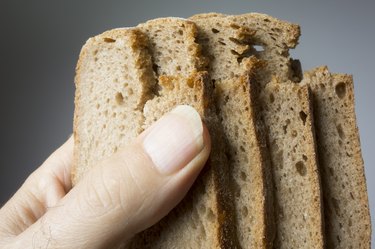
Including whole-wheat bread in your diet is an easy way to boost your daily intake of whole grains. Like other foods that contain whole grains, whole-wheat bread is full of fiber, vitamins, minerals and other nutritional content.
Read on to learn some facts about the calories and nutrition contained in a slice of whole-wheat bread — and discover new ways to work whole wheat into a healthy diet.
Video of the Day
Video of the Day
Whole-Grain Facts
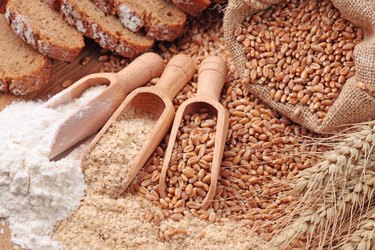
So-called "whole grains" are those that include the entire grain kernel, which is made up of the bran, endosperm and germ. "Bran is the hard outer coating of a kernel," explains the Mayo Clinic. "It has most of the kernel's fiber. It also has vitamins and minerals. The germ is the part that sprouts into a new plant. It has many vitamins, healthy fats and other natural plant nutrients. The endosperm is the energy supply for the seed. It mostly contains starches."
Whole Grains and Health
"Grains provide many nutrients that are vital for the health and maintenance of our bodies," says the U.S. Department of Agriculture (USDA). "Eating whole grains as part of a healthy diet may reduce the risk of getting heart disease [and] can support healthy digestion. [It may also] help with weight management."
When whole grains are milled to remove the bran and germ, they become "refined" grains. "This is done to give grains a finer texture and improve their shelf life," notes the USDA. "But it also removes dietary fiber, iron and many B vitamins."
Whole grains are also a non-meat source of protein, a nutrient vital to muscle growth and repair. "The current daily value for protein is 50 grams per day," says the USDA. "Whole unrefined grains provide more protein for each carb because the bran and germ of grains contain the most protein per carb."
The USDA recommends that people aged 19 and up consume 3 to 5 ounces of whole grains each day, depending on age and gender. "Make half your grains whole grains," they advise. A slice of whole-wheat bread can help you reach your daily quota — deliciously.
Tip
When it comes to foods containing grains of whole wheat, a slice of whole-wheat bread isn't your only option. Whole-wheat pastas, cereals, chips, bars, muffins, pancakes and crackers can all help you meet your daily need for whole grains. It isn't always easy to identify a whole-wheat product, however. Some may include wheat grain but not be made from whole-wheat grain. To ensure you're buying whole-wheat products, choose those that list "whole-grain wheat" as their first ingredient, or that say "100 percent whole wheat" on the package.
Whole-Wheat Bread Nutrition
Per the USDA, one 32-gram slice of store-bought whole-wheat bread contains about 4 grams of protein, 2 grams of dietary fiber, 81 milligrams of potassium, 68 milligrams of phosphorus, 51 milligrams of calcium and 24 milligrams of magnesium, among other nutrients.
Whole Wheat: What's in a Name?
The following 10 terms translate to "whole wheat." Do you know them all?
Bulgur: Wheat berries that have been blanched, dried and cracked.
Dinkel: An ancient wheat more commonly known as spelt.
Einkorn: Wild heirloom wheat.
Emmer: Another ancient wheat — and one of the world's first domesticated plants.
Farro: The European name for emmer wheat.
Freekeh: Roasted, cracked young wheat.
Kamut: Another ancient wheat.
Khorasan: Another name for kamut wheat.
Spelt: Familiar name for dinkel wheat.
Wheat Berry: A kernel of whole wheat.
Fiber
One slice of whole-wheat bread provides 2 grams of dietary fiber, which is 8 percent of the recommended daily value for a 2,000-calorie diet. Consuming a diet rich in fiber has been shown to reduce the risk of coronary heart disease. It also encourages proper bowel function and creates a sense of fullness that can help stave off feelings of hunger, thus aiding weight management.
Whole-wheat foods are a source of insoluble fiber. "Fiber is a type of carbohydrate that the body can't digest," observes the Harvard T.H. Chan School of Public Health (SPH). "Insoluble fiber, which does not dissolve in water, can help food move through your digestive system, promoting regularity and helping prevent constipation."
"Dietary fiber can help improve blood cholesterol levels and lower your risk of heart disease, stroke, obesity and even type 2 diabetes," adds the American Heart Association.
Phosphorus
The average slice of commercially prepared whole-wheat bread has 68 milligrams of phosphorus — about 10 percent of the recommended daily value of that essential mineral.
"Phosphorus is a component of bones, teeth, DNA and RNA," says the National Institutes of Health (NIH). "[It] is also a component of cell membrane structure."
Calcium
As noted by the SPH, "Calcium is a mineral most often associated with healthy bones and teeth, although it also plays an important role in blood clotting, helping muscles to contract and regulating normal heart rhythms and nerve functions."
Most people should aim to get about 1,000 milligrams of calcium per day, and a slice of whole-wheat bread provides 51 of those.
Potassium
According to the NIH, "Potassium is present in all body tissues and is required for normal cell function because of its role in maintaining intracellular fluid volume."
Most adults need 2,600 to 3,400 milligrams of potassium every day, depending on age and gender. One slice of whole-wheat bread provides 81 milligrams.
Other Vitamins and Minerals
Whole-wheat bread is a source of iron, which is important for transporting oxygen throughout the body and muscles. It's also a source of magnesium, providing about 24 milligrams per slice.
"Magnesium helps to maintain normal nerve and muscle function," says the U.S. National Library of Medicine. "[It] supports a healthy immune system, keeps the heartbeat steady and helps bones remain strong. It also helps adjust blood glucose levels [and] aids in the production of energy and protein."
When shopping for whole-wheat bread, remember that the USDA's nutrient guidelines are general. A bread's weight, ingredients and brand can all influence the number of calories and nutrients it contains.
Whole-Wheat Bread Calories
A 32-ounce slice of store-bought whole-wheat bread provides about 81 calories and 1 gram of fat. It contains no cholesterol, making it a low-fat, low-cholesterol food.
Adding foods low in saturated fat and cholesterol to your diet helps keep unhealthy LDL cholesterol levels low and reduces your risk of developing coronary heart disease.

Your Ultimate Guide to Buying Whole Grains, According to a Dietitian
Whole Wheat vs. Wheat Bran: What's the Difference?

Is It Good to Eat Whole-Wheat Bread on a Diet?

Everything You Need to Know to Bake Bread Like a Pro — and a Honey Whole-Wheat Loaf Recipe to Try
Can You Have Wheat Bread on a Low-Carb Diet?
Whole-Wheat vs. White Bread
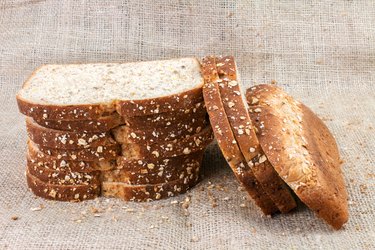
Whole-wheat bread often has a sweet, nutty taste and is marketed as being a healthier alternative to white bread. The caloric content of both breads is the same, but whole-wheat bread provides more fiber and nutrients than white bread, which is made from refined grain.
A meta-analysis published in the July 2021 issue of Advances in Nutrition determined that, compared to refined-grain foods like white bread, whole-grain foods such as whole-wheat bread "significantly reduced hunger and desire to eat and increased fullness and satiety."
Research published in March 2018 by the USDA's Agricultural Research Service (ARS), meanwhile, found that study participants who ate whole grains "lost approximately 100 more calories per day than refined-grain eaters — the equivalent of walking briskly for 30 minutes."
The 8-week human nutrition study "reaffirms the health benefits of substituting refined-grain products like white bread with whole-grain foods like whole-wheat bread," concluded the ARS.
- U.S. Department of Agriculture: "Bread, Whole-Wheat, Commercially Prepared"
- U.S. Department of Agriculture: "MyPlate: Grains"
- National Institutes of Health: "Potassium"
- Harvard T.H. Chan School of Public Health: "Calcium"
- National Institutes of Health: "Phosphorus"
- U.S. Department of Agriculture: "Top 10 Grains Highest in Protein"
- American Heart Association: "Whole Grains, Refined Grains and Dietary Fiber"
- Mayo Clinic: "Whole Grains: Hearty Options for a Healthy Diet"
- Harvard T.H. Chan School of Public Health: "Fiber"
- Advances in Nutrition: "Effects of Whole Grain Intake, Compared with Refined Grain, on Appetite and Energy Intake: A Systematic Review and Meta-Analysis"
- U.S. National Library of Medicine: "Magnesium in Diet"
- U.S. Department of Agriculture: "All Hail the Whole Grain!"