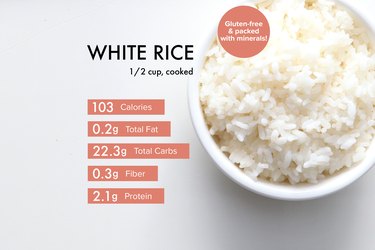
White rice has been deemed unhealthy by some in the dieting community, but it's a wonderfully versatile grain that complements practically any food. In fact, it's considered a staple food in cultures all around the world, and for good reason.
White rice, like all grains, is a carbohydrate-rich food, but that doesn't make it the enemy. When eaten in appropriate portions, carb-rich foods like rice offer an easily-digestible source of energy to fuel your body's needs. It's also gluten-free, making it an ideal grain choice for people with celiac disease or gluten sensitivity.
Video of the Day
Video of the Day
Because of the way it's processed, white rice doesn't have as much fiber as brown rice and other rice varieties. Other nutrients are lost when white rice is processed, but it's typically enriched to up the nutritional value.
Types of White Rice
White rice is categorized primarily by size and processing method. Long-, medium- and short-grain are the main size types. Long-grain white rice is typically less starchy and heavy, short-grain is stickier and heavier and medium-grain falls in between the two.
The milling or processing method helps define rice as well. White rice is polished, with all the bran, germ and most of the nutrients removed. In most instances nationwide, white rice has been enriched with the lost vitamins and minerals.
Some popular types of white rice in the U.S. include:
- Arborio: A round, short-grain starchy white rice that is traditionally used to make risotto.
- Basmati: An aromatic rice with a light flavor and texture.
- Sweet: A very sticky short-grain rice typically used to make sushi.
- Jasmine: A long-grain, soft-textured, aromatic rice.
White Rice Nutrition
According to the USDA, a 1-cup serving of cooked white rice has:
- Calories: 205
- Total fat: 0.4 g
- Saturated fat: 0.1 g
- Trans fat: 0 g
- Cholesterol: 0 mg
- Sodium: 1.6 mg
- Total carbs: 44.5 g
- Dietary fiber: 0.6 g
- Sugar: 0.1 g
- Protein: 4.3 g
White Rice Calories and Macros
The main nutrient in white rice is carbs, and it does offer a small amount of protein. You'll get 44.5 grams of carbs and 4.3 grams of protein in a serving of white rice. It's very low in fat, with just about 1/2 gram per cup.
Vitamins, Minerals and Other Nutrients
- Manganese: 33% of your Daily Value (DV)
- Folate (B9): 22% DV
- Selenium: 22% DV
- Thiamin (B1): 21% DV
- Niacin (B3): 15% DV
- Copper: 12% DV
- Pantothenic Acid (B5): 12% DV
- Iron: 10% DV
- Vitamin B6: 8% DV
- Zinc: 8% DV
- Phosphorus: 6% DV
White Rice vs. Other Types of Rice
Per 1/2 cup (78 g), cooked | White Rice | Brown Rice | Wild Rice | Black Rice |
|---|---|---|---|---|
Calories | 205 | 218 | 166 | 305 |
Fat | 0.4 g | 1.6 g | 0.6 g | 0 g |
Carbs | 45 g | 46 g | 36 g | 70 g |
Fiber | 0.6 g | 3.5 g | 1.4 g | 0 g |
Protein | 4.3 g | 4.5 g | 6.5 g | 6 g |
Health Benefits of White Rice
White rice contains a variety of vitamins and minerals that give it nutritional value. Some of the health benefits of white rice are:
1. It's a Good Pre- and Post-Workout Food
In general, pre-workout fuel and post-workout recovery food is essential.
It may benefit you to eat 30 to 60 grams of carbs between a half-hour and hour before a workout to sustain your enegy levels, and eat 40 to 80 grams of carbs within 30 to 45 minutes of exercising, per the Collegiate and Professional Sports Dietitian Association.
Carbohydrates are particularly important since your muscle stores of the macronutrient are likely down or depleted after a workout. White rice provides 45 grams of carbs per 1-cup serving, which is a good way to get those carbs.
2. It's High in Important Minerals
A cup of cooked white rice provides 33 percent of your DV of manganese, an essential mineral that plays a vital role in bone health, metabolism and antioxidant function, according to Oregon State University.
Manganese helps the body metabolize carbs, proteins and cholesterol, and plays a vital role in liver detox and the creation of neurotransmitters.
Manganese deficiency can impair bone formation and reduce bone strength, according to the National Institutes of Health (NIH). The mineral also plays a role in reducing free radicals in the body when it produces energy, per Oregon State University.
A cup of white rice provides 22 percent of your DV for selenium, an element that helps the body make DNA and protects cells from damage, per the Harvard T.H. Chan School of Public Health. Selenium has an important role in reproduction and thyroid health.
3. It's High in B Vitamins
B vitamins are known as the "building blocks" of the body because they play a role in our metabolism, brain function and nerve health, per the Harvard T.H. Chan School of Public Health.
White rice is high in several B vitamins, including folate (or vitamin B9), which is needed for DNA and RNA formation and protein metabolism. It's also particularly important during pregnancy, per the Harvard T.H. Chan School of Public Health. You'll get 22 percent of your DV for folate from white rice.
You'll also get 22 percent of your DV for thiamin (vitamin B1), which plays a role in cell growth and function, and 15 percent of your DV for niacin (vitamin B3), which helps convert food into energy.
White Rice Health Risks
1. Eating A Lot Is Linked to Diabetes
For people with diabetes, portion sizes are key — especially when it comes to high-carb foods like white rice.
Some research has linked eating white rice with a higher risk of type 2 diabetes, per the Harvard T.H. Chan School of Public Health. This research, however, shows the highest risk among people who ate a lot of rice — up to three to four servings per day.
Carbs should make up 45 to 65 percent of total daily calories, according to the USDA. Sticking within your recommended daily carbs is one way to avoid overdoing it with white rice.
If you have diabetes, talk to your doctor about adding white rice to your meal plan. If you're just trying to keep your blood sugar levels in check, stick to one serving at a time when eating white rice.
You can also add vegetables and grilled chicken or fish alongside white rice to make it a more balanced meal.
Can White Rice Cause Weight Gain?
Many foods, including grains like white rice, can lead to weight gain if the portion size is not factored into the meal.
A cup of cooked white rice is considered a serving — but, eating more than this at one once and frequently may not be a good idea if weight loss is your goal.
2. It Lacks Fiber
Because of the way the grain is processed, white rice doesn't have the same amount of fiber as whole-grain brown rice.
Eating a diet low in fiber is tied to digestive issues like constipation as well as a higher risk of many health conditions, per the USDA.
When you eat white rice, be sure to eat other high-fiber foods in your diet to make sure you're getting the nutrients you need.
3. Arsenic in Rice
Arsenic is a toxic element that's found in water, soil and rocks, and makes its way into groundwater that's used to cultivate rice, per an October 2011 report in Science of The Total Environment.
However, white rice contains 80 percent less arsenic than brown rice, per Consumer Reports. So make sure to eat white rice and brown rice in moderation to avoid taking in too much arsenic.
Tip
Consumer Reports found that white basmati rice from California, India and Pakistan, and sushi rice from the U.S. has about half of the arsenic of most other types of rice.
Check your rice package to find out where it came from, and opt for choosing rice grown in these areas.
You can also cut the arsenic in your rice by thoroughly rinsing it before cooking.
4. Food Allergies
White rice is generally regarded as safe for most people to consume. The hypo-allergenic nature of rice makes it a commonly recommended grain alternative.
However, there is a a fairly rare allergy called Food Protein-induced Enterocolitis Syndrome (FPIES). This is a food allergy that affects primarily infants and young children and may be triggered by grains such as rice, according to the American College of Allergy, Asthma and Immunology.
Symptoms may include:
- vomiting
- diarrhea
- dehydration
- lack of energy
In many cases, a clinically supervised food challenge may be required to confirm FPIES. In many cases, children outgrow FPIES by three or four years of age.
White Rice Preparation and Useful Tips
White rice is considered non-perishable and widely available in bulk and packaged varieties.
Be sure to check the dates on any prepackaged rice to ensure freshness and do not buy from bulk if there are signs of moisture or low turnover.
White rice should be stored in an airtight container in a cool, dry place where it can last for up to one year. Cooked rice should be kept in an airtight container in the refrigerator for up to five days.
How to Cook White Rice
- Thoroughly rinse rice grains and dump the water.
- Place water in a medium-sized pot with a tight-fitting lid. The ratio of rice to water is 1 cup white rice to 1 ½ to 2 cups of water.
- Bring water to a full boil over high heat. Once boiling, add rice, lower heat to a simmer, then cover the pot.
- Do not open the lid for 16 to 18 minutes. Then, open the lid to check on the rice — it may need another minute or two to cook.
- Turn off heat and leave the lid on for a few minutes for the rice to settle and steam.
- Grab a fork, open the lid and fluff prior to serving.
Tip
For less sticky rice, rinse the rice before using. Place your uncooked rice in a fine mesh sieve or strainer and rinse with cold water until the water runs clear.
White rice can be used in a wide variety of dishes. Here are some quick serving ideas.
- Add to salads, soups, stews and side dishes.
- Combine with beans and some chopped vegetables and mix in vinaigrette to make a colorful rice salad.
- Make veggie burgers by combining beans, onion, garlic, bell peppers, jalapeno, salt and pepper in a food processor. Place mixture in a bowl with an egg and rice, form into patties, bake and serve with salsa and avocado.
- Use leftovers to make fried rice.
- Serve with stir-fry or braised dishes.
- Try making rice with milk or nut milk with cinnamon, nutmeg, raisins and honey for a delicious dessert or rice pudding.
- Serve with beans and herbs, like cilantro, as a side dish.
White Rice Recipes
- NIH: “Fact Sheet for Health Professionals: Manganese”
- Endocrinology: “Manganese Supplementation Protects Against Diet-Induced Diabetes in Wild Type Mice by Enhancing Insulin Secretion”
- Nutrients: “Selenium and Its Supplementation in Cardiovascular Disease—What do We Know?”
- PLoS One: “Supplementation with Selenium and Coenzyme Q10 Reduces Cardiovascular Mortality in Elderly with Low Selenium Status. A Secondary Analysis of a Randomised Clinical Trial”
- Journal of the American Heart Association: “Folic Acid Supplementation and the Risk of Cardiovascular Diseases: A Meta‐Analysis of Randomized Controlled Trials”
- American College of Allergy, Asthma and Immunology: “Food Protein-Induced Enterocolitis Syndrome”
- Beyond Celiac: "What is Celiac Disease"
- Collegiate and Professional Sports Dietitian Association: "PERFORMANCE NUTRITION INFOGRAPHICS: Tips for Athletic Trainers and Coaches"
- Oregon State University: "Manganese"
- Science of The Total Environment: "High levels of inorganic arsenic in rice in areas where arsenic-contaminated water is used for irrigation and cooking"
- Consumer Reports: "How Much Arsenic Is in Your Rice?"
- USDA MyFoodData: Cooked Wild Rice
- USDA MyFoodData: Cooked Brown Rice
- USDA MyFoodData: Cooked White Rice
- USDA MyFoodData: Cooked Black Rice
- Harvard TH Chan School of Public Health: Selenium
- Harvard TH Chan School of Public Health: B Vitamins
- Harvard T.H. Chan School of Public Health: Eating white rice regularly may raise type 2 diabetes risk
- USDA: 2020-2025 Dietary Guidelines for Americans