If you're trying to lose weight, cutting back on calories is an important step. A diet that limits the daily calories to about 1,200 may help you reach your goal weight but may provide too little energy and nutrients for most active women and men (men need at least 1,500 cals per day).
Regardless of the specific calorie level that is right for you, strategies for success include planning ahead, choosing your foods wisely and creating meals and snacks that satisfy your appetite. So if you're dead set on starting your 1,200-calorie diet, here's how do (safely) do it.
Step 1: Seek Expert Advice
A 1,200-calorie diet is not inherently risky and may work well if this energy intake helps you achieve gradual, safe weight loss. But if following this plan makes you hungry or weak, you probably need to adjust your diet.
Also, if this low-calorie plan causes rapid weight loss — greater than 2 pounds a week on average — that means it's too low in calories or not well balanced. That's because weight loss of 1 to 2 pounds a week is ideal, as people who lose at this rate are more likely to keep the weight off, according to the Centers for Disease Control and Prevention (CDC).
If your goal is to lose weight or change your diet to manage another health condition, it's wise to seek the input of your doctor and a dietitian, a professional with nutrition and health expertise. A dietitian can design a food plan to match your specific energy needs, health conditions and food preferences, and can provide guidance on any supplements that are needed to complement your low-calorie diet.
Step 2: Understand Your Macro Needs
All meal plans provide a certain amount of energy from carbohydrates, protein and fat — the main energy nutrients in food. While the ideal proportions of these macronutrients continues to be a topic of dispute, the National Academy of Sciences provides fairly flexible guidelines.
"The percentages of macronutrients that make up a healthy meal plan are 45 to 65 percent of daily calories from carbohydrates, 20 to 35 percent from fats and 10 to 35 percent from proteins," Malina Malkani, RDN, spokesperson for the Academy of Nutrition and Dietetics and creator of the Wholitarian Lifestyle, tells LIVESTRONG.com.
So according to IOM guidelines, a well-planned 1,200-calorie diet can contain a range of 135 to 195 grams of carbs, 27 to 47 grams of total fat, and 30 to 105 grams of protein.
On the other hand, some research shows the quality of food choices may be more important than the proportion of carbs, protein and fat in the diet. According to a study of over 600 overweight adults, published in the February 2018 issue of JAMA, 12-month weight loss success was not linked to whether the diet was high or low in fat or carbs. Instead, weight loss was greater in those who cut back on added sugar, refined grains and highly processed foods — and in those who ate more vegetables and other whole, unprocessed plant foods.
"A 1,200-calorie diet is only as helpful to weight loss efforts as the nutritional quality of the calories," Moe Schlachter, RD and spokesperson for the Texas Academy of Nutrition and Dietetics and president of Houston Family Nutrition, says.
Step 3: Shop and Plan
Whether you are simply improving food choices or following a low-calorie meal plan, planning ahead is important for success. The Academy of Nutrition and Dietetics recommends that you start with a thoughtful grocery list. Make this list after planning meals for the week, and take note of what you already have on hand. When shopping, choose foods from all food groups and don't let yourself get distracted by foods not on your list.
Aim to purchase:
- A variety of colorful fruits and vegetables, including salad greens, in-season produce and any of your favorite fruits and vegetables. And remember to include white foods like cauliflower, mushrooms and onions, too. Try to purchase mostly fresh or frozen fruits and vegetables, although other options such as canned tomatoes or dried mushrooms may be handy pantry staples.
- Fiber-rich grains such as oatmeal, whole-grain cereals, barley, quinoa, whole-grain pasta, and brown or wild rice. Black beans, lentils, pinto beans or other legumes are also nutritious, high-fiber and protein-rich foods that can be purchased dried, frozen, steamed or canned.
- Unsalted nuts and seeds. Although the recommended portions may be small, these foods are great sources of plant protein and healthy fats.
- Lean protein foods such as fish, shellfish, chicken and lean cuts of beef or pork. Also try incorporate more plant protein choices, including tofu, soy products, veggie burgers, beans, nuts and seeds.
- Calcium-rich foods such as low-fat or fat-free milk, plain yogurt, low-fat cottage cheese and unsweetened plant-based milk (like soy, almond or cashew). A variety of green vegetables, nuts and seeds are also good sources of calcium.
- Fresh herbs, lemon and lime juice, vinegar, and your favorite herbs and spices. Also keep some healthy fats and oils on hand for moderate use, such as olive oil.
Make Every Bite Count
Hunger and cravings are significant barriers to any meal plan. To counter this, Malkani recommends more high-volume, fluid-containing and low-calorie foods, such as salads, vegetables, soups and fruits. In addition, she recommends eating balanced meals, drinking plenty of water and incorporating high-fiber foods, such as whole grains and legumes.
Equally important is to avoid getting calories from liquids and other low-nutrition and high-calorie foods. Avoid sugar-sweetened beverages, including sodas and sugary coffee drinks, and cut back on fried foods, desserts, candies and snack chips. Including these extra calories can really get in the way of your progress. "If you choose to restrict calories, it's important to make every bite count," recommends Malkani.
Read more: Does Eating Celery Actually Burn Calories?
A 1,200-Calorie Sample Menu
While you can easily incorporate many of your favorite foods into a low-calorie diet, sample menus can help add variety or reinforce the concepts of balance and moderation. Below, you'll find a weeklong sample menu for a balanced 1,200-calorie plan.
At any meal and snack, add water, unsweetened hot or iced tea or sparkling water as a beverage. Coffee is also acceptable in moderation.
Tip
For linked recipes, the portion size is one serving. Pay attention to the serving size and the servings the recipe makes. Also, a 1,200-calorie diet may be low in certain vitamins and minerals. Speak with your dietitian or doctor to understand which vitamin or mineral supplements are right for you.
Monday
Breakfast (293 calories)
- Mediterranean Breakfast Scramble
- 1 cup mixed berries and 1 slice whole-wheat toast
- 1/2 teaspoon butter or margarine
Lunch (304 calories)
- Healthy Lunch Fish Tacos
- 1/2 cup diced mango
Snack (141 calories)
Dinner (399 calories)
Snack (84 calories)
- 1 small pear
Tuesday
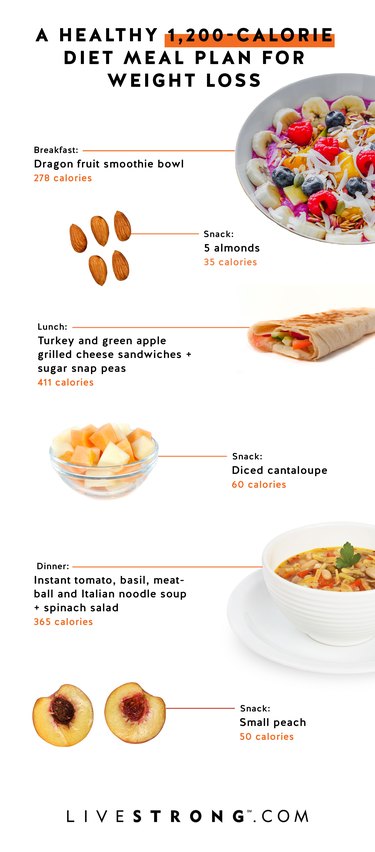
Breakfast (278 calories)
Snack (35 calories)
- 5 almonds
Lunch (411 calories)
- Turkey and Green Apple Grilled Cheese Sandwiches
- 1 cup fresh sugar snap peas
Snack (60 calories)
- 1 cup diced cantaloupe
Dinner (365 calories)
Snack (50 calories)
- Small peach or a small pear
Wednesday
Breakfast (300 calories)
- Smoked Salmon Breakfast Sandwich
- Fresh tomato, sliced
Lunch (389 calories)
- Grilled Chicken and Goat Cheese Salad
- Medium peach, sliced
Snack (113 calories)
- 4 walnut halves
- Small apple
Dinner (368 calories)
- Slow Cooker Beef Stew
- 1/2 cup steamed broccoli
Snack (42 calories)
- 1/2 cup blueberries
Thursday
Breakfast (330 calories)
- Protein Breakfast Scramble
- Whole wheat English muffin with 1 teaspoon of butter or margarine
- 1 cup diced watermelon
Lunch (414 calories)
- Tomato Mozzarella Platter
- 1/2 cup grapes
Snack (74 calories)
- 10 pistachio nuts
- 2 apricots
Dinner (299 calories)
- Dijon Salmon Dinner
- 1 medium corn on the cob
- Creamy Vegan Spinach
Snack (77 calories)
Friday
Breakfast (385 calories)
- Flaxseed Oatmeal
- 1/2 cup raspberries
Snack (64 calories)
Lunch (347 calories)
Snack (40 calories)
- 1 cup carrot and celery sticks
- Small plum
Dinner (352 calories)
Saturday
Breakfast (253 calories)
- Granola Breakfast Protein Balls
- 1 medium banana
Lunch (391 calories)
- Grilled Peanut Butter and Jelly Sandwich
- 1 nectarine
Snack (161 calories)
Dinner (363 calories)
- Spicy Turmeric Chicken
- 1/2 cup brown rice
- 1/2 cup steamed carrots
Snack (31 calories)
- 1/2 cup blackberries
Sunday
Breakfast (272 calories)
Lunch (324 calories)
- Simple Veggie Soup
- 4 whole-wheat crackers
- 1 cup sliced strawberries
Snack (143 calories)
- Cranberry Soy Yogurt
- 2 walnut halves
Dinner (360 calories)
- Chia Seed Crusted Fish
- 1 cup of baked acorn squash
- Caesar-Style Kale Salad
Snack (103 calories)
Warning
If you are under a doctor's care for any medical conditions, seek advice before starting a restrictive diet. Also, if your child or teen is overweight, do not place your child on a diet. Instead, discuss healthy weight strategies with your child's doctor or ask for a referral to a dietitian.
Eating just 1,200 calories a day may help you drop those last few pesky pounds. But even when cutting calories, weight loss success depends on the individual. So, it's not easy to predict, for example, how long it will take to lose 5 pounds on a 1,200-calorie diet.
"Genetic, metabolic, hormonal and environmental differences between people can affect weight and the rate of weight loss," Malkani tells us. "Past weight loss advice has been to recommend eating about 500 calories less per day than usual to achieve 1 pound of weight loss a week. Weight loss is rarely that simple, predictable and linear."
Another important tool for weight loss success is the incorporation of exercise. Exercise is safe when following a 1,200-calorie plan — if this target is appropriate for your energy needs. "Without physical activity, caloric restriction tends to result in loss of lean body mass, which is not ideal," Malkani says, adding that "weight-bearing exercises (such as walking) can help build and maintain muscle during weight loss."
Schlachter adds, "It's also important that your calorie target for weight loss takes the exercise program into consideration, so your diet is designed to support adequate activity." According to a review published in the June 2018 issue of Progress in Cardiovascular Disease, 150 minutes of moderate-intensity weekly exercise can prevent weight gain.